

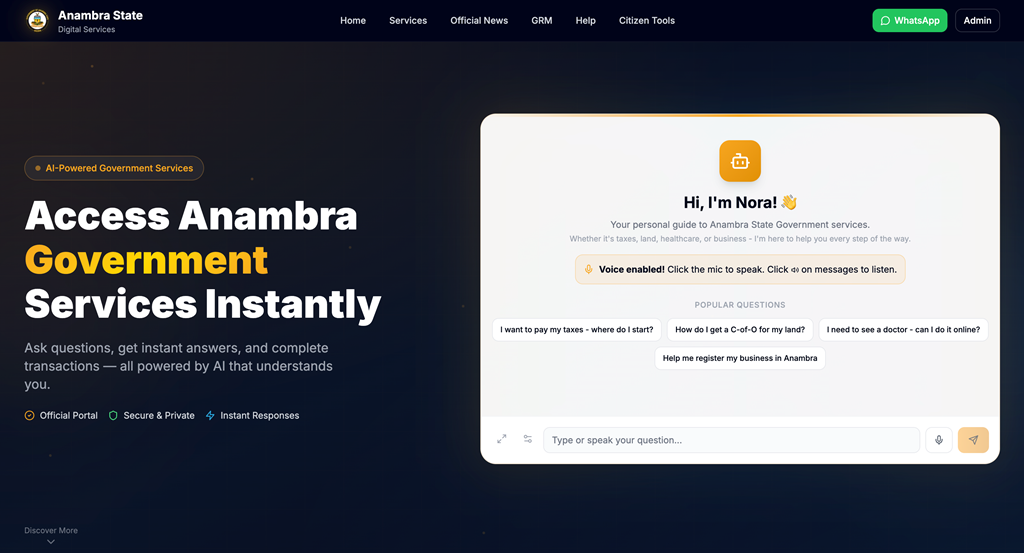
Anambra State has taken another decisive step in digital governance with the BETA launch of SmartGov, its digital government services platform designed to simplify how citizens access its over 31 public services anytime and anywhere.
SmartGov is powered by Artificial Intelligence (AI), enabling citizens to interact with government through natural conversations rather than complex procedures or paperwork.
At the core of the platform is NORA, an intelligent digital assistant trained on Anambra State government services, processes, and directories.
This launch further cements Anambra’s leadership in digital transformation, coming on the heels of its recognition at the recently held National Council on Communications, Innovation and Digital Economy (NCCIDE), where the State won four major national awards, including Best Overall Performing State in Digital Technology Development and Best State in Human Capital Development.
SmartGov serves as a single digital gateway to official government information, services, and platforms across the State.
Using AI, the platform understands citizens’ questions and guides them accurately to the right service, requirement, or process.
Through a simple three-step interaction, citizens can:
- Ask questions about any government service in plain language
- Receive intelligent AI-driven guidance that directs them to the correct procedure, requirements, or platform
- Get answers or complete transactions online, via WhatsApp, or through voice-enabled access
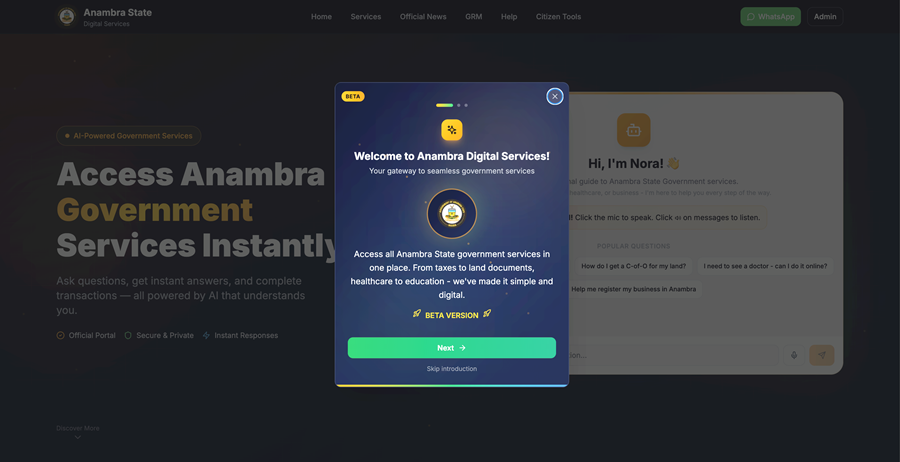
The platform currently covers eight major service categories, including Taxes and Revenue, Land and Property, Business Services, Health, Education, Security and Complaints, Transport and Vehicles, and Culture and Tourism.
With 24-hour availability and multilingual support in English and Igbo, SmartGov removes traditional barriers such as office hours, location, and unnecessary bureaucracy, making government services more inclusive and accessible.
From business-related inquiries to renewing vehicle papers, paying taxes, or locating the nearest health facility, SmartGov guides users clearly and seamlessly through each step of the process, ensuring accuracy and consistency across government interactions.
The BETA launch also showcases Anambra’s technical innovation by bringing together AI, voice-enabled access, and WhatsApp connectivity into one unified platform, all supported by a continuously updated government service directory.
This development positions Anambra as a national reference point for citizen-focused eGovernment, building on strong policy direction, sustained digital infrastructure investments, and a deliberate focus on human capital development.
Describing the platform and its functionality, Chukwuemeka Fred Agbata (CFA), MD/CEO of the Anambra State ICT Agency, said SmartGov was built with citizens at the center.

“SmartGov is more than a service directory. It is an intelligent gateway that makes government interactions simple, fast, and reliable.”
He added that Mr Governor, Prof. Chukwuma Charles Soludo, has consistently emphasized technology as the backbone of governance through the Everything Technology, Technology Everywhere vision.
“SmartGov is a practical expression of this vision. By embedding AI into everyday government services, Anambra State is making governance more transparent, accessible, and efficient for Ndi Anambra.”
As part of the BETA phase, SmartGov also has a dedicated feedback channel to support continuous improvement. Citizens are enjoined to submit feedback.
In addition to existing channels such as the Grievance Redress Mechanism (GRM) and official email platforms, NORA, the AI digital assistant, is also available to guide users through the feedback process where required.
“As we refine SmartGov during this BETA phase, we invite Ndi Anambra to explore the platform, use it actively, and share feedback to help us make it even better,” CFA concluded.
SmartGov is now live here, ushering in a new era of AI-enabled, citizen-centric governance in Anambra State and advancing Mr Governor’s Smart Mega City vision, where innovation is expected, not optional.