


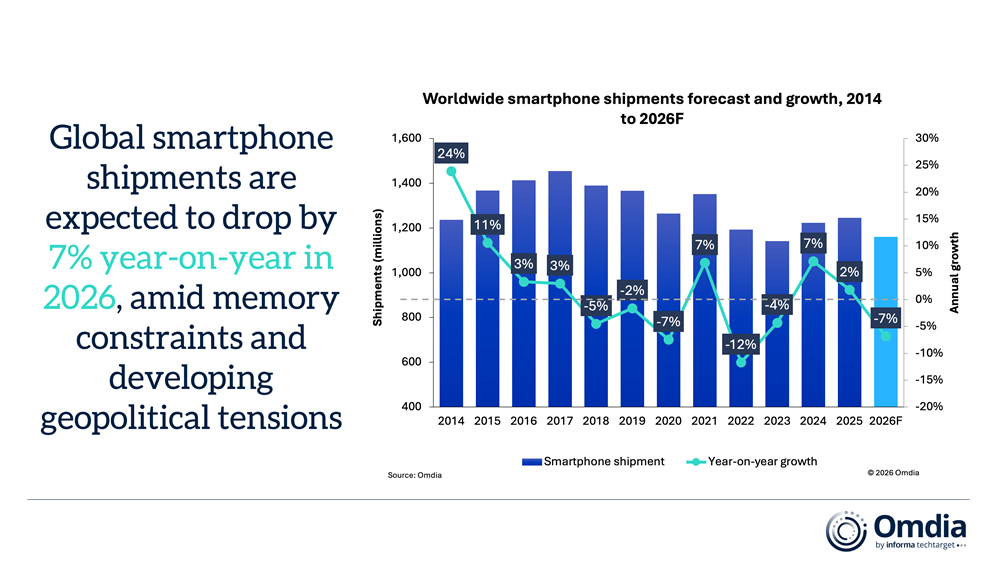
Global smartphone shipments are forecast to decline by around 7% year-on-year in 2026, Techeconomy can report.
This projection, contained in Omdia’s latest outlook, and based on Q1 memory price assumptions, which indicate that pricing pressure and constrained supply will begin to ease in the second half of the year.
The global smartphone market will face significant challenges in 2026 as tightening memory supply and elevated pricing place increasing cost pressures for vendors.
Memory now accounts for a significantly larger share of the smartphone bill of materials (BOM), eroding vendor profitability, particularly in entry-level devices.
Since 4Q25, smartphone manufacturers have already begun raising retail prices in order to maintain profit margins.
However, sustained price increases are likely to weaken demand, particularly in price-sensitive emerging markets.
Further memory pressure and geopolitical volatility raise the risk of over 15% smartphone shipment decline in 2026
Downside risks to the forecast remain significant. If memory prices continue rising into the second half of 2026 due to tight supply and increasing AI server demand locking in production capacity, smartphone vendors will face further cost escalation across both entry-level and premium devices.
At the same time, escalating geopolitical tensions in the Middle East could amplify macroeconomic volatility including higher energy prices, freight costs, and foreign-exchange instability, further weakening consumer upgrades in price-sensitive markets.
Under this downside scenario, global smartphone shipments are expected to decline by more than 15% in 2026, potentially exceeding the 12% contraction recorded in 2022.
“Rising memory costs and macro headwinds are expected to impact smartphone demand unevenly across price segments,” said Zaker Li, Principal Analyst at Omdia. “Devices priced below $100 are forecast to decline by nearly 31% year-on-year in 2026, reflecting the severe margin pressure vendors face in ultra-low-cost segments, which are highly sensitive to even modest shifts in the macroeconomic environment. Smartphones in the $100–$399 range, which represent the core volume bands of the global market, are also expected to contract as rising memory prices push retail prices upward in price-sensitive markets.
These segments are largely served by entry-focused vendors that rely heavily on LPDDR4X memory, operate with thin margins, and often have lower priority in the memory supply chain, leaving them more exposed to cost inflation and potential supply shortages. As a result, vendors concentrated in these price tiers are expected to face production constraints and shipment reductions, with many projected to experience double-digit declines in 2026.”
“In contrast, the premium segment is expected to remain relatively resilient despite rising component costs. Devices priced above $800 are forecast to grow by around 4% in 2026, supported by stronger brand positioning and greater pricing flexibility.
Apple maintains a dominant presence in the high-end market and benefits from strong supply chain relationships and higher margins that help absorb component cost inflation. Samsung also benefits from vertical integration and internal semiconductor capabilities, which provide greater security of supply and priority access to key components. While Samsung still utilizes LPDDR4X in some models and faces similar cost pressures, its supply chain advantages reduce the risk of significant shortages.”
“The evolving cost environment is reshaping dynamics across the global smartphone supply chain,” added Li. “As entry-level smartphone demand weakens, suppliers of mid- and low-end components – including chipsets, camera modules, and other key parts – are likely to face declining orders and intensified pricing pressure. Vendors are already responding by simplifying product configurations and tightening BOM costs. At the same time, volatility in memory pricing is pushing brands toward shorter-term production planning and smaller order volumes, increasing operational pressure across the supply chain. Smaller ODMs and specialized component suppliers will also face growing consolidation risks as margins compress and demand becomes more concentrated among leading brands.
In this environment, vendors will need to prioritize higher-value product innovation and disciplined production planning, while channel partners strengthen inventory management and demand forecasting to navigate slower replacement cycles and shifting consumer demand.”