

Nigeria’s broadband penetration rose to 53.86 per cent in February 2026, marking a notable milestone in the country’s digital connectivity journey, according to the Nigerian Communications Commission’s data.
The latest industry statistics show that broadband subscriptions climbed to 116.7 million during the period, reflecting sustained growth in internet adoption driven by mobile network expansion and increasing demand for data services across the country.
Steady growth in subscriptions
Data from the NCC indicates a consistent upward trend in broadband usage over the past year.
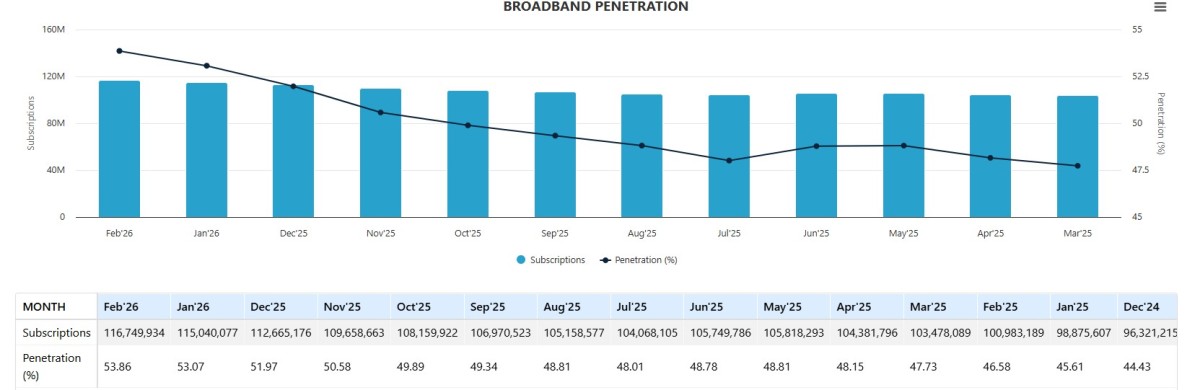
From 96.3 million subscriptions in December 2024, the figure has steadily increased, crossing the 100 million mark in early 2025 and continuing its upward trajectory into 2026.
By February 2026:
- Subscriptions: 116,749,934
- Penetration: 53.86%
This represents a significant improvement compared to 53.07 per cent in January 2026 and 51.97 per cent in December 2025, highlighting a steady rise in connectivity levels.
Mobile networks remain dominant
Nigeria’s broadband growth continues to be largely powered by mobile broadband (3G and 4G networks), which account for the vast majority of internet access nationwide. With limited fixed broadband infrastructure, most Nigerians rely on mobile devices for connectivity.
The expansion of 4G coverage, alongside early adoption of 5G in select urban areas, has helped drive the increase in penetration.
Urban gains, rural gaps persist
Despite the progress, broadband penetration remains uneven across the country. Urban centres such as Lagos, Abuja, and Port Harcourt continue to benefit from stronger network infrastructure, while rural and underserved areas lag behind.
Industry analysts have severally identified key challenges as limited fibre infrastructure outside major cities; high cost of network deployment in remote areas; power supply constraints, and right-of-way issues affecting infrastructure rollout.
These factors continue to slow the pace of nationwide broadband expansion.
Affordability remains a key barrier
While access is improving, affordability continues to shape adoption levels. Rising smartphone prices and economic pressures have made it harder for low-income users to come online, even as demand for internet services grows.
Industry observers note that sustaining broadband growth will depend not only on infrastructure expansion but also on making devices and data services more affordable.
The Nigerian Communications Commission (NCC) under the leadership of Dr. Aminu Maida, the executive vice chairman, has continued to advocate for increased investment in fibre networks; reduction in right-of-way charges, expansion of rural connectivity programmes, and strengthening of public-private partnerships
Broadband Penetration Outlook
The rise to 53.86 per cent penetration signals meaningful progress in Nigeria’s digital transformation journey.
However, maintaining this momentum will depend on addressing structural challenges that limit access and affordability.
As broadband becomes increasingly central to economic growth, financial inclusion, education, and digital services, the focus will now shift from expansion to inclusive and sustainable connectivity.
Nigeria is moving closer to universal broadband access, but bridging the digital divide will be critical to unlocking the full potential of its digital economy.