


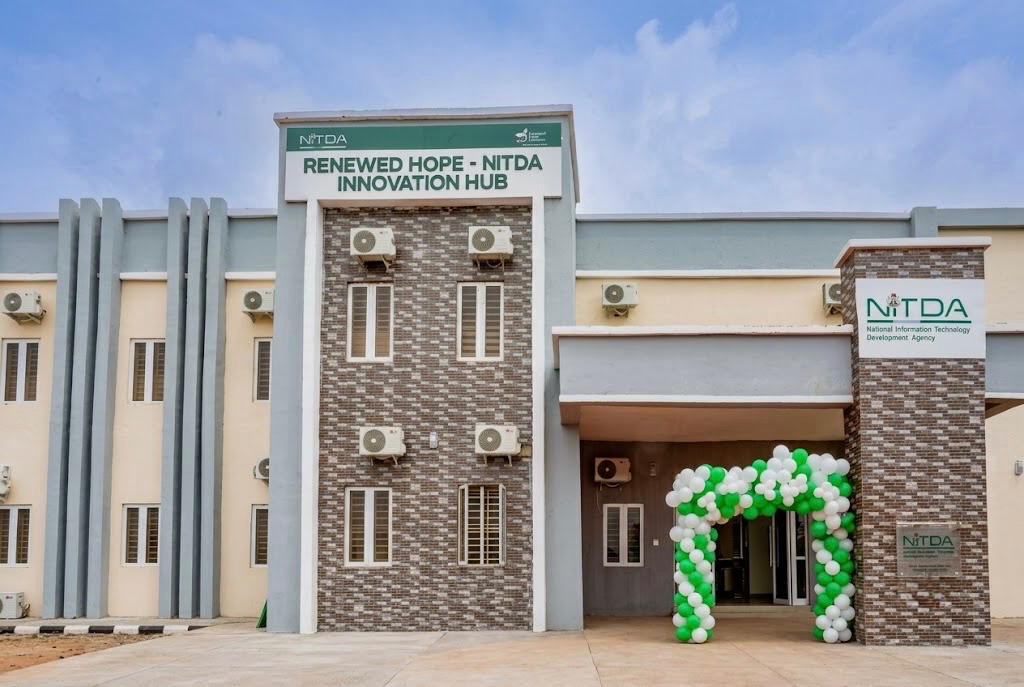
The Federal Government has commissioned and handed over the Renewed Hope and NITDA Innovation Hub at Obafemi Awolowo University (OAU) in Ile-Ife, Osun State.
Designed to expand practical technology training for students and young innovators, the facility was unveiled on Monday, June 8, by the Minister of Communications, Innovation and Digital Economy, Dr Bosun Tijani, during a ceremony held at the university.
The hub was launched under the National Information Technology Development Agency in partnership with the Renewed Hope Initiative.
It comes equipped with laboratories focused on artificial intelligence, robotics, additive manufacturing and the Internet of Things. These are areas the government says are highly important to modern industry, both in Nigeria and globally.
Inside the campus, the space is meant to move students beyond theory and into hands-on work. It provides tools that many public universities in the country have found difficult to provide consistently.
Dr Tijani said the NITDA innovation hub should be seen as an investment in young people, both in and outside OAU, rather than just a collection of machines and lab equipment.
He also encouraged students to make use of the facility and take an active role in building solutions that can work in real settings, not just in classrooms.
With this development, the government is linking education more directly with needs across the industry. Officials present repeatedly returned to the idea of practical output, not just academic learning.
The robotics and IoT labs are expected to support hardware development, an area where many Nigerian startups still face limitations due to the cost of equipment and prototyping.
Additive manufacturing, often referred to as 3D printing, also features strongly in the hub’s design. It has growing use across sectors such as healthcare, construction and engineering.
The federal government has in recent years increased attention on digital infrastructure as a foundation for these kinds of projects. Earlier plans outlined by the Ministry include nationwide fibre deployment, expansion of communication satellites, and new rural telecom towers aimed at improving access to connectivity across the country by 2027.
Alongside the government’s initiative, private sector investment is also beginning to impact the direction of innovation hubs in Nigerian universities.
Fintech company Moniepoint has committed about N3 billion to establish innovation centres at Obafemi Awolowo University, University of Nigeria Nsukka, and Ahmadu Bello University, Zaria.
The initiative, announced in May 2026, is designed to support training in areas such as artificial intelligence, software engineering, robotics, data science, product development and entrepreneurship.
The company says its engineers and product teams will be involved in mentorship, workshops and internship pathways. The aim is to make sure students are exposed early to how technology products are built and scaled in real business environments.
Government-led programmes and private funding are now being directed towards building a pipeline of tech talent across different regions of the country.
OAU in the South-West, UNN in the South-East and ABU in the North are among the institutions selected for these projects. The idea is to spread access beyond Lagos and Abuja, where most of Nigeria’s tech ecosystem has traditionally been concentrated.
There are still questions about how sustainable these initiatives will be. Funding is still a challenge, particularly when it comes to maintaining advanced equipment and keeping facilities up to date.
Hardware-based innovation also requires consistent technical support, which universities have sometimes found difficult to provide over time.
Connectivity is another factor that will determine how far these hubs can go. Many of the planned activities depend on reliable internet access and stable power supply, both of which are uneven in parts of the country.



