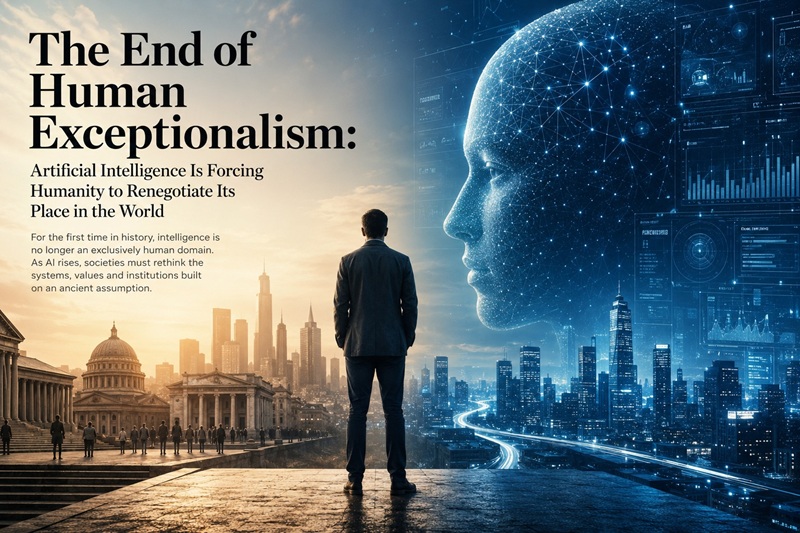
For decades, conversations about artificial intelligence have revolved around a familiar set of questions. Will it replace jobs? Which industries will disappear?
How much of human work can machines automate? Researcher and artificial intelligence expert Ugbotu Eferhire Valentine believes these conversations, while important, may be missing the much larger story unfolding beneath the surface.
His argument is both simple and unsettling. Humanity is not merely experiencing another technological revolution. It may be witnessing the collapse of one of civilisation’s oldest assumptions.
For thousands of years, human beings have understood themselves to be exceptional, not because they were the strongest species, the fastest species or even the most physically resilient species, but because they possessed a capability that no other entity could rival.
They possessed intelligence. More importantly, they possessed a monopoly over intelligence, and that monopoly quietly became the organising principle upon which civilisation itself was built.
According to Ugbotu, this single assumption shaped almost everything that followed. Viewed through this lens, much of human history begins to look different.
Governments, universities, corporations, legal systems and modern economies can all be interpreted as humanity’s attempt to coordinate its own cognitive limitations at scale.
Expertise was scarce. Knowledge was expensive to acquire. Information travelled slowly, and decision making was constrained by biology itself. Every institution that exists today emerged, in one form or another, as a response to those constraints.
Over time, humanity became so accustomed to these arrangements that they began to appear permanent. In reality, Ugbotu argues they were temporary responses to a world in which intelligence itself was finite. Artificial intelligence is now beginning to challenge that reality.
He believes society has dramatically underestimated the significance of what this means. AI continues to be grouped alongside previous technological breakthroughs such as electricity, smartphones and the internet, but he argues that these comparisons are increasingly inadequate.
Previous technologies expanded human capabilities without fundamentally threatening humanity’s monopoly over intelligence itself.
Artificial intelligence is different because it enters a domain that, until recently, belonged exclusively to human beings. That distinction, he says, explains why so many public conversations about AI feel incomplete. Questions about whether AI will replace jobs continue to dominate headlines.
Discussions about industry disruption and workforce automation occupy policymakers and business leaders alike.
Yet Ugbotu argues that these conversations are only addressing the symptoms rather than the underlying shift itself. Jobs are downstream manifestations of larger systems. Industries are expressions of even larger institutional structures.
The deeper and considerably more uncomfortable question is what happens when intelligence itself ceases to be humanity’s most exclusive resource.
At the centre of his argument is an idea he believes has been largely overlooked. Artificial intelligence is not replacing humanity.
It is replacing the scarcity upon which humanity built its systems. Although the distinction may initially appear subtle, he argues that its implications are extraordinary because scarcity has always been one of civilisation’s invisible architects.
This is where, according to Ugbotu, the conversation moves beyond technology and enters the realm of civilisation itself.
He believes artificial intelligence is steadily exposing the assumptions upon which many of society’s institutions were originally constructed.
If universities emerged because expertise was scarce, what becomes their defining purpose when knowledge can increasingly be synthesised and distributed instantly?
If corporations emerged because specialised individuals needed to be assembled under one organisational roof, how might they evolve when intelligence can flow dynamically across systems rather than remain attached to individuals alone?
If management hierarchies emerged because information moved slowly between people and departments, what happens when those bottlenecks begin to disappear?
For centuries, educational systems rewarded memorisation because information was scarce. Organisations rewarded narrow expertise because knowledge was fragmented.
Economies rewarded technical execution because specialised skills were difficult to obtain. Artificial intelligence is beginning to alter all of these equations simultaneously.
Society may be entering a future in which wisdom becomes more valuable than information, judgment becomes more valuable than analysis and interdisciplinary thinking becomes more valuable than isolated expertise. Paradoxically, Ugbotu believes artificial intelligence may force humanity to rediscover itself.
Humanity’s greatest contribution may never have been intelligence alone, but its ability to attach meaning, ethics, empathy and purpose to intelligence itself.
Machines may become extraordinary at generating answers, but societies have never been sustained by answers alone.
They have always been sustained by values, relationships and collective visions of the future that transcend pure computation.
The implications of this way of thinking become particularly visible in healthcare, an area Ugbotu has spent considerable time studying and working within. He explained that healthcare systems are not suffering from a shortage of information.
They are suffering from an inability to distribute intelligence effectively across increasingly complex environments. Clinicians are overwhelmed by data.
Administrators navigate extraordinary operational pressures. Patients frequently move through fragmented pathways that struggle to convert information into coordinated action.
Artificial intelligence introduces the possibility of redesigning how intelligence flows throughout these systems, but he cautions that such a redesign cannot be exclusively technical because healthcare has always been a profoundly human enterprise built upon trust as much as expertise.
His perspective also extends to Africa. For decades, conversations about the continent have centred on catching up with previous revolutions. Artificial intelligence, however, presents a different opportunity altogether.
Many of the rules that will govern the intelligence era are still being written. Agility, youthful populations and entrepreneurial adaptability may become strategic assets if they are supported by investments in education, research and intelligence infrastructure.
History, he warns, repeatedly demonstrates that technological revolutions are rarely distributed evenly. They create abundance while simultaneously concentrating power, and societies that fail to recognise structural transitions early often spend decades attempting to recover lost ground.
The question before Africa is therefore not whether it will use artificial intelligence because that outcome already appears inevitable.