
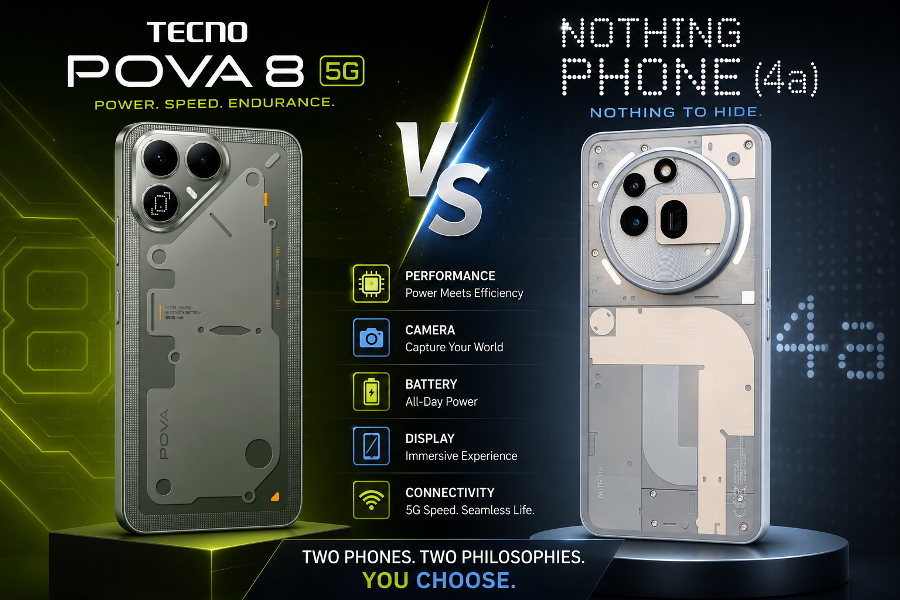
TECNO’s newest POVA phone, the Pova 8 5G, is currently available for preorder, with open sales which started on June 18, 2027.
The device is already generating discussion among TECNO fans, reviewers and tech enthusiasts. TECNO traditionally designed the POVA lineup differently from its Camon series.
Unlike the Camon lineup, which focuses more on cameras, media consumption and premium aesthetics, POVA phones are built primarily for sustained performance and gaming. However, the Pova 8 5G seems to lean more towards aesthetics than previous POVA devices.
It features a futuristic, glassy design with a customisable “Alive Matrix” LED display at the back for notifications and animations.
The concept is similar to the Matrix-style lighting systems that have become very popular in recent years, particularly through Nothing’s devices. In fact, only a few phones released in 2026 have embraced this approach:
- Nothing Phone 4a: launched March 2026 (Glyph Matrix micro-LED Display)
- Infinix Note 60 Pro: launched April 2026 (Active Matrix Lighting)
- TECNO Pova 8 5G: launched June 2026 (Alive Matrix Display)
Among them all, the Nothing Phone 4a stands out because of its versatility and also because Nothing has done a better job of popularising the design. Interestingly, all of these phones share one thing in common: they are performance-oriented devices built around gaming and battery life in the midrange segment.
Since its launch in March, the Nothing Phone 4a has attracted attention as a device that could help redefine the “flagship killer” category.
So, how does it compare with the newly released Pova 8 5G? Is the hype justified, or is it simply efficient marketing?
Let’s compare both phones across key factors like performance, display technology, battery life and finally, their unique Matrix lighting systems.
Performance
In terms of raw performance, the competition is closer than expected, but one device still has an advantage over the other.
The Snapdragon 7s Gen 4 inside the Nothing Phone 4a significantly outperforms the MediaTek Dimensity 7100 found in the Pova 8 5G. Qualcomm’s chipset offers a newer architecture, superior power efficiency and stronger graphics performance.
That does not make the Pova 8 5G a weak performer. For gaming, multitasking and everyday use, it remains more than capable for most users. But the more modern Snapdragon 7s Gen 4 delivers considerably more graphics power (40% more) and occupies closer to the upper midrange category.
Display
Display quality is where the two phones begin to target different priorities.
The Nothing Phone 4a features a 6.78-inch AMOLED panel with a 120Hz refresh rate. AMOLED technology actually offers deeper blacks, better contrast and more vibrant colours. This makes movies, social media and games look more immersive while also helping with battery efficiency.
The Pova 8 5G, meanwhile, comes with a similarly sized 6.76-inch IPS LCD panel with a faster 144Hz refresh rate.
While LCD technology cannot match the colour depth and contrast of AMOLED panels, the higher refresh rate provides smoother animations and more responsive gameplay, especially in supported games.
For gaming, both displays perform well, but they excel differently. The Pova 8’s 144Hz panel is better for fluidity, while the Nothing Phone 4a’s AMOLED screen delivers superior image quality, richer colours and better visibility.
Overall, the Nothing Phone 4a offers a better display experience, while the Pova 8 5G prioritises speedy response.
Battery
Battery life is one area where TECNO clearly takes the lead.
The Pova 8 5G comes with a massive 8,000mAh battery with 45W fast charging. This makes it one of the largest batteries available in a mainstream smartphone in 2026.
Heavy gamers and power users, especially in Nigeria, can comfortably get up to two days of use without worrying about battery life.
The Nothing Phone 4a ships with a 5,080mAh battery and slightly faster 50W charging. While charging speeds favour Nothing, battery capacity overwhelmingly favours the Pova 8.
Under real-world conditions, the Nothing Phone 4a can still comfortably last a full day on average use, but the Pova 8 5G simply operates on another level.
For battery size and endurance, the advantage clearly goes to the TECNO Pova 8 5G.
Matrix Display
Both devices bring personality to their respective Matrix LED displays, but they approach it slightly differently.
The Alive Matrix display on the Pova 8 5G provides customisable animations and notification effects that add a futuristic touch to the device. It is visually attractive and gives the phone a unique gaming identity.
However, Nothing’s Glyph system remains somewhat more mature and refined. It gives better integration with calls, notifications, charging indicators, timers and app interactions. This makes it more versatile and arguably more iconic as it is larger.
While the Pova 8’s implementation is an impressive first for the POVA lineup, Nothing still provides the more optimised and functional lighting system.
Conclusion
The truth is, for most Nigerians, accessibility matters just as much as specifications.
The Nothing Phone 4a may offer more graphics power, a superior AMOLED display and a more refined software experience, but it remains relatively expensive and less accessible to the average gaming enthusiast in Nigeria.
Although the price difference between the two phones is not that far (around $401 versus $313 for the Pova 8 5G), affordability and availability still favour TECNO.
TECNO also benefits from years of experience tailoring devices to the needs of African consumers. For many Nigerian users, an 8,000mAh battery and dependable performance may matter more than the extra graphics power offered by the Nothing Phone 4a.
Ultimately, the choice remains with the final buyer.
The Nothing Phone 4a is clearly the more powerful and premium device here, while the TECNO Pova 8 5G delivers better battery life and better value for money.
Whichever device you choose, both provide commendable upgrade options for Nigerians looking to move from the budget smartphone segment in 2026.