


Leadership is being tested in new ways across institutions, societies, and economies. As complexity deepens, technology accelerates, and expectations shift across generations, familiar leadership language no longer feels sufficient.
This paper explores stewardship as a deeper leadership posture, one that moves beyond service into long horizon responsibility, coherence, and the capacity to hold complexity without collapsing into reaction.
Drawing from lived leadership experience, women’s realities, and emerging questions around artificial intelligence, it proposes that countries such as Nigeria may offer important insight into how future leadership can remain both grounded and human.
Introduction: Why this conversation matters now
There are moments in history when a word that has served us well begins to feel insufficient. Not because it was wrong, but because reality has become more layered than the word can carry. Leadership may be entering such a moment.
For years, many institutions, businesses, and leadership programmes around the world have embraced the language of servant leadership, and rightly so. It offered an important correction to older models built too heavily around hierarchy, control, and command. It reminded leaders that influence is not only about authority; it is also about listening, empowering others, making space, and understanding that leadership carries responsibility beyond personal ambition.
Yet the pressures leaders are now facing suggest that something further is required.
Across institutions, families, governments, and businesses, leaders are being asked to absorb uncertainty, make difficult decisions with incomplete clarity, hold emotional pressure, and retain composure even when outcomes are not immediately fair, visible, or rewarding. At the same time, technology is moving faster than regulation, younger generations are relating differently to hardship, and many societies are searching for leadership models that still feel human in the middle of acceleration.
This paper begins from a simple observation: leadership today requires a deeper inner discipline than the language we currently use.
What follows is not a formal academic argument. It is a reflection drawn from lived experience, leadership transitions, women’s realities, social observation, and the growing question of how societies such as Nigeria can shape future leadership conversations in ways that are both grounded and globally relevant.
Some of the reflections in this paper also connect with the emerging Radiance Framework, a leadership methodology exploring coherence, stewardship, and inner authority in leadership practice, developed through applied advisory work across leadership, governance, and transition contexts.
At the centre of this reflection is one word: stewardship.
From service to stewardship
Stewardship introduces a deeper interior demand than service alone. It asks a person not only whether they are serving well, but whether they are able and willing to think beyond themselves in a way that protects the continuity of something larger. It asks whether one can remain responsible for the whole even when the moment does not flatter the self.
That distinction matters more than it may first appear.
Service often carries generosity, humility, and care. Stewardship carries those too, though it also adds another layer: long horizon responsibility. It asks whether a leader can hold complexity without immediately personalising every shift, every discomfort, or every change in role.
In practice, this shift is already visible in how organisations are evolving. Traditional hierarchies, built for clarity of authority and control, are increasingly complemented by more networked ways of working.
This reflects a simple reality: complexity requires coordination across functions, geographies, and perspectives.
In such environments, leadership becomes less about asserting position and more about maintaining direction. Authority remains essential.
The leader is still responsible for decisions, boundaries, and outcomes, though the way that authority is exercised becomes more measured and less reactive.
As complexity increases, the ability to hold direction without over-correcting becomes a defining leadership capability.
One of the conversations that shaped this reflection began with a simple leadership story. A senior leader and friend of the authors, after years of operating at one level of responsibility, accepted a move into a less senior role because she understood that at that moment the company needed continuity more than title negotiation. To many around her, such a move could easily have been read as loss. In many environments, stepping into a narrower formal role is quickly interpreted as regression, or even failure.
Yet that was not how she read it.
She understood that what mattered in that moment was not whether the move felt flattering, but whether it preserved the organisation’s continuity. Others around her struggled to see it that way. Some resisted. Some could not imagine making the same choice. Yet over time, that decision proved right, not because it produced immediate applause, but because it allowed the company to continue from a place of greater stability.
This is where stewardship begins to reveal itself. Not every wise decision looks strong in the moment. Some of the strongest decisions a leader makes are almost invisible when they happen.
Fairness, steadiness, and the maturity to see beyond oneself
Fairness belongs naturally to human expectation. We all understand it instinctively. We ask whether something is deserved, proportionate, justified. Fairness matters because it protects dignity and trust.
Yet leadership often reaches moments where fairness alone is not enough to guide action.
Institutions carry timing, personalities, pressure, history, and constraints that do not always produce outcomes that feel immediately fair to everyone involved. A person attached only to fairness may remain trapped in grievance, measuring what should have happened. A person capable of steadiness begins asking another question: what does reality require now?
Stewardship takes this further still, because it asks what protects the whole over time.
This is not passive acceptance. It is not weakness. It is the maturity to understand that not every meaningful contribution arrives wrapped in recognition.
In practical terms, this often means seeing beyond the first emotional reaction. It means resisting the temptation to turn every difficult moment into a personal injury. It means understanding that preserving coherence or continuity may sometimes matter more than defending position.
Difficulty as leadership advantage, not only obstacle
One reason stewardship is difficult is because modern culture often struggles with difficulty itself.
Across many societies today there is growing impatience with process. People want movement, speed, visibility, and immediate reward. In Nigeria, as in many places, one sees both extraordinary ambition and a growing language around wanting ease, quick progress, and a softer life.
That longing is understandable. Nobody prays for suffering.
Yet real life has never unfolded without contrast. Every serious life contains friction, disappointment, recalibration, and unexpected lessons.
A difficult interaction with a colleague may initially feel like a problem. In practice, such situations often expose something more useful, our own patterns, limits, and responses under pressure. An experience that is painful in the moment can later clarify how to understand, manage, and communicate more effectively. It does not become pleasant, though it becomes useful.
The situation may return, the person may remain the same, though the internal response shifts. Energy is no longer lost to irritation, it becomes available for clearer judgment.
This is not only personal growth. It is leadership growth.
Women and the lived practice of stewardship
In many societies, women understand stewardship before naming it.
A mother may never describe herself as practising leadership theory, yet she makes long horizon decisions every day. She regulates herself when tired, carries responsibility without applause, prioritises under pressure, protects vulnerable life, and continues even when unseen.
This capacity often becomes so normal that society stops noticing the intelligence inside it. Yet the underlying movement is unmistakable. It is stewardship.
Many women already know how to think beyond immediate self because life has demanded it from them repeatedly: through family, work, health, care, and responsibility. In many cases they are already making difficult decisions for continuity long before institutions invite them into formal leadership language.
This is one reason why stewardship may resonate deeply in contexts such as Nigeria, where women often hold both visible and invisible systems together.
Research from the Africa Gender Index (2023), produced by the African Development Bank and the UN Economic Commission for Africa, documents that while women score 50.3% on overall equality indicators, they reach 98.3% in social empowerment measures, a striking gap that reflects how much leadership capacity is already being exercised informally, well outside the reach of formal recognition.
Evidence from McKinsey Global Institute further reinforces this: organisations with gender-diverse leadership consistently demonstrate stronger performance, suggesting that the qualities stewardship requires, long horizon thinking, steadiness under pressure, and responsibility for the whole, are already present in women leaders whom institutions are still learning to recognise.
One powerful reflection that emerged in this conversation came from motherhood itself: the recognition that women often do not wait to be taught stewardship, they already live it. What remains is to help them see that this same instinct, when consciously developed, can extend beyond family into business, policy, community, and institutional leadership.
Nigeria, resilience, and future leadership
Nigeria carries something important in this conversation. It is a live case study of leadership under pressure.
It is a country where resilience is not abstract. It is lived. Faith, pressure, ambition, contradiction, creativity, and possibility coexist daily. That creates leadership lessons that are often richer than formal theory suggests.
There is enormous youth energy, enormous female capacity, and growing awareness that leadership must now move beyond survival into shaping systems.
The data reflects this clearly: Nigeria is home to an estimated 23 million female entrepreneurs, one of the highest concentrations globally, and women own approximately 41% of micro-businesses in the country (PwC Nigeria, 2023).

Women-owned SMEs contribute to an informal economy that forms a significant share of Nigeria’s GDP.
These are not aspirational statistics. They describe a leadership infrastructure that already exists, built largely by women, operating largely outside institutional frameworks, and representing precisely the kind of stewardship this paper describes: long horizon thinking, responsibility for others, continuity over recognition.
The women shaping Nigeria’s future are not waiting for permission. Three examples
make this visible.
Ngozi Okonjo-Iweala, Nigeria’s former Finance Minister and current Director-General of the World Trade Organization, has consistently demonstrated stewardship at the highest institutional level, making structurally difficult decisions in service of long-term stability, often at significant personal and political cost.
Folorunsho Alakija, one of Africa’s most prominent businesswomen and philanthropists, has built her influence not through title alone but through sustained commitment to the communities her work serves, a model of whole-system thinking that stewardship requires.
Funke Opeke, founder of MainOne and a 2026 Fellow of Harvard’s Advanced Leadership Initiative, built a 7,000-kilometre undersea cable stretching from Portugal to West Africa at a cost of $240 million, creating the digital infrastructure that enabled Nigeria’s technology sector to scale.
When the moment came, she chose to sell MainOne to Equinix because it was, in her own words, the best route to ensure the long-term sustainability of what had been built. That is stewardship made visible. Her story is documented in the Harvard Business School Creating Emerging Markets archive.
These leaders are not simply success stories. They are evidence that Nigeria already produces the kind of leadership this paper argues the world needs more of.
This is why Nigeria may not simply be a place where leadership models are imported. It may become a place where new leadership language is tested and developed from lived reality. The question is not whether capacity exists. It clearly does. The question is whether the language, support structures, and opportunities can now be built intentionally enough for that capacity to influence larger systems.
Stewardship and AI: why this matters now
Artificial intelligence is no longer a future issue. It is already entering daily life, whether societies feel ready or not.
For many people, AI still sounds distant, technical, or intimidating. Yet for many women entrepreneurs and small businesses, its first usefulness may be very practical.
A woman taking orders through WhatsApp can use AI to structure responses faster, draft clearer communication, organise schedules, improve customer follow-up, and reduce repetitive work. A small business owner can improve visibility through simple automated content support. A professional can prepare documents faster and think through options more clearly.
In that sense, AI can become less a threat and more a practical assistant.
Yet its deeper potential lies elsewhere. As Sol Rashidi’s Human Amplification Index suggests, artificial intelligence is not here to diminish human capacity, but to extend it.
By relieving people from repetitive tasks, it creates space for qualities no system can replicate, creativity, collaboration, judgement, and compassion.
The next wave of AI may move even closer to this idea, evolving into personalised cognitive companions that begin to understand how we think, how we work, and how we communicate. Such systems could become thinking partners, helping individuals structure ideas, explore possibilities, and make decisions with greater depth.
Yet this amplification is not automatic. It depends entirely on the intent and discipline with which it is developed and used.
Responsible AI requires clear principles, fairness, reliability and safety, privacy and security, inclusiveness, transparency, and accountability. These are not abstract ideals. They are practical conditions that ensure technology remains anchored in human value.
As explored in recent reflections on leadership in the age of artificial intelligence (Williams, 2025), the real imperative is not only technological capability, but the ability to lead with both clarity of thought and depth of human awareness.
This is where stewardship becomes essential. Because the question is no longer only what AI can do, but how it is guided, and by whom. Leaders who approach AI with a stewardship mindset do not simply pursue efficiency. They ask whether what is being built can be trusted, whether it strengthens people rather than displaces them, and whether it contributes to continuity rather than fragmentation.
AI will not determine the future of leadership. It will reveal the quality of it.
Technology by itself does not create wisdom. It amplifies what is already present. If leadership is shallow, AI can accelerate shallow outcomes. If leadership is extractive, AI can amplify confusion. If leadership is rooted in stewardship, AI becomes a tool that serves people rather than displacing them.
This is why women, especially those already practising forms of stewardship, may become important carriers of responsible AI adoption at the local level.
It is also why policy matters. Technology is moving faster than regulation, and many institutions still do not fully understand what they are being asked to govern. The UNESCO Recommendation on the Ethics of Artificial Intelligence (2021) identifies
human oversight, long-term thinking, and the protection of vulnerable communities as foundational to responsible AI governance, principles that map directly onto what stewardship demands of leaders. This is where stewardship must enter public conversation, because speed without moral depth becomes dangerous very quickly.
Why this may be the next leadership frontier
Perhaps what is becoming clear is that leadership now requires something quieter and stronger than many visible models suggest.
It requires people who can remain steady while complexity increases.
It requires leaders who understand that not every setback is failure, not every reduction in visibility is loss, and not every difficult moment is a sign that something is wrong.
Sometimes the wiser movement is less dramatic. Sometimes grounded judgement matters more than immediate recognition. Sometimes the strongest leader in the room is the one who can hold the whole without needing to be seen doing it.
If servant leadership taught leaders to move beyond domination, stewardship may now teach leaders how to remain grounded when complexity no longer allows simple comfort.
That may be one of the most important leadership lessons of our time. And perhaps countries like Nigeria, and especially women already living this intelligence quietly, have something important to contribute to that lesson.
Looking ahead: listening, testing, and building from lived reality
The reflections in this paper are intended as a beginning rather than a conclusion. One natural next step would be to test these ideas more deliberately through listening and research.
A survey currently being considered in Nigeria, to be conducted in partnership with the Uzemi Empowerment Initiative, would invite women leaders, younger professionals, and senior decision makers to reflect on how they understand success, failure, fairness, resilience, and responsibility in leadership today.
The intention would not be to impose a framework, but to observe what already exists within the social fabric of a country where faith, ambition, pressure, and creativity coexist so visibly.
From there, a small pilot conversation could emerge linking stewardship, women’s leadership, and practical AI literacy, exploring how emerging technologies can support entrepreneurship, leadership development, and responsible innovation in everyday contexts.
If approached with humility and curiosity, such an initiative could allow Nigeria not only to participate in a global leadership conversation, but to help shape a more grounded and human version of what leadership may need to become in the years ahead.
This conversation also connects with emerging leadership frameworks and grassroots initiatives already working to support women in leadership and technology.
The Radiance Framework explores stewardship and coherence as inner leadership disciplines, while organizations such as the Uzemi Empowerment Initiative work to prepare and position women for leadership roles in technology across Nigeria.
Together they represent different but complementary pathways for shaping the leadership landscape of the future.
In a world moving faster each year, stewardship may prove less an ideal and more a necessity.
Addendum: Invitation to collaborate
This paper is a starting point for a broader conversation on leadership, stewardship, and the role of technology.
The authors welcome engagement with individuals and organisations exploring related work, across research, leadership, policy, or practice.
Those working on similar initiatives, in Nigeria, across Africa, or globally, are invited to connect, share perspectives, and explore collaboration.
Author notes
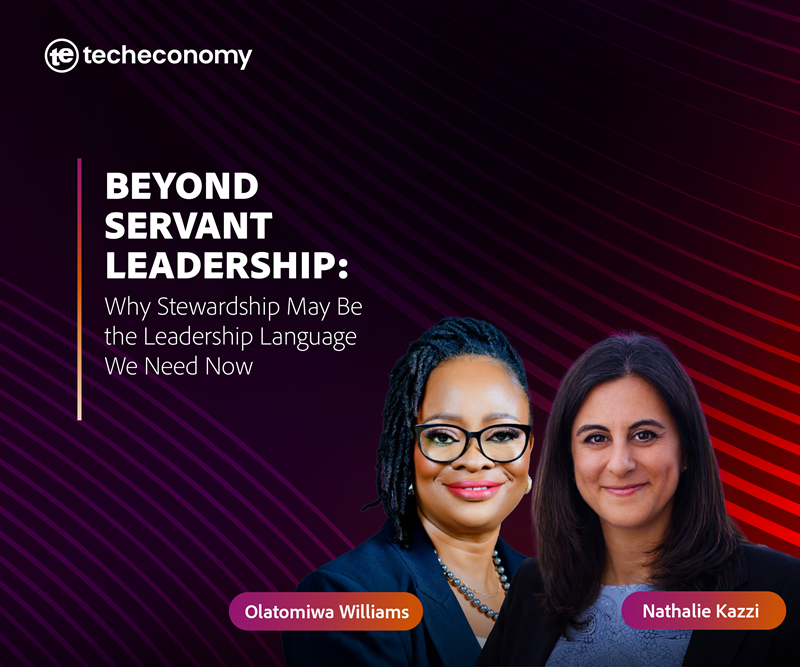
Nathalie Kazzi is founder of Blue Tree Advisors, a Swiss strategic advisory firm working with high-responsibility leaders, founders, and investors across strategy, governance, and transition. She operates as a trusted sparring partner to senior decision-makers, supporting them in navigating complexity, holding long-term direction, and making high-stakes decisions under pressure and uncertainty.
She is also the creator of the Radiance Framework, an emerging leadership methodology exploring stewardship, clarity, and inner authority in decision-making, developed through applied work across leadership, governance, and cross-border environments.
Olatomiwa Williams is the Chief Growth & AI Officer for Microsoft Middle East and Africa growth markets, where she leads strategy and expansion across multiple markets. She previously served as Country General Manager for Nigeria and Ghana, overseeing large-scale digital transformation initiatives.
With more than two decades of experience in enterprise technology, she works at the intersection of innovation, responsible AI adoption, and inclusive digital ecosystems, supporting organisations and governments in navigating technological change at scale. A passionate advocate for women in tech, she founded Uzemi to advance women leadership in tech. Her visionary leadership and hands-on expertise position her as a catalyst for innovation and positive change.