

When Nigeria launched the National Broadband Plan (NBP) 2020–2025, the ambition was bold: 70% broadband penetration in five years.
It was a statement of intent, one that assumed policy alignment, capital flow, and infrastructure rollout would move in tandem.
Five years later, the numbers tell a more sobering story. As of November 2025, broadband penetration stood at 50.58%, leaving a nearly 20-percentage-point gap between policy ambition and on-ground reality.
To understand why Nigeria stalled halfway, and what must change next, Techeconomy engaged industry experts whose perspectives reveal a complex mix of legacy bottlenecks, economic realities, and structural miscalculations.
Was FX Volatility the Real Culprit? Not Entirely
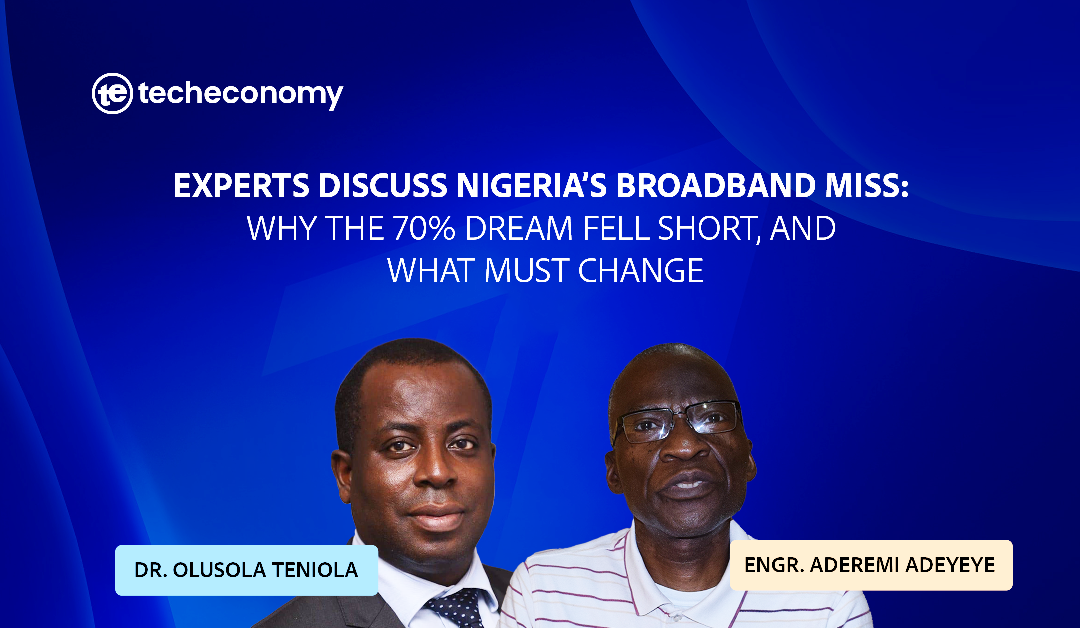
Nigeria’s volatile exchange rate and rising inflation have undoubtedly increased the cost of imported telecom equipment. But Dr. Olusola Teniola, director of Strategy at ipNX, cautions against reducing the broadband shortfall to macroeconomics alone.
According to him, many of the challenges were already embedded in the system long before FX pressures worsened.
“RoW issues, multiple taxation and infrastructural gaps such as InfraCo deployments were legacy headwinds dating back to 2013,” Teniola explained. “It was assumed these would be resolved early in the plan’s lifecycle, but that didn’t happen.”
While recent Federal Government efforts, particularly in partnership with the World Bank Group, have begun addressing the business environment, the delayed interventions meant the original 2025 deadline became unrealistic.
By contrast, Engineer Aderemi Adeyeye, President/CEO of Enext Inc., was more direct:
“No. The necessary investment was not being made even before the naira devaluation.”
Here, both experts converge on a critical point: FX volatility worsened the problem, but it did not create it.
CAPEX, ROI and the Rural Broadband Reality
One of the most persistent challenges remains capital expenditure. Telecom CAPEX has slowed, and the question is whether Nigeria’s current ROI profile can still attract large-scale investment, especially for rural connectivity.
Dr. Teniola sees CAPEX as cyclical and constrained by the absence of patient capital, noting that African markets rarely attract long-horizon investors without structured support.
“The proposed SPV under Project Bridge reflects the kind of patient capital required for capital-intensive infrastructure,” he said, pointing to undersea cable projects like 2Africa as proof that the right framework can still unlock FDI.
Engineer Adeyeye, however, takes this stance:
“Tier-1 investors will never fund rural broadband without necessary government investment.”
This divergence highlights a policy fault line: should government act as a facilitator or a direct co-investor? Without clarity, rural broadband remains commercially unattractive.
Right of Way: The Bottleneck Everyone Agrees On
On Right of Way (RoW), there was rare unanimity.
Engineer Adeyeye described it plainly:
“It is surely a bottleneck.”
Dr. Teniola added nuance, noting that even in states where RoW has been harmonised or waived, deployment has not always followed.
“States are not legally obligated to align. While about 26 states have keyed into the World Bank’s SABER programme, inconsistent charges and bureaucratic processes still discourage CAPEX.”
The result is a patchwork broadband map, where fiber deployment depends more on state-level politics than national policy.
Mobile-First Nigeria: A Strategic Choice or a Constraint?
Nigeria’s broadband growth has leaned heavily on mobile technologies, 4G, and potentially 5G. Dr. Teniola describes Africa as a “mobile broadband-first continent,” driven by faster deployment cycles and quicker returns on investment.
But he also warns of a ceiling.

“There is a limit to what wireless technology can provide. Only fixed-line infrastructure can consistently deliver the high speeds that define true broadband.”
Engineer Adeyeye agrees the challenge was underestimated.
“Yes,” he said bluntly when asked whether Nigeria misjudged the difficulty of fixed-line deployment.
Both experts acknowledge that while mobile broadband expanded access quickly, deep penetration requires fiber to homes, offices and institutions—a reality Nigeria has yet to fully confront.
Spectrum: Availability without Accountability
The Nigerian Communications Commission (NCC) has been praised for its proactive spectrum auctions, yet utilization remains uneven.
Dr. Teniola argues that spectrum pricing and economics are misaligned with rural realities.
“Without affordable spectrum and incentives like grants or waivers, operators cannot justify serving underserved areas.”
Engineer Adeyeye suggests weak enforcement:
“Operators have national spectrum licences without any intention of covering more than a few cities.”
Here, the consensus is uncomfortable but clear: access to spectrum has not translated into universal service.
E-Government, Purchasing Power and Digital Adoption
While the NCC has recently been ranked among Nigeria’s top-performing MDAs, both experts believe digital adoption cannot outpace affordability.
Dr. Teniola emphasized that e-government under the Digital Public Infrastructure (DPI) framework must be matched with nationwide digital skills and change management.
Engineer Adeyeye’s response was simpler, and starker:
“Yes,” the masterplan needs a pivot.
Broadband, they suggest, is not just an infrastructure challenge but a human and economic one.
Satellite Broadband, MVNOs and the Post-2025 Question
Is satellite broadband, like Starlink, Nigeria’s silver bullet? Dr. Teniola sees it as complementary, not substitutive.
“Where terrestrial networks exist, satellite should serve as backup. Ubiquitous connectivity depends on affordability.”
On MVNOs, he is optimistic, noting their historical role in serving unmet demand since 1998.
“Anyone with a Tier-5 MVNO licence can go beyond and address the unserved.”
What Must Change After 50%?
Looking ahead, Dr. Teniola proposes three urgent policy shifts for 2026:
- Public State Broadband Readiness Rankings
- Local content development across the ICT value chain
- Grants via a dedicated Telecom Bank to support indigenous hardware, software and services
The message from both experts is unmistakable: 50% is not failure, but it is not success either.
Without unified RoW enforcement, smarter spectrum incentives, government-backed rural investment, and a recalibrated broadband strategy, Nigeria risks remaining permanently stuck at the halfway mark.
In broadband, ambition is easy. Alignment is hard. Delivery is everything.