



For decades, programming has been the foundational skill of the digital economy. From early mainframe systems to modern cloud platforms, software development has largely revolved around writing precise instructions in structured languages that machines could execute.
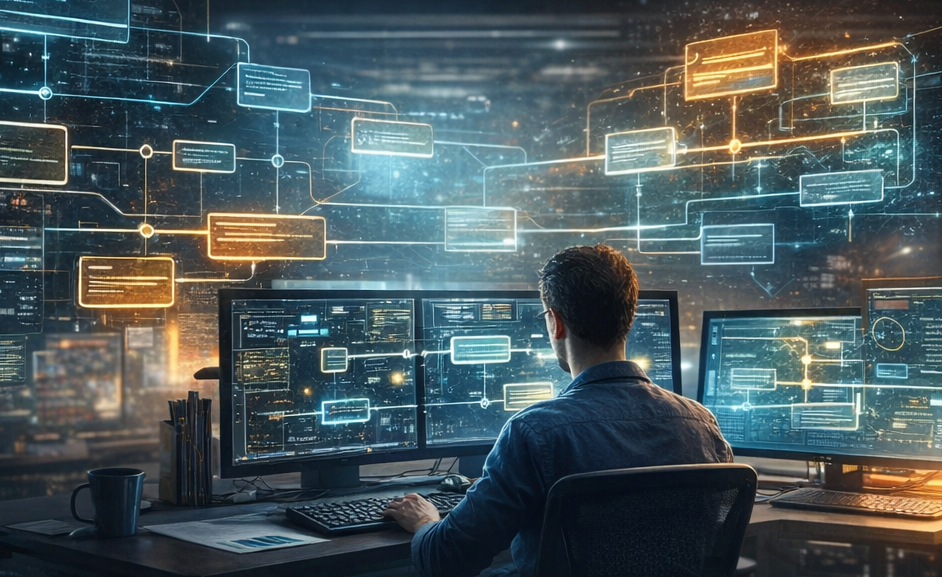
However, today, a quieter transformation is unfolding – one that may redefine how humans interact with technology. We are gradually moving from programming to what could be described as flowgramming.
This shift does not eliminate coding. Rather, it changes where the centre of human effort lies – away from writing every line of syntax and toward designing the logical flow that intelligent systems execute.
Programming: The Era of Syntax Mastery
Traditional programming required deep familiarity with specific languages such as C++, Java, Python, or JavaScript. Developers needed to understand syntax rules, data structures, memory management, and system constraints to instruct computers precisely on what to do.
In this model, human developers acted as translators between human intention and machine execution. Every function, loop, and instruction had to be manually written and debugged.
The bottleneck in software creation was therefore the speed and skill of the programmer.
Flowgramming: Designing Systems Instead of Writing Code
Artificial intelligence and modern development tools are beginning to cause paradigm change.
With the rise of generative AI, low-code platforms, workflow automation systems, and AI coding assistants, developers can increasingly describe intent, structure, and process, while machines generate much of the underlying code.
Instead of writing every line manually, engineers now define:
- System behaviour
- Process flows
- Decision logic
- Interaction structures
The machine then converts those flows into executable instructions.
In essence, programming languages remain important, but the human role shifts from syntax construction to system orchestration.
This emerging model can be understood as flowgramming – designing the flow of intelligence that machines implement.
Why This Shift Matters
The implications extend far beyond software engineering.
First, product development cycles accelerate. When systems generate large portions of code, the time between concept and implementation shrinks dramatically.

Second, barriers to entry fall. Entrepreneurs, designers, and domain experts who are not traditional programmers can increasingly build digital solutions using visual workflows and AI-assisted tools.
Third, the value of thinking shifts. The most valuable skill becomes the ability to structure problems, design systems, and understand interactions across complex environments.
In short, coding becomes less about typing instructions and more about architecting intelligent processes.
The New Skillset for the AI Era
If flowgramming continues to evolve, the next generation of developers will require a different mix of capabilities.
Future digital builders will need stronger grounding in:
- Systems thinking
- Workflow architecture
- Problem decomposition
- Human-AI collaboration
- Ethical technology design
Syntax knowledge will remain useful, but it will no longer be the defining skill.
Instead, the most valuable professionals will be those who can design the logic that intelligent systems execute.
Implications for Education
This transition raises important questions for education systems. Many school curricula still treat programming primarily as language memorisation and syntax practice. While foundational understanding remains important, education systems must begin to incorporate broader computational thinking approaches.
Students must learn not only how to code, but how to:
- Frame complex problems
- Design logical workflows
- Collaborate with intelligent tools
- Evaluate AI-generated outputs
In other words, education must evolve from teaching coding as a craft to teaching computational thinking as a discipline.
The Future Developer
The developer of the next decade may look less like a traditional programmer and more like a systems architect.
They will define flows, guide AI systems, and orchestrate digital processes across platforms, data sources, and intelligent agents.
Programming will not disappear, but the centre of gravity is shifting. The future of computing may belong not to those who write the most code, but to those who best design the flows that machines follow.
And that future is already beginning.