

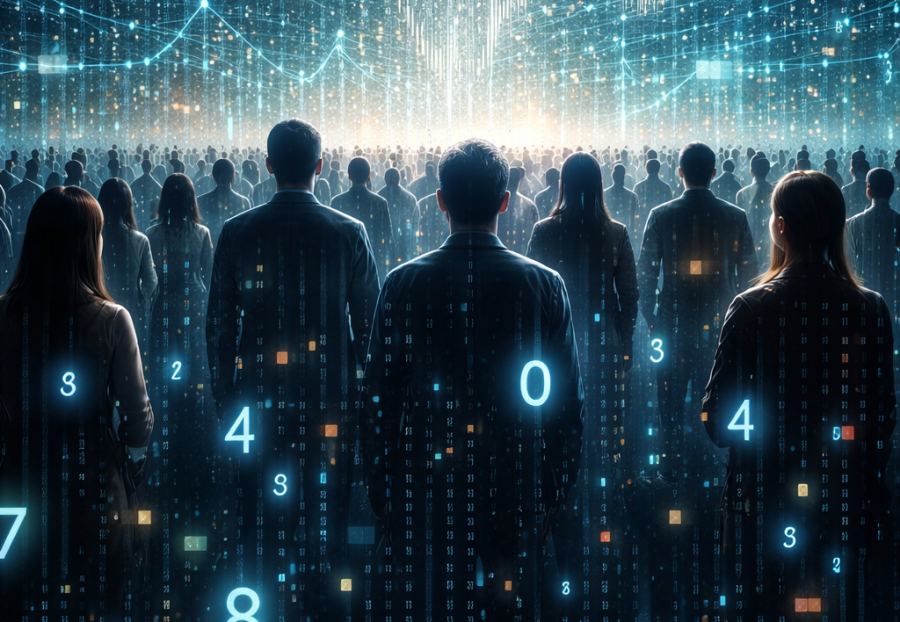
In every age, there is a quiet shift that changes how we see ourselves. In our own time, that shift is numerical.
We are living through what might be called the act of falling under numbers: a subtle but profound surrender of human identity, judgement and community to the rule of metrics, algorithms and data-driven systems.
Once, numbers were tools, servants of human reason. Today, they increasingly behave like masters. They rank us, sort us, predict us and, in many cases, decide for us.
The digital age has not merely produced more data; it has enthroned data as the primary lens through which reality is interpreted and value is assigned.
This is not a neutral development. It is a cultural, moral and spiritual turning point.
From being persons to becoming profiles
In the analogue world, a person was known through story, memory, relationship and character. In the digital world, a person is increasingly known through a profile: a shifting mosaic of clicks, likes, locations, purchases and search histories. These fragments are captured, quantified and recombined into what some scholars call a ‘data double’, a numerical shadow that follows us everywhere.
This data double is not a harmless abstraction. It is traded, analysed and used to make decisions about credit, employment, insurance, policing, advertising and even political messaging.
The human being of flesh, history and hope is quietly displaced by the human being of metrics, probabilities and risk scores.
We are, in effect, falling under numbers, being redefined by what can be counted, even when what truly matters about us cannot be.
The seduction of objectivity
Part of the power of numbers lies in their aura of objectivity. A score feels fair. A percentage feels neutral. An algorithm feels dispassionate. In a world weary of human bias and corruption, the promise of numerical decision-making is deeply attractive.
Yet this promise is often illusory. Algorithms are built by people, trained on historical data and deployed within existing structures of power.
They do not float above society; they are embedded in it. When an algorithm decides who is a ‘high-risk’ borrower, or which neighbourhood deserves more police patrols, it is not simply reading reality, it is reinforcing a particular version of it.
The danger is that once a judgement is expressed as a number, it becomes harder to question.
A mark on an exam script can be challenged; a teacher can be asked to explain. But who explains the algorithmic score that quietly labels a young person as unlikely to succeed? Who takes responsibility when a numerical model amplifies old prejudices under the guise of efficiency?
We risk moving from human bias we can see to machine bias we cannot see, and therefore rarely contest.
Life under the empire of metrics
The act of falling under numbers is not confined to the world of big technology firms or government systems. It has seeped into everyday life.
Schools are under relentless pressure to perform against league tables. Hospitals are judged by targets and throughput.
Universities chase rankings. Journalists track clicks. Pastors watch view counts. Even friendships and influence are increasingly measured in followers, likes and engagement rates.
Metrics can be useful. They can reveal patterns, highlight problems and drive improvement. But when metrics become the main measure of worth, they distort the very things they claim to serve.
A school may quietly sidelines the most vulnerable pupils because they threaten its statistics. A hospital may prioritise what is measurable over what is meaningful.
A content creator may choose outrage over truth because outrage travels faster in the attention economy. In each case, the tail of measurement begins to wag the dog of mission.

We are not just using numbers; we are being shaped by them.
The spiritual cost of quantification
There is also a deeper, more interior cost. Human beings have always wrestled with questions of identity, significance and destiny. In many traditions, these questions are answered in the language of calling, conscience and community. In the digital age, they are increasingly answered in the language of metrics.
Am I successful? Look at my analytics.
Am I loved? Count my likes.
Am I influential? Check my followers.
This quiet shift moves the centre of gravity from intrinsic worth to external validation. It encourages a restless comparison with others and a constant performance before an invisible audience. The self becomes a brand; presence becomes content; attention becomes currency.
For those of faith, this is not a trivial matter. It challenges the conviction that human beings possess a dignity that cannot be reduced to utility, popularity or productivity. It risks replacing the gaze of God, or, more broadly, the moral and spiritual horizon, with the gaze of the algorithm.
To fall under numbers, in this sense, is to forget that we are more than what can be counted.
Power, inequality and digital feudalism
The numerical turn is not evenly distributed. The power to collect, store and exploit data is concentrated in the hands of a small number of global technology companies and state actors.
They preside over vast “digital fiefdoms” in which billions of users generate data that they do not own, do not fully understand and cannot easily withdraw.
In this emerging order, many citizens function as ‘digital serfs, bound not by law, but by dependence. We rely on platforms for communication, work, education, entertainment and even worship. In return, our behaviours are monitored, predicted and nudged in ways that serve commercial and political interests.
This is not simply a matter of privacy. It is a matter of power. When the numerical representations of our lives are controlled by others, so too are many of the opportunities and constraints that shape our futures.
The risk is that data becomes a new instrument of domination, deepening existing inequalities and creating new forms of exclusion.
Falling under numbers, then, is also falling under those who own and interpret the numbers.
Resisting reduction, reclaiming humanity
What, then, is to be done? We cannot, and should not, romanticise a pre-digital past. Data, when used wisely, can save lives, improve services and illuminate injustice. The goal is not to abandon numbers, but to dethrone them from their current place of quiet supremacy.
That requires action on several fronts.
First, ethical and legal frameworks must catch up with technological power. Transparent algorithms, meaningful accountability, robust data protection and genuine user rights are not luxuries; they are necessities for a just digital society.
Second, institutions must recover their moral purpose beyond metrics. Schools, hospitals, universities, media houses, churches and civic organisations need the courage to say: ‘We will measure what we can, but we will not worship what we measure.’ Targets should serve vocation, not replace it.
Third, citizens must cultivate digital literacy and moral imagination. We need to learn not only how to use digital tools, but how they use us. We must ask hard questions about who benefits from our data, what is being assumed about us and how we might live more intentionally in a world of constant quantification.
Finally, there is a call to reaffirm the mystery of the human person. Whether one speaks in theological terms of the image of God, or in philosophical terms of human dignity, the point is the same: there is something about each person that exceeds every metric. No algorithm can capture the full depth of a human story, the possibility of repentance, the surprise of grace or the power of sacrificial love.
Beyond the tyranny of the countable
The digital age invites us to extraordinary possibilities, but it also tempts us to a dangerous simplification. If we are not careful, we will come to believe that what cannot be counted does not count.
The act of falling under numbers is not inevitable. It is a cultural choice, reinforced every time we treat metrics as ultimate rather than provisional, every time we allow data to speak with the final word about human worth, every time we forget that behind every number is a neighbour.
Our task, as societies and as individuals, is to step back from that edge. To insist that numbers must answer to ethics, that algorithms must answer to justice, and that data must answer to the enduring truth that human beings are more than the sum of their digital traces.
In the end, the question is simple, even if the context is complex: will we live as data points, or as persons? The future of our digital civilisation may depend on how we answer.