

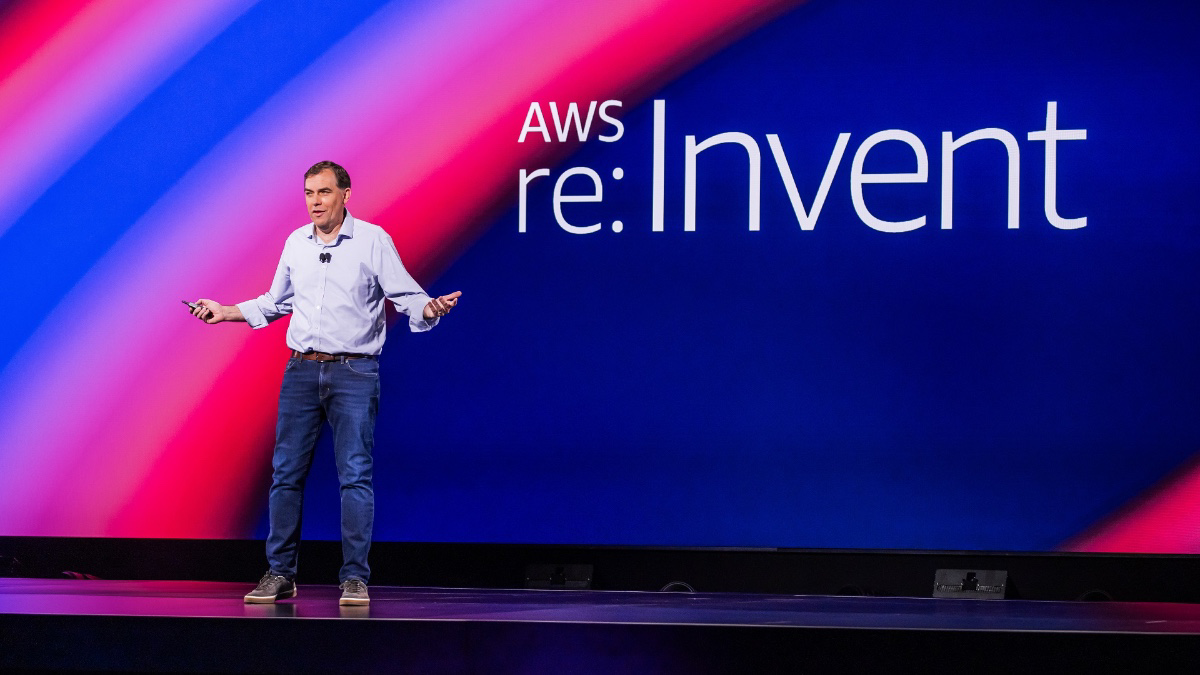
Amazon Web Services (AWS) has unveiled a wave of new AI tools, models, and enterprise solutions at its re:Invent 2025 conference, and we see it making AI agents more autonomous, scalable, and integrated across business operations.
The announcements cover hardware, software, cloud services, and partnerships with companies like Lyft, Sony, and Visa.
The focus this year is on giving businesses better management over AI systems. AWS CEO Matt Garman spoke about how AI agents can drive tangible business results.
“AI assistants are starting to give way to AI agents that can perform tasks and automate on your behalf,” he said during the keynote. “This is where we’re starting to see material business returns from your AI investments.”

Powerful Chips and UltraServers
AWS introduced the Trainium3 chip and UltraServer systems, promising up to four times faster AI training and inference while using 40% less energy.
Trainium4, already in development, will be compatible with Nvidia’s chips, signalling AWS’s intent to bridge proprietary and third-party hardware ecosystems.
AI Agents Evolving
AWS also expanded its AgentCore platform. Features like Policy allow developers to set clear boundaries for agents, while new memory and evaluation capabilities let AI agents remember interactions and be tested against 13 prebuilt evaluation systems.
Among the new “Frontier agents,” the Kiro autonomous agent stands out, writing code and learning team workflows to operate independently for hours or even days. Additional agents focus on security and DevOps tasks, helping teams prevent errors and manage operations more efficiently.
Nova AI and Customisation
Amazon’s Nova family of AI models grows with four new releases, including three text-generation models and a multimodal model that handles text and images. Nova Forge introduces “open training,” enabling organisations to fine-tune pre-trained models with proprietary data.
Companies like Reddit and Hertz are already leveraging Nova to replace multiple specialised models or accelerate development velocity.
Real-World Applications
AWS customers demonstrated practical impacts. Lyft’s AI agent, built with Anthropic’s Claude model via Amazon Bedrock, now resolves driver and rider queries 87% faster and has increased driver adoption by 70%.
Christina Minardi from Amazon noted sustainability applications: “By working with Trane Technologies and the BrainBox AI team, we’re turning our buildings into intelligent systems that learn and adapt, helping us meet both our sustainability and performance goals in real time.”
Other partners showcased broad enterprise use cases. Sony is deploying AWS-powered AI platforms internally and through the Sony Engagement Platform, processing 760 terabytes of data daily to enhance fan experiences.
Nissan’s cloud-based software platform for vehicles has reduced testing time by 75%, while Visa and AWS are enabling AI agents to conduct secure, autonomous transactions.
Data Control and Sovereignty
AWS also introduced AI Factories, which allow companies and governments to run AWS AI in their own data centres. Combining Nvidia GPUs with Trainium3 chips, the system meets regulatory and data sovereignty requirements without sacrificing performance.
Cloud Services and Storage Upgrades
Several AWS services received significant updates. Amazon S3 now supports objects up to 50TB and scales to two billion vectors per index for AI search, while S3 Tables introduces automatic replication and cost-optimising Intelligent-Tiering.
CloudWatch unifies operational, security, and compliance logs for easier insights, and EMR Serverless eliminates local storage provisioning for Apache Spark jobs, cutting costs by up to 20%.
Enhanced Support and Security
AWS also announced upgraded support plans, combining faster AI-assisted responses with expert guidance. Amazon GuardDuty Extended Threat Detection now covers EC2 and ECS environments, while Security Hub offers near real-time risk analytics across multiple AWS services.
Expanding Partnerships
Adobe, Deepgram, BlackRock, and WRITER highlighted collaborative initiatives. Adobe is using AWS for AI-powered creative tools, Deepgram for enterprise voice solutions, BlackRock for Aladdin investment technology, and WRITER for securely scaling enterprise AI agents.
The announcements underline AWS’s strategy to embed AI across infrastructure, enterprise software, and real-world operations.
Starting from autonomous coding agents to sustainability-driven building systems, the AWS re:Invent 2025 conference revealed how businesses are starting to rely on AI agents not just as tools, but as autonomous collaborators.