



Africans are better educated today than they have been at any other time, with many African nations making strides towards ensuring access to quality education and lifelong learning for their citizens.
UNESCO’s report on Transforming Learning and Skills Development notes that delivering education well is not only a fundamental human right, it is also a critical ingredient of building solid foundations for the future, empowering people not just to develop the skills they will need for the workplace, but also ensuring that they can unlock their potential as members of society.
UNICEF estimates that there are 450 million school-age children in Africa in 2025, and this population is predicted to swell to over 600 million by 2050.
However, although 75 million more African children are enrolled in school today compared to 2015, the number of out-of-school children has increased by 13.2 million to over 100 million during the same period.
For Africa to actively participate in the global digital economy, it’s a continent-wide imperative to unlock not just access to education, but access to the resources that will help children thrive in education.
Harnessing technology to provide educational resources
Millions of children across the continent are eager but struggling to learn or are dropping out due to the high cost of quality education, outdated materials, and overburdened teachers.
Schools also struggle with reliable web access – the Global Education Monitoring Report found that Africa has the lowest school connectivity globally, with most schools lacking even basic electricity, making reliable internet rare. Mobile penetration in Africa is far higher, yet many learning platforms are built for the web.
In 2020, frustrated by their own experiences, and tired of witnessing how young Africans were held back by a lack of access to quality education, a group of entrepreneurs started Afrilearn International Limited. Their goal was simple, but ambitious: to democratise access to quality education across Africa using a mobile-first solution.
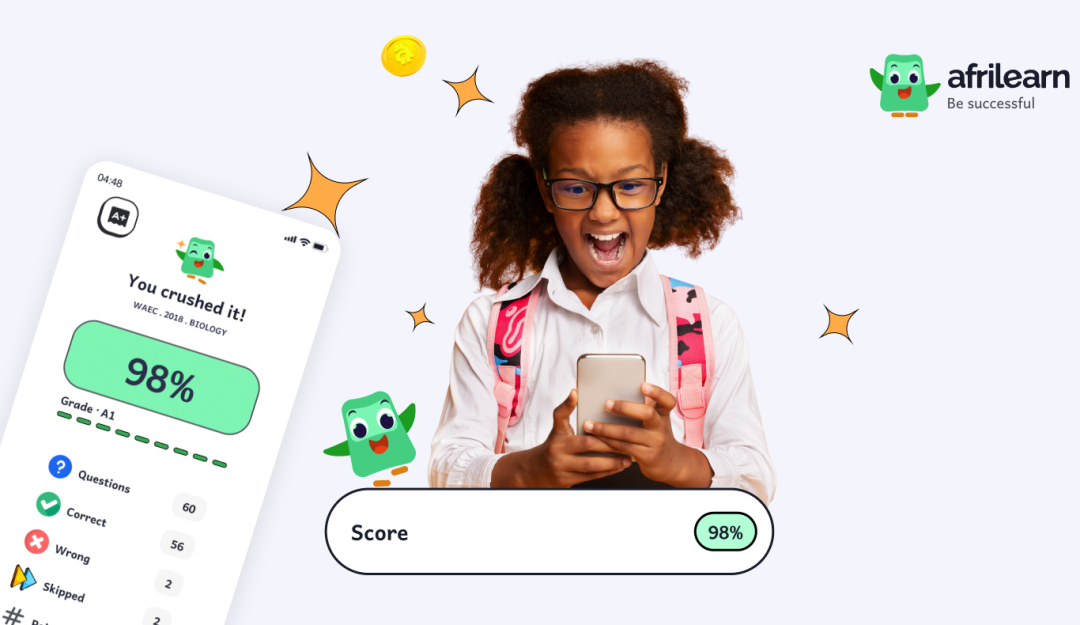
The company started with ClassNotes.ng, which quickly became the #1 education platform in Nigeria, empowering students with curriculum-based class notes.
By July 2022, Afrilearn had reached 1 million learners across Nigeria and Africa, a major step in delivering quality education to undeserved communities.
Now, this AI-powered K-12 learning platform is on a mission to make world-class education freely available to all African children by making learning fun, using gamified experiences to engage school learners with their studies.
The Afrilearn App for Students provides a comprehensive library of study materials and homework help. Learners can master a subject using the class notes, video lessons, quiz materials and games on the app, earning coins, and winning rewards along the way, while parents can track their children’s progress through learning reports.
Afrilearn also provides adaptive practice for local and international exams through Exambly.com, which provides free exam practice for entrance, admission and matriculation exams across Africa.
Supporting educators is part of the process
To support educators, Afrilearn has built and refined its new AI-powered School Management Software, which is a smart platform for learning, administration, and managing school fees, reports and results.
The company collaborates with Schoolinka, a leading African teacher-training organisation, to co-create and distribute professional development resources, onboard teachers onto Afrilearn, and support schools with continuous training. This has significantly improved teacher adoption and classroom impact across the schools Afrilearn serves.
A constant evolution
The School Management Software offering was developed as part of the first cohort of the Microsoft and NVIDIA African GenAI Accelerator Programme.
The collaboration allowed Afrilearn to leverage Azure AI and cloud infrastructure to enhance automation, learning personalisation and school analytics on the platform.
The company created a rebuilt, AI-powered SMS programme during the Accelerator Programme, and plans to introduce upgrades including adaptive learning profiles, predictive analytics and automated fee management for schools, and offline-first learning flows. Teachers will soon benefit from enhanced AI tools for lesson preparation and assessments.
With Microsoft’s support, Afrilearn uses GitHub for its engineering workflow, enabling the company to release updates faster and with fewer errors.
Visual Studio Code is the team’s preferred integrated development environment, as its integration with Axure extensions, debugging tools and GitHub repository reduce friction across engineering tasks.
Collectively, these tools, alongside Azure, have improved delivery speed, strengthened reliability and enabled the team to build a more stable, scalable AI education platform. And for a distributed team working in multiple countries, Microsoft’s collaboration tools, Teams and Sharepoint, have proven invaluable for daily contact and communication.
Broadening access to education across Africa
To date, Afrilearn has reached more than 4 million learners and more than 800 schools across more than 10 countries.
More than 80% of users report achieving improved learning outcomes within a week of consistent usage, while the AI-powered personalisation improves learners’ grades by up to 52 percent within eight weeks of consistent study. Schools implementing the Afrilearn management software have saved more than 10 administrative hours per week and have boosted their fee collection by 35 to 40 percent.
The Afrilearn team has big ambitions to scale into additional countries across Africa, deepening partnerships with UNICEF and the African Union to scale their impact. In addition to Nigeria, Afrilearn serves learners in Ghana, Liberia, Sierra Leone, Gambia and the wider diaspora.
“At Afrilearn, we’re the ecosystem closing the gap between Africa’s potential and its future, where no child is left behind because of where they live or how much their parents earn. We’re especially excited about our upcoming product upgrades that make personalised learning even more accessible to children at home and in school,” says Isaac Oladipupo, CEO at Afrilearn International Limited. “Our goal is to reach 10 million learners across 12 African countries in the next 36 months. We believe that every child deserves a quality education that positions them for future success.”



