


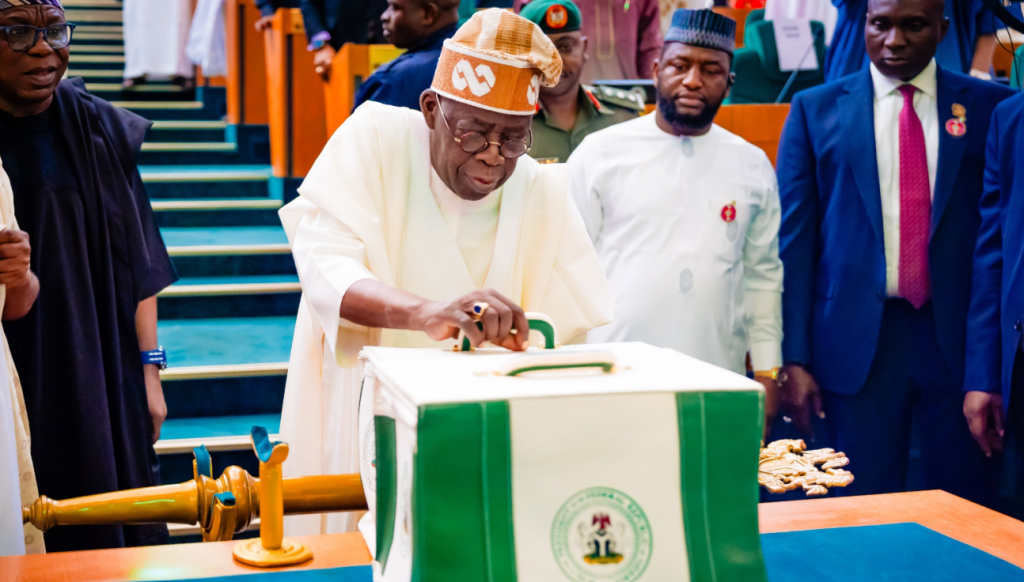
President Bola Tinubu presented the ₦58.18 trillion 2026 Appropriation Bill, titled “Budget of Consolidation, Renewed Resilience and Shared Prosperity,” to a joint session of the National Assembly on December 19, 2025.
The presentation is another step in pushing forward the Renewed Hope Agenda.
The 2026 Appropriation Bill is the largest budget proposal in Nigeria’s history. It sets out how the government plans to tackle key national challenges, with spending choices that show how different priorities connect.
Below are five key lessons from the proposal.
First, security remains the foundation of growth: President Tinubu proposed ₦5.41 trillion for defence and security, underlining the role security plays in economic stability.
Without safety, businesses cannot operate and investment cannot grow.
The allocation reveals a drive to strengthen the country’s security framework and address threats such as kidnapping, armed robbery, cultism, banditry, and terrorism.
Secondly, human capital drives productivity: The budget proposes ₦3.52 trillion for education and ₦2.48 trillion for health. This shows the belief that a skilled and healthy population is essential for economic progress.
As Tinubu stated, “Without educated and healthy citizens, productivity will not rise.” Increased support for programmes such as the Nigerian Education Loan Fund points to a focus on building a better-prepared workforce.
Thirdly, infrastructure fuels economic activity: With ₦3.56 trillion set aside for infrastructure and urban renewal in 2026, the budget aims to close long-standing infrastructure gaps.
Better roads, power, and transport systems are expected to lower business costs and create jobs.
Tinubu stressed that “Without infrastructure, jobs and enterprises will not scale.”
Fourthly, national priorities must work together: The President made it clear that the budget sectors are linked, describing them as “a single, coherent programme of national renewal.”
This suggests a move away from isolated spending towards a more coordinated approach.
Finally, delivery matters as much as planning: Tinubu pledged to improve budget execution by tightening implementation rules, ending overlapping budget cycles, and focusing on results rather than promises.
Together, these lessons show a budget built around security, people, infrastructure, coordination, and accountability.





I need it