
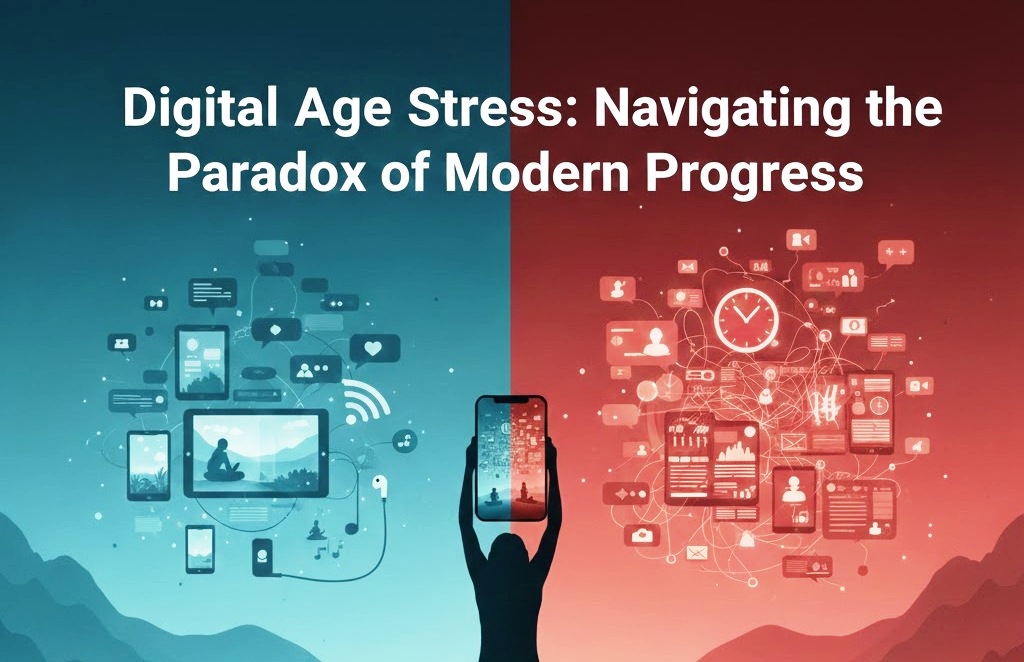
The Digital Age promised liberation through automation, artificial intelligence, and hyper-connectivity, aiming to eliminate monotony and reduce stress. Yet stress has not vanished, it has transformed.
Physical strain has given way to cognitive and emotional pressure, fuelled by constant connectivity and rapid innovation.
To understand this shift, stress must be examined across three critical dimensions: individuals, organisations, and governance.
Stress at the Individual Level: Liberation or Digital Fatigue?
For individuals, the Digital Age has dismantled many traditional stressors. The daily commute, a source of exhaustion and lost productivity, has been replaced by remote work and flexible schedules.
Virtual assistants automate mundane tasks, freeing time for creativity and leisure. Mental health resources, once scarce and stigmatized, now reside in our pockets through apps and teletherapy platforms. These innovations suggest a world where stress recedes into history.
Yet, the reality is different. The mind is overwhelmed by constant notifications, emails, and updates. People now process more data daily than what earlier generations did in a month.
The line between work and personal life blurs, fostering an “always-on” culture where the home becomes a permanent workspace. Performance measures and social comparisons heighten anxiety, as digital presence makes every success publicly visible.
Stress has shifted from physical exhaustion to cognitive and emotional strain, demanding a new discipline: digital mindfulness.
This involves intentional engagement with technology, curating notifications, scheduling tech-free zones, and practicing mental resilience.
Without these strategies, the promise of stress reduction becomes an illusion, replaced by a new form of digital fatigue.
Organisational Stress: Efficiency Meets Urgency
Organizations have embraced digital transformation as a pathway to efficiency. Cloud computing, AI-driven analytics, and collaboration platforms streamline operations, reducing inefficiencies and accelerating decision-making.
HR systems now personalize wellness programs, monitor employee stress levels, and offer flexible scheduling options. These tools suggest a workplace designed for harmony and productivity.
Yet, hyper-connectivity breeds urgency. Real-time communication fosters a culture of instant response, eroding deep work and strategic thinking.
Cybersecurity threats loom large, placing immense pressure on IT teams and leadership. Continuous technological change demands perpetual upskilling, overwhelming employees who struggle to keep pace with evolving tools and expectations.
The antidote lies in human-centric digital cultures. Organizations must move beyond technology adoption to embed well-being into their digital strategies.
This means balancing connectivity with autonomy, creating policies that respect downtime, and investing in mental health programs. Digital transformation should not be a race for speed but a journey toward sustainable productivity.
Governance Stress: Anticipatory Leadership in a Digital World
Governments leverage technology to reduce bureaucratic friction. E-governance platforms simplify citizen engagement, while predictive analytics enable proactive policy-making.
These innovations promise stress-free governance, where efficiency and transparency replace red tape and inefficiency.
But the stressors are formidable. Cybersecurity risks threaten national security, as state-sponsored attacks and data breaches become weapons of geopolitical influence.
The digital divide challenges equity, forcing governments to balance innovation with inclusion. Regulatory frameworks struggle to keep pace with technological disruption, creating tension between progress and protection.
Governance must evolve from reactive regulation to anticipatory leadership. This involves embracing ethical AI, robust cybersecurity, and inclusive digital policies that safeguard societal trust. Governments must also invest in digital literacy programs to ensure citizens are not left behind in the race toward modernisation.
Global Examples: Lessons from the Frontlines
Estonia has emerged as a global leader in the realm of digital governance, setting a benchmark for other nations through its innovative approach to public administration.
The country has successfully implemented a comprehensive e-government system that enables citizens to access a wide range of services online with remarkable ease and efficiency.
From filing taxes to managing healthcare records, these digital platforms have significantly reduced bureaucratic hurdles and streamlined interactions between the government and its people.
This transformation has not only saved time but also enhanced transparency and accountability within the public sector. However, such extensive reliance on digital infrastructure comes with its own set of challenges. The need for constant vigilance against cyber threats has become paramount, as any breach could compromise sensitive data and undermine public trust.
Consequently, Estonia invests heavily in cybersecurity measures and digital literacy to ensure that its pioneering model remains secure and sustainable.
In recent years, Japan has been actively addressing the long-standing issue of overwork culture, which has historically placed immense pressure on employees and affected their overall well-being.
To tackle this, Japanese companies are increasingly adopting advanced technological solutions, including artificial intelligence-driven scheduling tools, to optimise workloads and promote healthier work-life balance.
These tools are designed to allocate tasks more efficiently, reduce unnecessary overtime, and create a more structured approach to time management. While these initiatives represent a positive shift towards employee welfare, they have also introduced new complexities.
Many workers report growing anxiety linked to performance metrics and algorithm-based evaluations, which can feel impersonal and demanding. This paradox highlights the delicate balance between leveraging technology for efficiency and ensuring that human factors such as mental health and job satisfaction are not overlooked.
The challenge for Japan lies in harmonising technological progress with cultural and psychological considerations to create a truly supportive work environment.
Nigeria is making concerted efforts to bridge the digital divide and foster greater inclusion in the rapidly evolving technological landscape.
Central to this ambition is the expansion of broadband access across urban and rural areas, aimed at reducing the stress and frustration caused by connectivity gaps that hinder communication, education, and economic participation. By improving internet penetration, the government seeks to empower citizens, stimulate innovation, and enhance governance through digital platforms.
Nevertheless, these aspirations are not without obstacles. Persistent infrastructural deficiencies, such as unreliable power supply and inadequate network coverage, continue to pose significant challenges. These limitations place additional pressure on policymakers and service providers to deliver sustainable solutions that can withstand the demands of a growing population.
The success of Nigeria’s digital inclusion strategy will ultimately depend on coordinated efforts between the government, the private sector, and international partners to overcome these barriers and create an environment where technology catalyses social and economic transformation.
The Core Paradox
The Digital Age offers tools to simplify life, yet it amplifies complexity and vulnerability. Stress is not fading, it is evolving, driven by constant connectivity and relentless innovation.
The future demands digital resilience: secure systems and adaptive mindsets that strike a balance between technological progress and human well-being.
Individuals should practise digital mindfulness by managing notifications, scheduling technology-free time, and using wellness applications.
Lifelong learning is essential to remain confident in a rapidly changing world. Organisations must embed well-being into their digital strategies, balancing connectivity with autonomy and investing in mental health initiatives.
Cultures that prioritise deep, focused work over constant availability will reduce cognitive overload and enhance productivity. Governance must advance inclusive digital policies and strengthen cybersecurity to protect trust, while promoting digital literacy to ensure equitable participation in the digital economy.
Ultimately, the challenge is clear: to shape a future where technology and humanity coexist in harmony. Digital resilience, rooted in secure systems, informed policies, and mindful practices, will be the cornerstone of this vision.
Conclusion
The Digital Age is not a stress-free utopia. It is a dynamic landscape where stress evolves as fast as technology. Our challenge is not to eliminate stress but to transform it into a catalyst for growth, creativity, and resilience.
By embracing digital mindfulness, human-centric organizational cultures, and anticipatory governance, we can ensure that technology serves humanity, not the other way around.