
• News
  • Tech
    • DisruptiveTECH
    • ConsumerTech
    • How To
    • TechTAINMENT
  • Business
    • Telecoms
    • Commerce & Mobility
    • Environment
    • Travel
    • StartUPs
      • Chidiverse
    • TE Insights
    • Security
  • Partners
  • Economy
    • Finance
    • Fintech
    • Digital Assets
    • Personal Finance
    • Insurance
  • Features
    • IndustryINFLUENCERS
    • Guest Writer
    • EventDIARY
    • Editorial
    • Appointment
  • TECHECONOMY TV
  • Apply
  • TBS
  • BusinesSENSE For SMEs
Monday, December 29, 2025
  • Login
No Result
View All Result
NEWSLETTER
Techeconomy
  • News
  • Tech
    • DisruptiveTECH
    • ConsumerTech
    • How To
    • TechTAINMENT
  • Business
    • Telecoms
    • Commerce & Mobility
    • Environment
    • Travel
    • StartUPs
      • Chidiverse
    • TE Insights
    • Security
  • Partners
  • Economy
    • Finance
    • Fintech
    • Digital Assets
    • Personal Finance
    • Insurance
  • Features
    • IndustryINFLUENCERS
    • Guest Writer
    • EventDIARY
    • Editorial
    • Appointment
  • TECHECONOMY TV
  • Apply
  • TBS
  • BusinesSENSE For SMEs
  • Chidiverse
  • News
  • Tech
    • DisruptiveTECH
    • ConsumerTech
    • How To
    • TechTAINMENT
  • Business
    • Telecoms
    • Commerce & Mobility
    • Environment
    • Travel
    • StartUPs
      • Chidiverse
    • TE Insights
    • Security
  • Partners
  • Economy
    • Finance
    • Fintech
    • Digital Assets
    • Personal Finance
    • Insurance
  • Features
    • IndustryINFLUENCERS
    • Guest Writer
    • EventDIARY
    • Editorial
    • Appointment
  • TECHECONOMY TV
  • Apply
  • TBS
  • BusinesSENSE For SMEs
  • Chidiverse
No Result
View All Result
Techeconomy
No Result
View All Result
  • News
  • Finance
  • StartUPs
  • TechTAINMENT
  • Guest Writer
  • Digital Assets
  • IndustryINFLUENCERS
  • Environment
  • Macro Monday
ADVERTISEMENT

Home » Infrastructure, Inflation and Sabotage: Inside Nigeria’s Failed 70% Broadband Ambition

Infrastructure, Inflation and Sabotage: Inside Nigeria’s Failed 70% Broadband Ambition

While internet usage has surged, the country has officially missed its crown-jewel target of 70% broadband penetration, stalling at 50.58% as of November 2025.

Peter Oluka by Peter Oluka
December 29, 2025
in Broadband
Reading Time: 2 mins read
0
Mobile broadband quality in Abuja | 70% Penetration in Nigeria

Internet user

UBA
Advertisements

As the curtain falls on the National Broadband Plan (NBP 2020–2025) this December, Nigeria finds itself in a bittersweet position.

While internet usage has surged, the country has officially missed its crown-jewel target of 70% broadband penetration, stalling at 50.58% as of November 2025.

11 States Waive Right of Way Fees to Boost Broadband Expansion - Bosun Tijani
Dr. Bosun Tijani, minister of Communications, Innovation and Digital Economy

While the 144.7 million Nigerians now connected to the internet represent a significant achievement, the 20% deficit reveals a widening digital divide.

Here is Techeconomy’s autopsy of why Nigeria’s “Digital Leap” fell short of its mark:

1. The Smartphone Affordability Paradox

The National Broadband Plan was built on the assumption that entry-level 4G smartphones would be accessible to the average Nigerian at approximately ₦18,000.

Infinix phone

However, the reality of 2025 tells a different story. Driven by persistent Naira devaluation and import duties, the cheapest 4G/5G enabled devices now retail for over ₦100,000.

This 400% price hike has transformed a “basic tool for inclusion” into a “luxury item,” effectively locking out millions of low-income citizens from the broadband net.

2. The “Vandalism Epidemic”
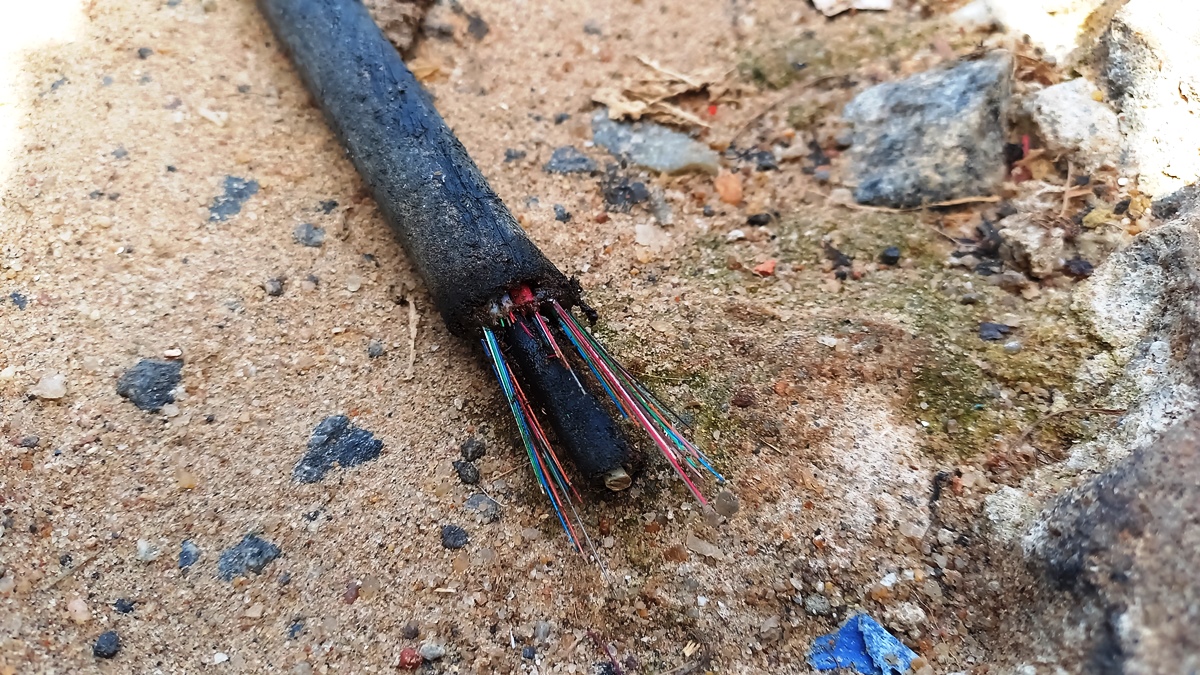
Damaged fibre Optic cables
Damaged fibre Optic cables (Photo: Techeconomy)

Infrastructure security remains the Achilles’ heel of the Nigerian telecoms sector. According to NCC reports and operator data, the industry suffers an average of 30 to 43 fiber-optic cable cuts every single day.

MTN New

These are not just accidents; they are often the result of construction negligence or targeted sabotage.

Every cut requires immediate, expensive repairs, diverting capital that was originally earmarked for expanding network coverage into underserved “white spaces.”

The Right-of-Way (RoW) Standoff

Despite the Federal Government’s push for a harmonized Right-of-Way fee, many states continue to treat telecoms infrastructure as a “cash cow” rather than a developmental catalyst.

Prohibitive fees for laying fiber-optic cables have discouraged operators from expanding beyond high-yield urban centers like Lagos and Abuja, leaving the “Hinterland” in a persistent digital blackout.

4. Capital Flight and Investment Inertia

Foreign Direct Investment (FDI) in the telecoms sector has faced a downturn. Global investors, wary of foreign exchange volatility and the high cost of doing business in Nigeria, have slowed the flow of capital needed to deploy the massive “Last Mile” infrastructure required to hit the 70% mark.

The Silver Lining: Data Consumption at All-Time High

Paradoxically, while the number of users didn’t meet the target, those who are connected are using more data than ever before.

  • November 2025: 1.23 Million Terabytes consumed.
  • Growth: A 34.96% increase in data usage year-on-year.
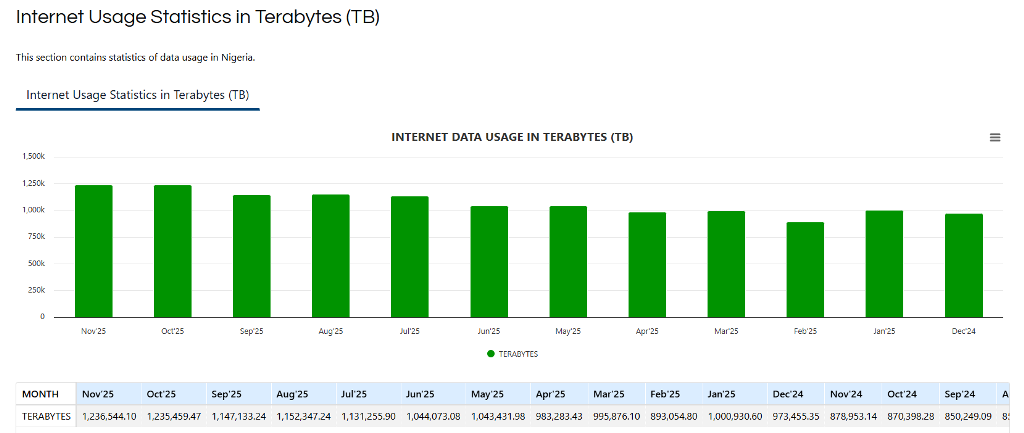
Internet Usage Statistics  in Nigeria - November 2025 by NCC
Internet Usage Statistics (Source: NCC.GOV.NG)

This suggests that while the quantity of users is lagging, the quality of engagement is deepening, driven by the rise of the digital economy and remote work.

The 2026 Strategy

With the January 1, 2026 Tax Reforms on the horizon, industry experts are calling for a “Broadband 2.0” strategy.

By exempting 97% of small businesses from corporate tax, the government may provide the indirect stimulus needed for local ISPs to finally bridge the “Last Mile” gap that the 2020–2025 plan could not.

0Shares

stanbic
Previous Post

Samsung Electronics Ranks 5th in Global Brands for the Sixth Consecutive Year

Next Post

Google Brings Pixel 9 Panorama Camera Feature to Pixel 8

Peter Oluka

Peter Oluka

Peter Oluka (@peterolukai), editor of Techeconomy, is a multi-award winner practicing Journalist. Peter’s media practice cuts across Media Relations | Marketing| Advertising, other Communications interests. Contact: peter.oluka@techeconomy.ng

Next Post
Google Brings Advanced Pixel 9 Panorama Camera Feature to Pixel 8

Google Brings Pixel 9 Panorama Camera Feature to Pixel 8

Leave a Reply Cancel reply

Your email address will not be published. Required fields are marked *

I agree to the Terms & Conditions and Privacy Policy.

This site uses Akismet to reduce spam. Learn how your comment data is processed.

MTN New
UBA
Advertisements
  • About Us
  • Advertise
  • Careers
  • Contact Us

© 2025 TECHECONOMY.

No Result
View All Result
  • Home
    • Home – Layout 1
    • Home – Layout 2
    • Home – Layout 3
    • Home – Layout 4
    • Home – Layout 5
  • World
  • Politics
  • Business
  • Science
  • Tech
  • Entertainment
  • Lifestyle

© 2025 TECHECONOMY.

Welcome Back!

Login to your account below

Forgotten Password?

Retrieve your password

Please enter your username or email address to reset your password.

Log In
This website uses cookies. By continuing to use this website you are giving consent to cookies being used. Visit our Privacy and Cookie Policy.