

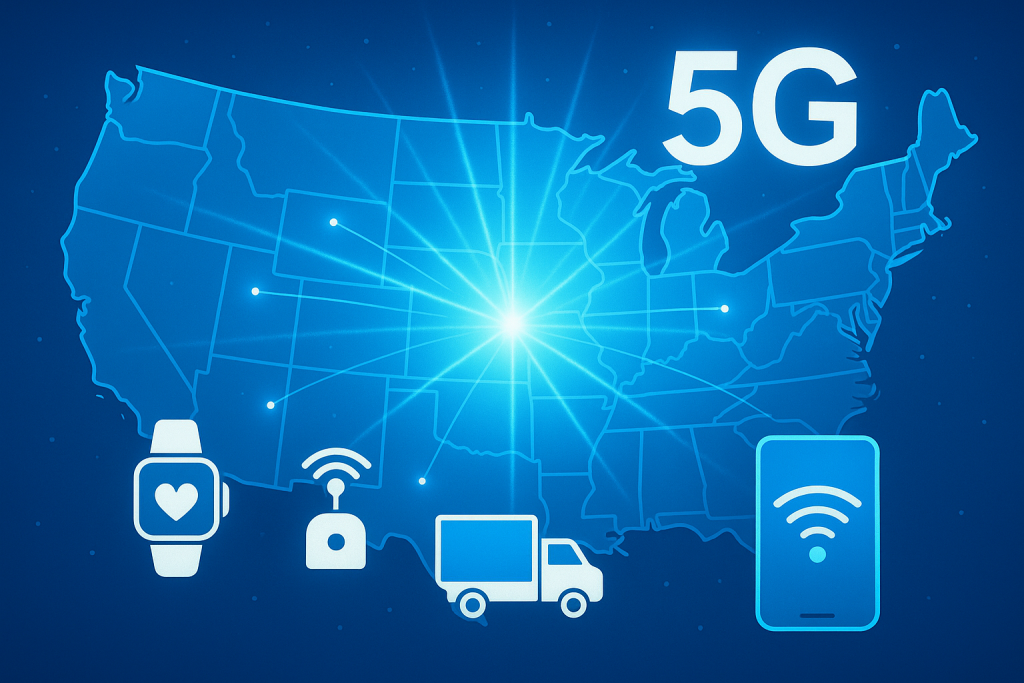
Sony Semiconductor Israel, recently announced its long-term vision for 5G IoT connectivity, positioning eRedCap with enhanced reduced capability, as the foundation for the next generation of global, long-life connected Altair devices.
As industries accelerate the AI revolution and mobile operators plan the retirement of legacy networks, the transition from 4G to 5G is reshaping what is possible in large-scale IoT deployments.
LPWA technologies, from gas and water meters to asset trackers and safety infrastructure, have varying throughput demands that are set for operating in the field over the next 10 to 20 years.
However, applications that depend on higher throughput, voice capability, or richer data streams, such as industrial automation, next-generation safety systems, wearables, and a new category of AI-centric consumer devices, that are shifting towards eRedCap.
These applications will focus on real-time, low power and higher throughput communication, while traditional LPWA devices keep supporting ultra-low power and deep indoor use-cases where only small amounts of data are sent.
“The future of IoT is clearly converging around eRedCap,” said Nohik Semel, CEO of Sony S emiconductor Israel. “It brings the performance needed for tomorrow’s connected devices while preserving the efficiency and longevity that industries count on. For device makers designing for the next 10 to 20 years, eRedCap is the technology that will facilitate the move from 4G into a fully 5G world.”
A fully 5G world means operators can finally sunset 4G and unify their networks. Today, they must keep 2G and 4G networks alive because many legacy devices remain in the field, and spectrum is a scarce, shared resource.
eRedCap enables the gradual migration of IoT devices to 5G, allowing operators to free up spectrum, stop maintaining parallel networks, and eventually discontinue 4G.
Built on 3GPP Release 18, eRedCap creates a new middle ground between advanced 5G and narrowband IoT.
Compared to LPWA technology, eRedCap delivers higher data throughput for data-heavy applications while maintaining lower complexity and cost compared to high-throughput 5G NR implementations, all optimized for long-lasting, battery- powered devices.
As IoT networks & devices evolve and transition to eRedCap, HD-FDD (Half-Duplex Frequency Division Duplex) is emerging as the preferred deployment option for eRedCap devices.
HD-FDD better aligns with the design requirements for low-cost, low-power, long- lasting 5G IoT devices due to its lower cost, simpler RF design, and better power consumption.