


MTN Group’s digital infrastructure company, Bayobab, was one of the consortium partners recognised for its pioneering role at a celebratory event held in Cape Town last night to mark the completion of the world’s longest subsea cable infrastructure project.
The milestone marked a significant advancement in global connectivity and underscored the role that MTN, through Bayobab, plays as a digital ecosystem enabler to give Africans hope, dignity and opportunity.
2Africa, a META-led digital infrastructure initiative, is the first subsea cable to provide a continuous link between East and West Africa while extending onward to the Middle East, South Asia and Europe. The system has taken nearly six years to build.
It crosses 50 jurisdictions and required constant adjustment to shifting regulatory environments and technical conditions.
Its delivery reflects years of close collaboration, technical innovation and a shared vision among 2Africa consortium partners to connect communities, drive economic growth, and enable transformative digital experiences across Africa and beyond.
“For MTN, 2Africa isn’t just a cable but rather a statement of intent of what can be achieved when the world’s technology leaders and Africa’s own champions come together with purpose,” said Mazen Mroué CEO, MTN Group Digital Infrastructure, receiving the award on behalf of MTN and Bayobab.
“This project stands as proof that global scale and African leadership can combine to build the infrastructure that will define the next chapter of Africa’s growth story. Yes, together we’re connecting Africa to the world, but above all, we’re connecting Africa to its potential.”
2Africa delivers a step change in international bandwidth for Africa. On the West segment, from England to South Africa, the cable supports 21 Tbps per fibre pair with 8 fibre pairs on the trunk, totalling 168 Tbps.
In the Mediterranean, shorter distances allow for more than 30 Tbps per fibre pair, and with 16 fibre pairs, the system can deliver over 180 Tbps in these segments.
This leap in capacity is expected to contribute up to $36.9 billion USD to Africa’s GDP within the first two to three years of operation, boosting job creation, entrepreneurship, and innovation hubs across the continent.
With landings in 33+ countries and counting, 2Africa will help enable connectivity for 3 billion people – over 30 percent of the world’s population.
This scale is unprecedented, and it was only possible through the collective effort of stakeholders across the ecosystem.
Mroué said, “At MTN, we view connectivity as the foundation of Africa’s digital future. Through Bayobab, we bring world-class infrastructure capability and the reach of a network serving over 300 million subscribers across 16 African markets. Of course, the Bayobab footprint, which embeds just under 135 thousand kilometres of cable extends beyond these markets to accelerates Africa’s Digital Transformation and AI adoption.”
Building 2Africa required pushing the boundaries of subsea infrastructure. The cable is double the capacity of older systems. It incorporates undersea optical wavelength switching, enabling flexible bandwidth management and supporting evolving demands for AI-Enabled Data Centre, cloud, and high-bandwidth applications.
Advanced SDM (Spatial Division Multiplexing) technology was deployed and undersea optical wavelength switching for flexible bandwidth management incorporated.
The cable burial depth was increased by 50 percent and carefully routed the cable to avoid seabed hazards like hot brine pools and the Congo Canyon turbidity currents, optimizing for both capacity and reliability.
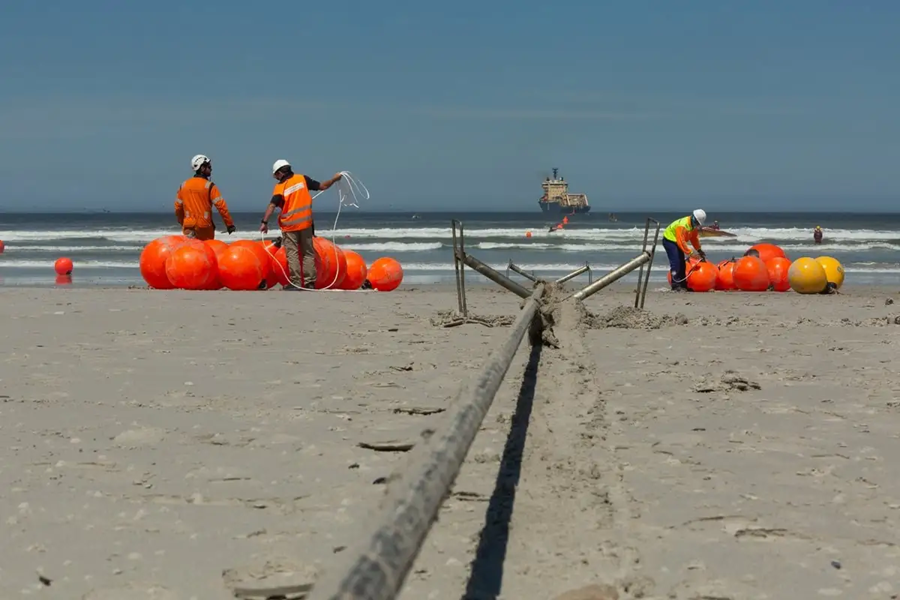
Over 35 offshore vessels and extensive local operations were mobilised, with specialist equipment deployed to ensure safe and resilient installation across 50 jurisdictions.
2Africa’s success is rooted in partnership. The consortium led by Meta, included Bayobab, center3, CMI, Orange, Telecom Egypt, Vodafone Group, and WIOCC.
The 2Africa celebration ceremony was held at Zeitz Museum of Contemporary Art Africa in Cape Town.



