
In the digital economy, data is the ultimate arbiter of truth. We use analytics to optimize supply chains, algorithms to predict market trends, and metrics to measure corporate performance.
Yet, when it comes to our most valuable national asset, our reputation, Nigeria has historically relied on intuition, emotion, and political sentiment.
This week, that era ended.
With the release of the inaugural Nigeria Reputation Perception Index (NRPI) 2025 Report by the Nigerian Institute of Public Relations (NIPR), we have moved from debating our image to diagnosing our identity.
As the Lead Researcher tasked with building the “engine” for this study, I can tell you that the data tells a story that is both a validation of our resilience and a stark warning about our future.
We call it the “Trust Paradox.”
The Engine: Building a Reputation Operating System
To understand the findings, one must first understand the tool. We did not simply run an opinion poll. We built a diagnostic framework, the RPI Framework, designed to function like an operating system for national trust.
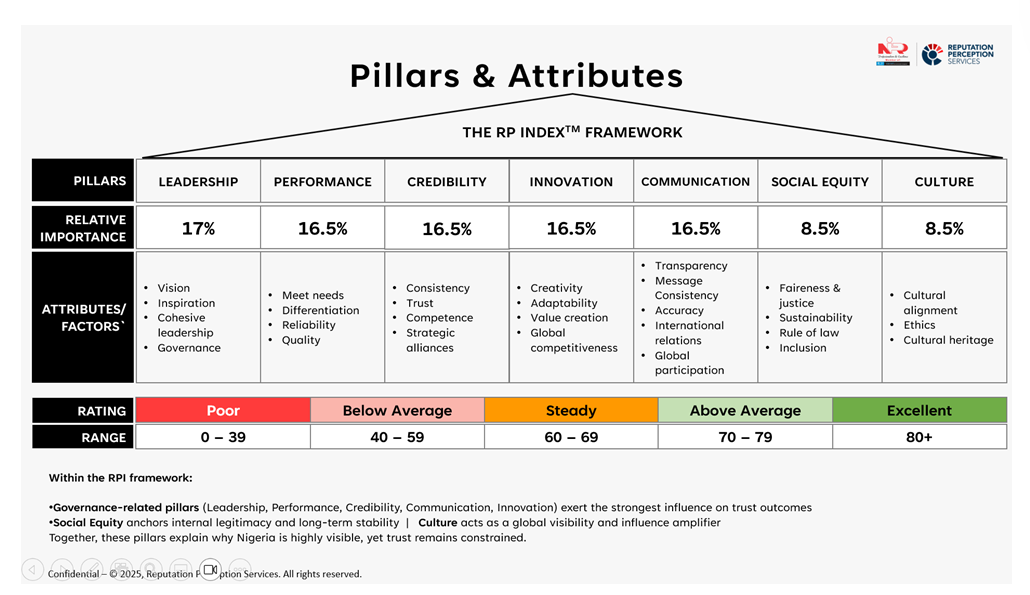
We identified seven strategic pillars backed by 28 empirical attributes to measure how Nigeria is experienced. We weighted these pillars based on their influence on economic confidence:
- The Drivers: Leadership (17%) and the “Delivery Block” (Performance, Credibility, Innovation, Communication – 16.5% each) hold the most weight because they determine risk.
- The Amplifiers: Culture and Social Equity (8.5% each) are critical for visibility but are less decisive in driving capital investment.
We combined a nationally representative Nigerian sample with an international cohort across priority geographies and stakeholders (diplomats, investors, media, NGOs, diaspora).
We used mixed methods (quantitative surveys, qualitative FGDs, and media/sentiment analytics), applied settlement/demographic weights, handled “don’t know” carefully, and used AI/device/IP checks to prevent duplicate online entries.
When we ran the data from over 3,900 respondents across 37 countries and 36 states through this engine, the results revealed a fundamental disconnect in Brand Nigeria.
The Paradox: High Visibility, Low Credibility
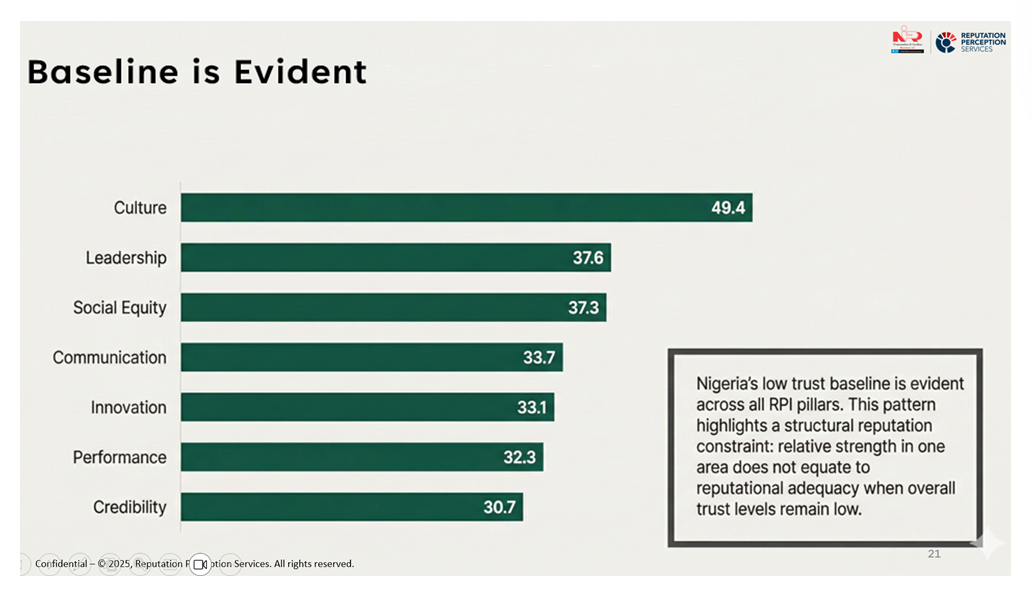
The data shows that Nigeria is highly visible but insufficiently trusted. We scored our highest marks in Culture (49.4).
The world consumes our Afrobeat, watches our Nollywood narratives, and respects our creative energy. Our “Soft Power” is firing on all cylinders.
However, reputation is a currency, and visibility alone does not buy trust.
Our lowest scores were recorded in Credibility (30.7) and Performance (32.3). This creates the “Trust Paradox.” International investors and global stakeholders view Nigeria through a “Risk-First” lens.
They see the undeniable talent and market potential, but they hesitate at the gate because the foundational signals of trust, policy consistency, institutional delivery, and narrative integrity, are weak.
In tech terms, our “hardware” (the people, the culture, the market size) is world-class, but our “software” (governance, credibility, and systems) is buggy.
The Innovation Gap: A Signal for the Tech Ecosystem
For the Techeconomy audience, the Innovation Pillar (33.1) offers a critical insight.
How can a nation known for its unicorns, fintech disruption, and resilient startups score so low on innovation? The answer lies in the attributes we measured. The RPI does not just measure “creativity”; it measures the enabling environment.
The data suggests that while Nigerian innovators are globally celebrated, the institutional framework is often perceived as a constraint rather than a catalyst. We are seen as innovating despite the system, not because of it.
For Nigeria to close this gap, policy must move at the speed of code. We need an environment where regulatory frameworks facilitate, rather than frustrate, the future.
The Strategic Mandate: From Image Making to Identity Management
So, how do we debug the system? The NRPI 2025 Report offers a data-backed roadmap:
- Fix the “Gatekeeper”: Credibility is the gateway to investment. We cannot “brand” our way out of a 30.7 score. Government communication must move from propaganda to verifiable facts. When we say we will deliver, we must deliver.
- Harmonize the Narrative: Our Communication score (33.7) suffers from fragmentation. We need a unified “API” for government information, one clear, consistent source of truth.
- Leverage Culture Strategically: We must stop treating Culture as just entertainment. It is our strongest diplomatic tool. We need to use the goodwill generated by our creatives to buy time for our institutions to repair their credibility.
Conclusion: The Era of Evidence
The release of this report is a milestone for the NIPR and for Nigeria. We have established a baseline. We know exactly where the “Reputation Tax” is being levied on our economy.
The choice is now ours. We can continue to manage our national narrative through guesswork, or we can use this evidence to build a more resilient, investable, and respected Nigeria.
The science of reputation is here. Let’s use it.
Download the full NRPI 2025 Report and explore the data here.
About the Author
*Dr. Celestine Achi is a Digital PR Strategist, AI Innovator, and the Lead Researcher for the Nigeria Reputation Perception Index (NRPI) 2025.