

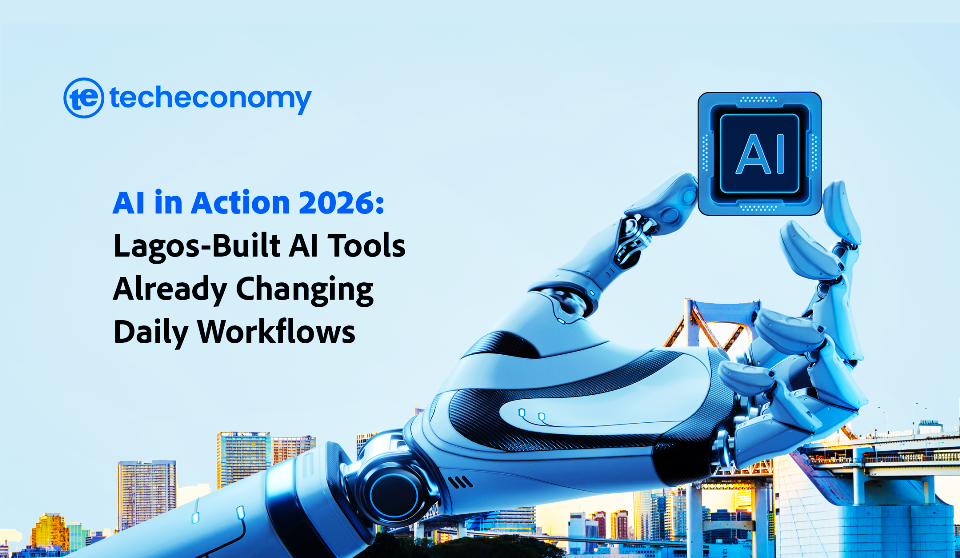
AI in Nigeria has evolved quickly from something people just talked about to tools that really help out in everyday tasks and routines.
In 2026, according to a recent survey made by Arion Research on behalf of Zoho, 93% of Nigerian companies use AI in some way, and companies that render financial services lead the adoption at 29%.
In Nigeria, Lagos stands out as the main economy hub where this shift to AI happens fastest, thanks to its growing startup ecosystem, the tech hubs like Yaba, and global partnerships.
In busy Lagos offices, artificial intelligence now takes care of repetitive tasks so that people can boost productivity by focusing more on the most important things.
These home-grown startups can save hours in high-pressure scenarios with tight deadlines. Also, fintech giants like Flutterwave now use AI for fraud detection, saving them extra time, effort, and money in a sector that handles millions of transactions every day.
The fast adoption of AI by organisations and AI startups in Lagos makes this city-state Africa’s testing ground for AI.
With over 600 tech startups and hubs, the city attracts talent and funding, turning ideas into important tools that work even though there are still local challenges like unstable internet and electricity.
Below, we highlighted some Lagos-built AI tools that fit key categories, with some details about how they work.
Customer Support, Accounting, and Chatbots for Banks, Fintechs, and SMEs
CDIAL.AI (now Indigenius AI):
Founded in 2021 in Lagos by Yinka Iyinolakan, this startup started CDIAL, which is an acronym for the Centre for the Digitization of Indigenous African Languages with a mission to break the language barriers of Nigerians using AI.
CDIAL.AI was built to make technology more accessible in African languages with low learning resources, focusing more on automatic speech recognition (ASR) and text-to-speech (TTS) for enterprise and creators. It proposes solutions such as multilingual keyboards and no-code APIs for customer interactions in Nigerian contexts, outperforming foreign made AI tools in local accent recognition.
In Lagos and Nigeria at large, the innovations created by this startup might potentially solve communication issues by supporting major languages like Yoruba, Hausa, Igbo, and Pidgin in chatbots for customer support, reducing response times by up to 70% for banks and SMEs through WhatsApp integration. Although this startup promises essential functions, there are still challenges that come with the Nigerian tech ecosystem including data scarcity for rare dialects, ethical concerns around consent for language data collection, and reliance on stable internet, which might reduce the adoption in rural areas.
Kudi.AI (now Nomba):
Kudi was founded in 2017 in Lagos by Yinka Adewale and Pelumi Aboluwarin, where it started as a chatbot made for financial requests to make transfers and payments easier.
Its main purpose is to provide accessible financial services to the unbanked population and has now evolved into an omnichannel platform that handles billions of dollars in transactions yearly from over 300,000 businesses.
In Nigeria, it solves query handling for fintechs through natural language processing, simplifying support without human intervention.
The limitations this startup faces include limited internet access for users, trust issues from older people in digital finance, and competition from larger industry players, potentially slowing growth in underserved areas.
Expense AI:
This Lagos-based AI tool was launched around 2024 with its primary focus on finance automation for SMEs. It is designed to simplify accounting in volatile markets using artificial intelligence for error detection and categorizing expenses. It proposes solutions like automated invoicing fused with Nigerian data patterns, eliminating the need for extra hiring and reducing overall cost.
The main limitations this new AI tool faces in Nigeria are the cost of cloud computing and the quality of data quality from informal economies.
HR Tasks Such as Recruitment, Screening, and Payroll Assistance
SeamlessHR:
Seamless HR was founded in 2018 in Lagos by Emmanuel Okeleji and Deji Lana, where it began as an HR software to help streamline hiring processes in Africa.
Its latest AI integration features help to optimize human capital with cloud-based tools compliant with local regulations.
In Nigeria, Seamless HR can solve hiring inefficiencies with AI screening, predicting fits and managing payroll, and speeding processes by up to 50%.
Some limitations that could hinder the growth of this startup include skills gaps for users, data privacy concerns, and expansion challenges because of Africa’s varying laws.
Intelia:
Founded in 2016 in Lagos, Intelia’s main focus is on data-oriented engineering for enterprises. It is a B2B startup. Their main purpose is to reduce the risks of software delivery with AI, including HR solutions just like Seamless HR.
Itelia addresses staff management in unstable economies in Africa through automated screening and augmentation.
Limitations that could hamper adoption in Nigeria are blockchain/AI expertise shortages, ethical standards in data use, and infrastructure problems like unstable electricity.
AI For Creators, Media, and Digital Entrepreneurs
Lagos’ creative scene now has AI tools that level the playing field for content makers and entrepreneurs. In a city where social media drives a major percentage of sales, these startups help small agencies compete globally.
Here are some key AI startups in Lagos trying to make an impact on the creator economy with homegrown tools.
Zummit Africa:
Zummit Africa was founded in 2021 in Lekki, Lagos, by Jonathan Enudeme, its main aim is to democratize AI education and solutions in Lagos and Nigeria at large by empowering Africans with AI skills through training and an API marketplace.
It also proposes custom models for content writing and analytics, well fitting for African markets. The potential limitations this startup might face include market size for revival of paused projects, skills gaps, and infrastructure problems.
Datalens Africa:
Datalens Africa was founded in 2025 in Lagos, and it specializes in data annotation for AI. It was created to provide high-quality datasets for AI models.
In media, this tool enables generative AI for insights and predicting trends on social media. Limitations to this tool are ethical data governance, quality assurance, competition from other startups, and scalability in Africa’s data-scarce digital ecosystem.
Intron:
Founded in 2020 in Lagos by Tobi Olatunji, Intron started with EHR software, but they later evolved to speech recognition.
Its purpose is to bridge the gaps in voice tech for African accents. It solves media production with APIs for voice-overs in local languages, and it is trained to support over 300 Sub-Saharan accents.
Challenges that could hinder the adoption of this software include training data needs, accent diversity challenges, and fraud risks from deepfakes.
Lagos-Built AI Startups for Healthcare
Lagos is emerging as a hub for AI-driven health solutions in Africa, addressing Nigeria’s core challenges like limited number of doctors, high maternal mortality rate, and poor access to healthcare in rural areas. Here are two good examples.
Ubenwa:
Ubenwa was founded in 2017 with strong Lagos operations and partnerships with hospitals like the Lagos University Teaching Hospital and Lagos State University Teaching Hospital. Ubenwa uses AI to analyze newborn cries for early detection of conditions like birth asphyxia and hypoxic-ischaemic encephalopathy (HIE).
Its main purpose is to save the lives of infants in settings with limited resources by turning cry sounds into diagnostic insights through machine learning algorithms trained on a large amount of data.
In Lagos and Nigeria, it can solve problems like delayed diagnosis in neonatal care, where asphyxia is a leading cause of death, by partnering with hospitals for clinical validation and by also creating smartphone apps and baby monitors.
This fits local realities like poor health facilities and lack of specialists.
Some challenges like the need for large, diverse datasets to avoid bias, regulatory approvals for medical devices, and high compute costs for model training still remain.
Also, infrastructure challenges such as scaling to low-connectivity areas despite mobile focus might hinder adoption in rural areas.
Famasi Africa:
Founded between 2021 and 2022, this Lagos based digital pharmacy uses AI to improve access to medication and delivery. Its core purpose is to digitize pharmacy operations, making it easier to locate, order, and receive medications while empowering local pharmacists.
In Nigeria, it solves the issue of poor access to original medicines, especially outside Lagos, through an AI “care assistant” for more personalized recommendations, inventory management, and streamlined delivery.
Famasi Africa joined Google’s AI-First Accelerator in 2023 to scale AI features like predictive logistics and patient support. This addresses local issues such as high costs, fake drugs and pharmacy operators, and also logistics problems in a city with poor traffic and power issues.
AI tools built in Lagos could expand to other African countries and beyond, with AI for health, education, and legal sectors growing. By the late 2020s, Lagos could export AI services, adding billions of dollars to GDP.
A recent study by CSEA projected that Nigeria’s AI market could reach $434.4 million in 2026 and this increase in revenue is mainly due to fast adoption and a growing demand for AI skills, with Lagos leading the wave in Nigeria.
Also, expect more industry-specific AI models like for Nigerian farming to dominate soon because most Nigerians are employed in the agricultural sector, and global partnerships like with NVIDIA.