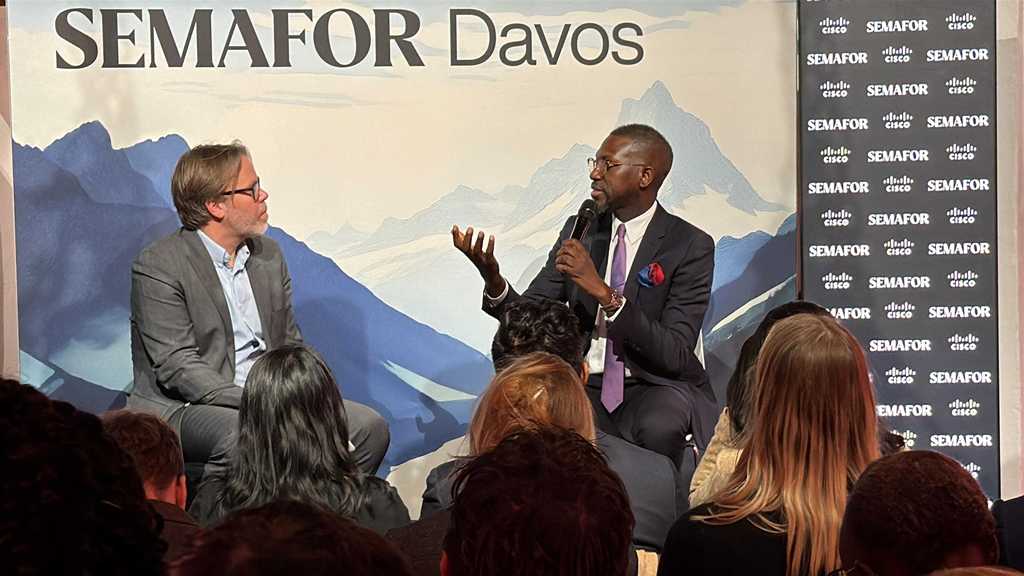
Olugbenga “GB” Agboola, Flutterwave founder and CEO, has defined stablecoins and open banking as the essential “operating system” for the next decade of growth across the Middle East and Africa (MEA).
Speaking on the sidelines of the 2026 World Economic Forum (WEF), he said that in a global economy projected to grow by just 3.1 percent, the Middle East and Africa face both a challenge and an opportunity.
Outperforming global peers will depend on building infrastructure that drives productivity at scale and delivers value across the region.
Speaking at Semafor’s Next 3 Billion event at Davos, Agboola elaborated on how Flutterwave is addressing this need. He highlighted the urgency of reducing friction in financial transactions and enabling seamless access to reliable data, positioning these rails as critical enablers for the region’s full participation in the global economy.
“Stablecoins and open banking are not abstract ideas; they are practical tools acting as the operating system for productivity at scale,” Agboola said.
He positioned Flutterwave’s recent acquisition of Mono, a leading open banking platform, as a foundational data layer for this new operating system.
By enabling secure, interoperable access to financial data, open banking allows lenders to make better decisions and businesses to build more tailored products.
Complementing this is an additional and faster movement of value. Agboola highlighted Flutterwave’s stablecoin infrastructure as key to transforming cross-border trade, noting its ability to slash settlement times from days to minutes.
“When settlement is instant and data is interoperable, innovation follows. That is how you move from exclusion to opportunity for the next three billion people,” Agboola added.
Agboola’s engagement at Davos aligns with Flutterwave’s broader focus on technical excellence as a driver of long-term economic output.
By investing in modern rails that cut settlement times and verify identity instantly, Flutterwave empowers enterprise merchants and small businesses, the backbone of Africa’s economy, to operate faster and more efficiently.
This creates new opportunities for businesses, individuals, and partners, ensuring the entire region can harness the benefits of these new economic realities and be fully integrated into the global economy.