
If there’s one thing Nigerians didn’t do in 2025, it was go offline. Despite a year marked by a 50% tariff hike and a currency that seemed to be in a permanent freefall, Nigeria’s digital appetite didn’t just survive, it became a feast.
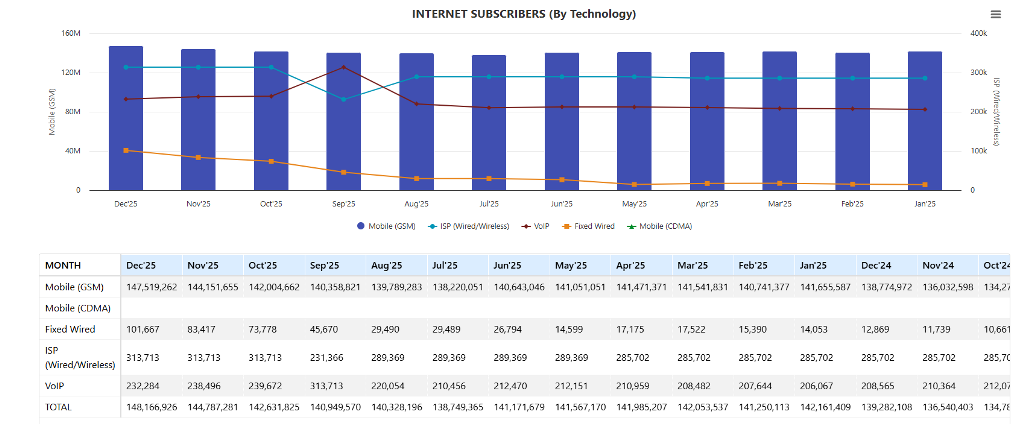
By December 2025, the country’s internet subscriber base hit a massive 148.2 million, according to the latest data from the Nigerian Communications Commission (NCC).
To put that in perspective: about 68.3% of the population is now tethered to the web. But while the numbers look great on a spreadsheet in Abuja, the reality on the streets of Lagos and Kano is a mix of high-speed dreams and “E no go” frustration.
The Numbers: A Duopoly’s Playground
The Nigerian telecom market has effectively hardened into a two-horse race. MTN and Airtel now control roughly 86% of the entire market, leaving the rest to scrap for the crumbs.
MTN remains the Goliath of the industry, but Airtel is the one with the spring in its step, adding a robust 1 million new subscribers in December alone. Meanwhile, Glo and 9mobile (now T2) are increasingly looking like legacy players in a world moving too fast for them.
Data is the New Oxygen, and it’s Getting Expensive
Nigerians didn’t just browse; they consumed. In 2025, total data usage skyrocketed to 13.25 million terabytes. That’s a 35% jump from 2024.
But this growth came at a steep price. Techeconomy’s analysis shows that Nigerians spent an average of ₦20.87 billion daily on data in 2025.
Annual spend hit ₦7.62 trillion ($5.58 billion), driven by the shift from ₦287 to ₦575 for the average gigabyte.
“Last December, the network got so bad I could not join most of my meetings. I lost workdays to network failure,” says Bankole Aliu, a Lagos-based lawyer.
Bankole isn’t alone. Despite the billions flowing into telco coffers, the user experience remains “vibes and God help me.”
Between January and August 2025, there were thousands of recorded fibre cuts, mostly due to road construction and vandalism, leaving millions of users digitally stranded for hours.
The Tech Gap: 4G is King, 5G is a Luxury
While we talk a lot about 5G, the real workhorse of the Nigerian internet is 4G LTE, which now commands 52.95% of the market.
4G (The Standard): 52.95% share. It’s the baseline for the “Zoom-and-TikTok” generation.
2G (The Survivor): 37.37%. Still holding on in rural areas where “H” or “E” on your phone is a way of life.
5G (The Promise): 3.77%. Growing, but still largely an urban elite flex, hampered by the high cost of compatible devices and limited base stations.
The Verdict: Connectivity vs. Quality
The NCC’s National Broadband Plan targeted 70% penetration by the end of 2025. We ended the year at 51.97%. We missed the mark, but we’re no longer gasping for breath underwater.
The telcos are back in the black, reporting profits after a brutal 2024. The government is happy because the ICT sector contributed ₦7.47 trillion to the GDP in Q3 alone.
But for the average Nigerian telecom subscriber, the question remains: When will the service quality finally match the price of the subscription?
In 2026, the focus will likely shift from just getting people online to keeping them there without the spinning wheel of death.
Until then, keep your power bank charged and your data balance monitored. It’s a wild digital world out there.