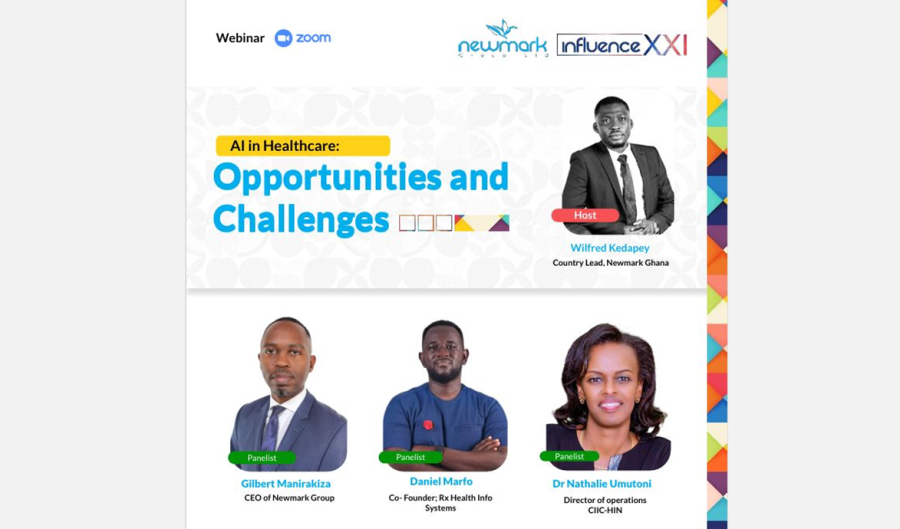
Medical and technology leaders across Africa have underscored the urgent need for custom-built artificial intelligence (AI) systems tailored to the continent’s healthcare realities, emphasising trust, data sovereignty, and clinical relevance as key drivers for adoption.
The call came during a high-level webinar organised by The Newmark Group on the theme “AI in Healthcare: Opportunities and Challenges”, where stakeholders highlighted both the transformative potential of AI in clinical settings and the limitations of importing generic models trained on non-African datasets.
AI: A Transformative Tool – If Rooted in Local Context
According to Mr. Daniel Marfo, co-founder of Rx Health Info Systems, AI’s ability to analyse complex medical data, from X-rays to CT scans, can significantly augment diagnostic capacity, especially in environments where radiologists and specialists are scarce.
He noted that many hospital management systems are now embedding AI tools that can process large volumes of claims and data, offering efficiency gains.
However, Marfo stressed that for AI to be truly effective and trusted, it must be built on locally relevant treatment protocols and clinical guidelines.
“Once AI systems are infused with knowledge bases tailored to African contexts, confidence grows, from ministries of health to medical teams, because the technology reflects how they work,” he said.
Operational Hurdles: Data Protection & Localised Training
Experts acknowledged operational challenges, particularly the need to train AI on local data and ensure stringent patient data protection.
Dr. Afriyie Karikari Bempah, founder of Aduro Analytics, highlighted that beyond reputational risk, mismanagement of sensitive health information can endanger lives.
Safeguarding patient rights and privacy, he argued, is essential before broader deployment can succeed.
Trust, Bias, and Africa-Centric AI
Echoing these concerns, Mr. Gilbert Manirakiza, CEO of The Newmark Group, argued that reliance on AI tools trained primarily on Western data introduces cultural, linguistic, and clinical biases that may undermine outcomes if not addressed. He made a strong case for custom-made AI platforms that are trained on African languages, treatment patterns, and health system structures to mitigate bias and build trust among users.
“Bias is not just a technical problem, in healthcare, when AI gets communication wrong, the consequences can be human, not just reputational,” Manirakiza said, reinforcing the view that homegrown AI is essential for patient safety and system credibility.
Looking Ahead: Policy, Data and Local Innovation
While enthusiasm for AI’s potential in African healthcare continues to grow, experts emphasise that success hinges on local data ecosystems, privacy protections, and policy frameworks that support confidential, ethical use of AI. Without these foundations, adoption risks being superficial, or worse, harmful.
The consensus from the webinar, and emerging discourse across the continent, is clear: AI in African healthcare must be African-centred.
This means building systems that understand local diseases, languages, workflows, and ethical norms, ensuring that technology enhances, rather than replaces, the human judgement at the heart of quality care.