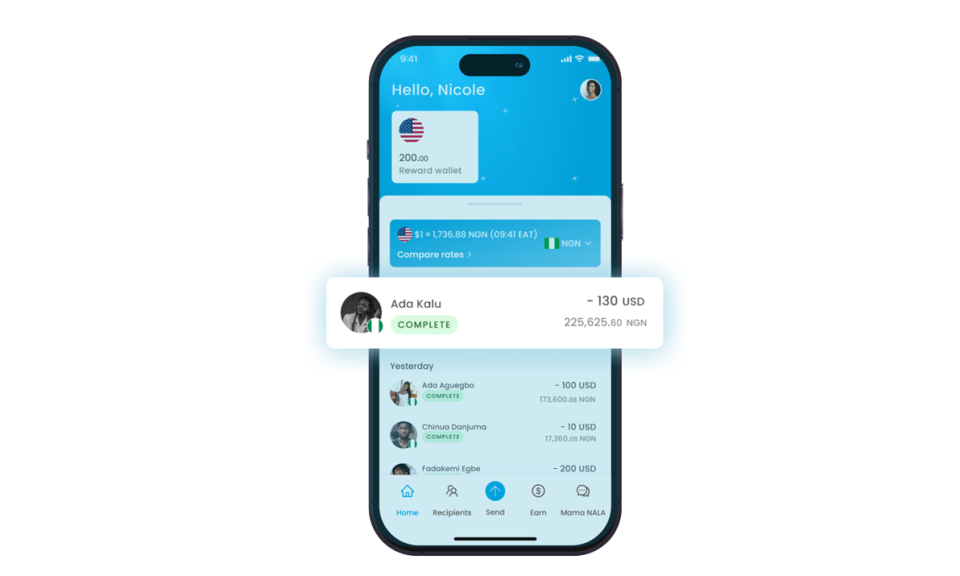
The Central Bank of Nigeria (CBN) has granted an International Money Transfer Operator (IMTO) licence to NALA, a global payments company.
Seeking to improve how Nigerians abroad send money home, the approval allows NALA to plug directly into the Nigeria Inter-Bank Settlement System (NIBSS).
This removes the need to route transactions through intermediary banks, a process that usually slows transfers and adds extra expenses.
Speaking at a briefing in Lagos, Nicolai Eddy, NALA’s co-founder and chief operating officer, described Nigeria as central to the company’s growth plans in Africa.
“Nigeria is one of our largest markets on the continent. With this licence, we can ensure that money reaches families, businesses and institutions quickly and reliably,” he said.
Until now, many cross-border transfers passed through multiple financial institutions before reaching recipients, with each layer taking a fee.
Direct integration with NIBSS removes that chain, allowing funds to move more efficiently into Nigerian bank accounts.
Eddy said the licence also ensures compliance with CBN regulations while enabling faster and more cost-effective transfers from key corridors such as the UK, United States and Europe.
The expected impact includes:
- Faster transfers: Funds can arrive in Nigerian accounts within minutes
- Lower fees: Fewer intermediaries reduce transaction costs
- Improved reliability: The company is targeting a 99.9% success rate
Nigeria is one of the largest recipients of diaspora remittances in Africa, with official inflows estimated at about $23 billion annually.
Reports, however, say the true figure could be higher when informal channels are included.
Brian Edwards, NALA’s country manager for West Africa, said a key objective is to bring more of these flows into formal, regulated channels.
“The official numbers are strong, but a large volume still moves through informal routes. Our goal is to provide a trusted alternative that is transparent and secure,” he said.
He also addressed a common concern among senders, noting that remittances sent through licensed IMTOs are not subject to tax in Nigeria.
Expanding Beyond Personal Transfers
NALA is also targeting business transactions through its B2B platform, Rafiki. The service allows global firms and remittance providers, including partners such as MoneyGram, to use NALA’s infrastructure to move funds into African markets more efficiently.
This positions the company both as a consumer remittance app, and as a backend provider for cross-border payments at scale.
Transparency as a Selling Point
One of NALA’s distinguishing features is price visibility. The platform shows users how its rates compare with competitors in real time, allowing them to choose the best available option.
The company says this approach is aimed at building trust with diaspora users who are usually sensitive to exchange rates and hidden charges.
Implications for Nigeria’s Economy
Increased use of licensed IMTOs will enhance convenience for senders in Nigeria, and higher inflows through official channels can strengthen foreign exchange liquidity, support the naira and improve transparency in the financial system.
With more fintech firms securing regulatory approvals and investing in payment infrastructure, the long wait times and uncertainty that once affected cross-border transfers are gradually fading.