
Nigeria has a population of over 240 million but fewer than 250,000 registered “.ng” domain names, a gap that shows how little the country controls its own digital identity.
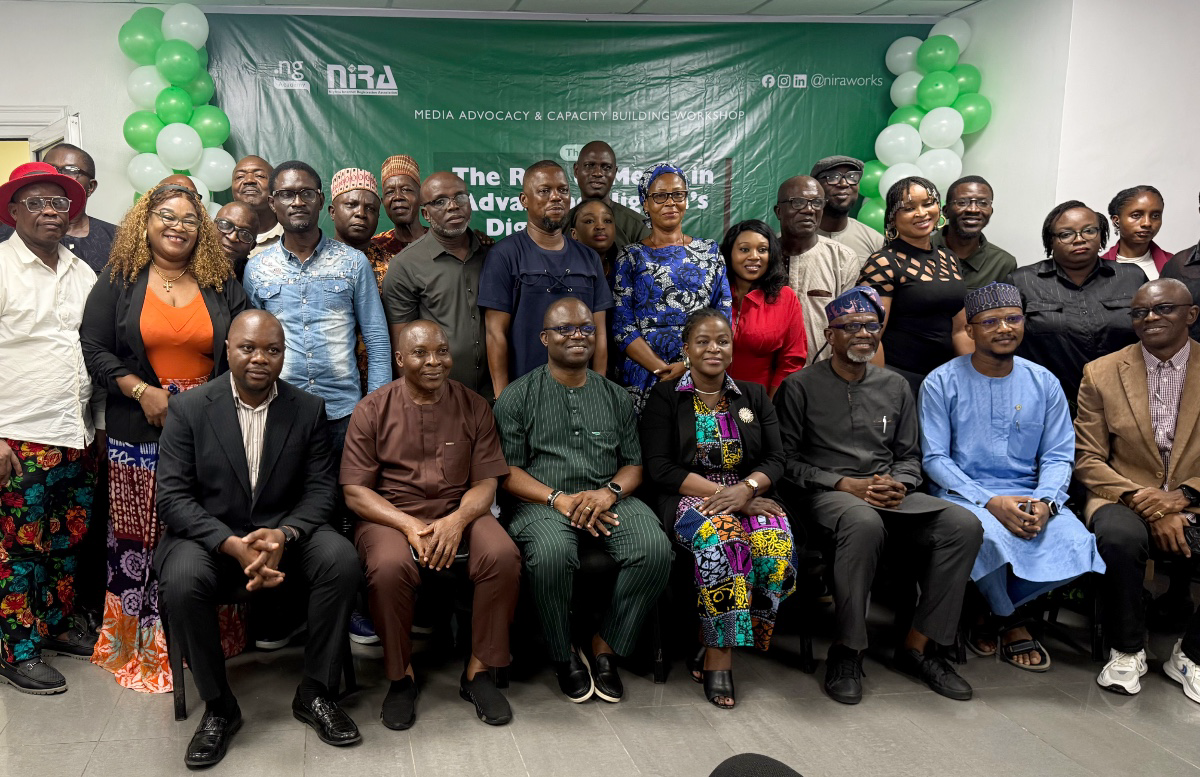
The issue came into focus at a Media Advocacy and Capacity Building Workshop organised by the Nigeria Internet Registration Association (NiRA) in collaboration with the Nigeria Information Technology Reporters Association (NITRA), where journalists gathered under the theme “The Role of Media in Advancing Nigeria’s Digital Identity.”
In his opening remarks, Adesola Akinsanya, NiRA president, said the engagement aimed to strengthen collaboration with the media on digital identity awareness.
He described the session as a “handshake” between NiRA and journalists, stressing that the partnership is essential to growing Nigeria’s digital presence.
“I would like to begin with a critical question that should frame our engagement today: who truly owns Nigeria’s digital identity? Is it shaped by the platforms we use, the domains we register, or the narratives we amplify?” he said.
“The reality is that digital identity is neither accidental nor passive, it is deliberately constructed, and increasingly, it is contested. In this context, your role as journalists and media professionals becomes not just relevant, but strategic.”
The president encouraged participants to see themselves as active stakeholders in national development, urging a more patriotic approach to digital identity. “We should be seen doing it to be patriotic and to move this country forward.”
Speaking at the session, Adebiyi Oladipo, vice chair, ICANN ccNSO, also a researcher and lecturer said the issue goes beyond technology and shows how Nigeria values its own digital space.
“This is not about NiRA, this is about Nigeria,” he said.
He compared Nigeria with other countries, pointing to wide gaps between population size and the number of registered country-code domains.
China, with over 1.4 billion people, has about 21 million domain names. Germany, with 83.6 million people, has more than 17 million. The Netherlands, with just 18.4 million people, holds about 6.3 million domains.
Nigeria, by contrast, has only about 240,000.
The difference becomes apparent when measured per population. Germany has more than 200 domains per 1,000 people. The Netherlands records over 300. Nigeria stands at less than one.
“I find it really absurd that a country of over 200 million people we are struggling with 240,000 domain names,” Oladipo said.
A stronger economic framing came from Oluwaseyi Onasanya, COO of NiRA, who said the “.ng” domain is not a technical product but a national critical asset tied directly to economic survival and sovereignty.
“.ng is not a technical tool, but a national critical asset. It is the bedrock of a digital economy,” she said.
She warned that every time a Nigerian business chooses a foreign domain, the country loses part of its digital economic value.
“What that means is that we are taking out a significant part of our digital economy offshore,” she said.
Oladipo said Nigeria is failing to treat “.ng” as a national asset. Instead, many businesses prefer foreign domains, especially “.com”.
“When you choose .com, you are pushing the value away from our environment,” he said.
He described domain names as economic assets rather than technical tools, comparing them to land in real estate.
“The domain is not a technical asset. It’s an economic asset, because you can make money from it,” he said.
He added that the opportunity extends across a value chain, from domain registration to website development, digital marketing and online business growth.
Oladipo also addressed perception challenges, noting that many Nigerians wrongly believe local domains are less secure, even though infrastructure matches global standards.
“Everything that exists with .com exists with us,” he said.
He linked the slow adoption to mistrust and poor information, warning that false narratives can shape public opinion.
“There’s a lot of fragility around online credibility,” he said, referring to a recent fake video that falsely claimed an attack in Abuja.
He placed responsibility on the media to correct misinformation and promote local digital identity.
“Nobody is going to tell your story like you,” he said.
Onasanya stressed that the issue is not perception alone but structural economic leakage, explaining that foreign domain use results in capital flight as payments leave the country in foreign currency.
“Every foreign domain is a capital flight,” she said, noting that even small annual fees multiply into significant national losses when scaled across businesses.
Oladipo urged journalists to go beyond reporting startups and fintech, stressing that the domain system is the foundation those industries depend on.
“It’s akin to celebrating the house but ignoring the land,” he said.
He called on media professionals to act as educators, amplifiers and trust builders by explaining digital identity issues, promoting Nigerian platforms and calling out fraud.
He also urged organisations and individuals to adopt “.ng” domains for their platforms.
“For those who are not, switch to .ng,” he said.
Onasanya said policy intervention is critical to improving adoption, urging stronger government intervention through legislation, executive orders, and institutional enforcement.
She proposed that “.ng” should be mandatory for government communication, licensing, and procurement processes, and called for alignment with national identity systems such as the Corporate Affairs Commission (CAC).
Without stronger policy backing, she warned, adoption would remain slow. “Adoption is not luck, it is not by chance, it is driven by policy,” she said.
Despite the gap, Oladipo said the situation is not beyond repair, noting that the digital economy already contributes more than 20% to Nigeria’s GDP and continues to grow.
“There are endless possibilities for us,” he said.
He ended by challenging the media to take the lead in changing perception and driving adoption.
“Will you lead or will you follow?” he asked.