

ADVERTISEMENT
Saturday, April 18, 2026
Tech | Business | Economy
No Result
View All Result
  • Technology
    • Trends
    • Telecoms
      • Broadband
    • ConsumerTech
      • Gadgets and Appliances
      • Apps
      • Accessories
      • Reviews
      • Unboxing
    • EnterpriseTECH
    • Security & Data Protection
    • How To
    • GameTech
  • Business
    • Company News
    • StartUPs
      • Founder’s Story
      • Funding
    • Deals
    • People & Moves
    • SME & Entrepreneur Focus
      • BUSINESS SENSE FOR SMEs
    • Competition & Market Positioning
    • Commerce & Mobility
    • Travel
    • WomenPreneurs
  • Economy
    • Macroeconomic Trends
      • Macro Monday
      • TE Insights
    • Finance
      • Banks
      • Fintech
      • Insurance
      • Digital Assets
      • Personal Finance
    • Policies
      • Tech & Society
    • Market Analysis
    • Jobs & Workforce Economy
  • Features
    • Guest Writer
      • Chidiverse
      • Digital Assets
    • EventDIARY
    • IndustryINFLUENCERS
    • MarkTECH
    • TBS
    • NewsEXTRA
  • Editorial
  • Brand Content
  • TECHECONOMY TV
Saturday, April 18, 2026
Tech | Business | Economy
No Result
View All Result
Tech | Business | Economy
No Result
View All Result

Home » How Starlink-Kuiper Competition Could Benefit Nigerian Users

How Starlink-Kuiper Competition Could Benefit Nigerian Users

On the ocassion of International Day of Human Space Flight, we looked at how Starlink-Kuiper competition could benefit Nigerian users

Ethan Ebenezar by Ethan Ebenezar
April 18, 2026
in Telecoms
Reading Time: 3 mins read
0
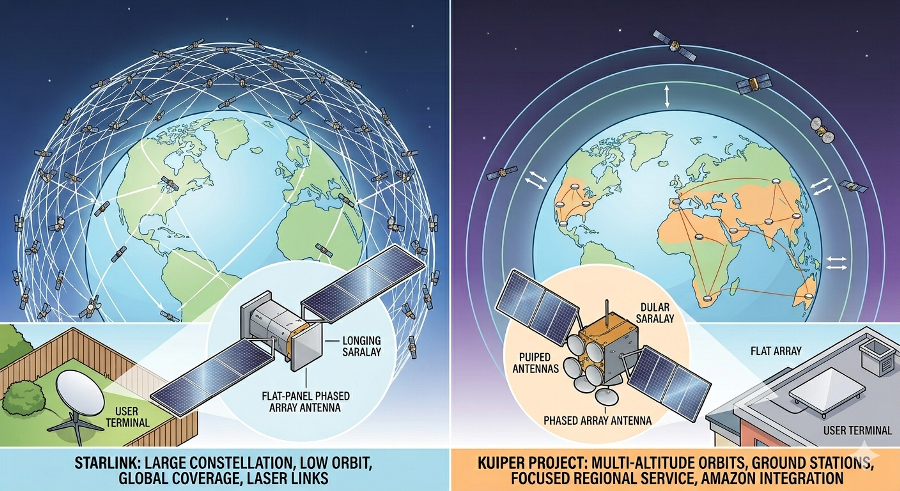
Starlink and Amazon Kuiper Project

Starlink vs Amazon Kuiper Project

The International Day of Human Space Flight was marked on April 12, commemorating the first human journey into space by Yuri Gagarin aboard the Vostok 1.

While the day is global in scope, its relevance is growing in Nigeria, where satellite internet is gaining ground as an alternative to traditional connectivity.

Nigeria’s own satellite journey has evolved steadily. In 2011, when the United Nations officially recognised April 12, the country strengthened it’s space infrastructure with launches including NigComSat-1R, designed to replace NigComSat- 1.

Since then, satellite internet has expanded, though it is still expensive for many users. Early entrants such as Spectranet and SpaceX’s Starlink helped introduce the market, particularly in underserved areas.

With the Nigerian Communications Commission (NCC) granting an operation licence to Amazon Kuiper Project this year (2026), another global company has entered the race to make satellite connectivity more widespread in Nigeria, and just like that satellite connectivity is slowly becoming a more mainstream alternative to traditional network providers.

Subscribe to our Telegram channel for the latest updates.

Follow the latest developments with instant alerts on breaking news, top stories, and trending headlines.

Join Channel

Now, Starlink, which grew by over 110% since 2023 now has a new competitor in its Internet market niche, and Nigerian consumers are eager to compare which gives them more value for their money.

Starlink vs Project Kuiper

Both Starlink and Amazon Kuiper Project have their unique upsides and disadvantages. But while Starlink has the advantage of being a pioneer in Nigeria’s space connectivity market, Kuiper is entering with scale, pricing and ecosystem leverage that could disrupt the market quickly.

The first metric to examine is the strategy of both companies. Starlink’s core strategy has always been a direct–to-consumer approach, which has enabled it to capture a good portion of the market. While Amazon Kuiper LEO satellites appear to be more ecosystem-driven, with easy integration with AWS, Prime, and Amazon.

This ecosystem advantage of Amazon Kuiper gives them better adoption opportunities, especially as AWS holds approximately 11.7% of Nigeria’s cloud computing market.

Also, satellite hardware from the Amazon Kuiper Project is much smaller and cheaper than Starlink’s standard-sized dish. Although they are smaller in size, the Amazon Kuiper dishes can handle up to 400 Mbps, a far cry from Starlink’s 100-200 Mbps network speed.

Starlink:

  • Speed up to 150–250 Mbps
  • Standard satellite dish and hardware (prices stabilised in 2026)
  • Direct-to-consumer strategy

Amazon Kuiper Project:

  • Speed up to 400 Mbps
  • Smaller, mass-market dish and hardware (expected to be cheaper)
  • Ecosystem-driven (Amazon, AWS, Prime)
  • Likely partnerships with MTN, Airtel

Amazon’s biggest selling point is simple: making the entry point cheaper, especially for emerging markets like Nigeria. While Starlink benefited from being a market pioneer.

By designing smaller and more affordable terminals, Kuiper aims to reduce Starlink’s upfront hardware cost, which has always been the biggest barrier for Nigerian users.

Altogether, both Starlink and Amazon’s Kuiper Project are developing projects that allow ordinary smartphones to connect to satellites directly without any need for an attached dish. This simply means, no extra cost for installation and no special equipment, while undeserved areas in Nigeria receive instant connectivity.

The NCC’s support for satellite services aligns with a goal to bridge the internet connectivity gap in Nigeria and this is the bigger picture.

Satellite connectivity is not just about the speed, fibre optic cables are still much faster, depending on latency.

The major selling point is access. It’s about connecting rural schools and businesses, and ensuring that location does not determine opportunity.

With the competition, the real winners are the average users because it will promote affordability and good service delivery while covering more areas than before.


0Shares

Previous Post

FCCPC Denies Ban on Airtime Borrowing after MTN, Airtel Suspensions

Next Post

Best Camera Phones in 2026: Why 200MP is No Longer Just a Spec

Ethan Ebenezar

Ethan Ebenezar

Related Posts

Airtime Borrowing Service

MTN Halts Airtime Borrowing Service Due of FCCPC Rules

April 16, 2026
Veolia Data Center

Veolia Targets €1bn Clean Tech Revenue from Data Centres, Chip Production by 2030

April 16, 2026

Amazon to Acquire Globalstar in $11.57bn Deal to Boost Satellite Network

April 15, 2026
Load More
Next Post
2026 best camera phones

Best Camera Phones in 2026: Why 200MP is No Longer Just a Spec

Leave a Reply Cancel reply

Your email address will not be published. Required fields are marked *

I agree to the Terms & Conditions and Privacy Policy.

This site uses Akismet to reduce spam. Learn how your comment data is processed.

Techeconomy Podcast
Techeconomy Podcast

The Techeconomy Podcast is a thought-leadership show exploring the powerful intersection of technology, business, and the economy, with a strong focus on Africa’s fast-evolving digital landscape.

BUILDING TRUST IN AFRICA ECOSYSTEM
byTecheconomy

Africa’s digital economy is growing fast, but growth without trust cannot last.Join us for the February Edition of the Techeconomy Business Series as industry experts explore how trust, security, innovation, and user experience are shaping Africa’s evolving digital ecosystem.

BUILDING TRUST IN AFRICA ECOSYSTEM
February 27, 2026
Techeconomy
Navigating a Career in Tech Sales
January 29, 2026
Techeconomy
How Technology is Transforming Education, Health, and Business
November 27, 2025
Techeconomy
INNOVATION IN MOBILE BANKING
October 30, 2025
Techeconomy
The Rise of AI: Impact on Jobs & Businesses
September 25, 2025
Techeconomy
Search Results placeholder
  • About Us
  • Careers
  • Contact Us

© 2026 TECHECONOMY.

No Result
View All Result
  • Technology
  • Business
  • Economy
  • Features
  • Editorial
  • Brand Content
  • TECHECONOMY TV

© 2026 TECHECONOMY.

This website uses cookies. By continuing to use this website you are giving consent to cookies being used. Visit our Privacy and Cookie Policy.