The global economy could follow markedly different paths over the next 25 years. For business leaders, the challenge is how to make decisions today while preparing for a wide range of possible futures.
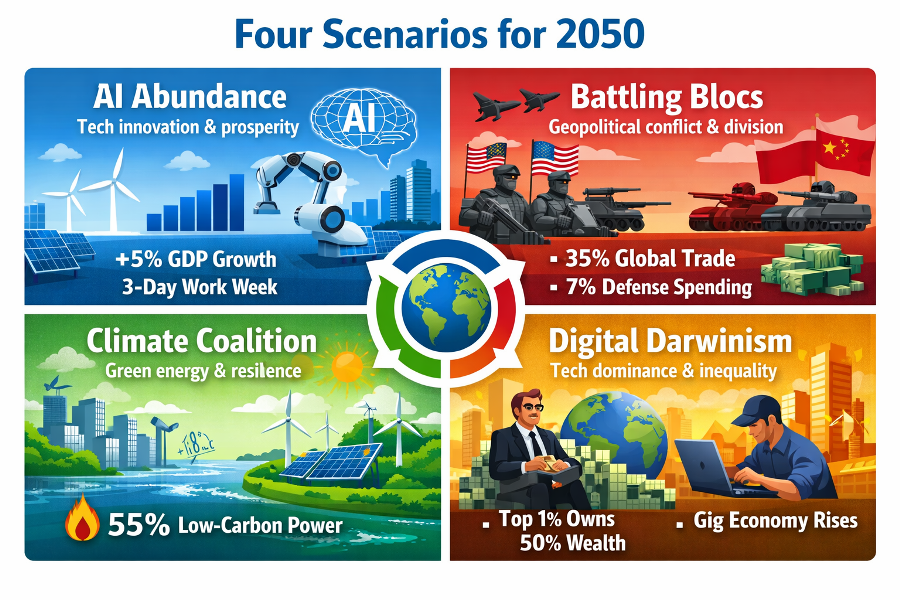
New Scenarios 2050 research from the BCG Henderson Institute (BHI), Boston Consulting Group’s think tank, anticipates four distinct futures that push boundaries but remain plausible.
The report explores what each scenario could mean for businesses and how early signals may indicate which direction the world is heading.
Among the findings:
- Global GDP growth could slow to about 1.8% or rise to 5.0% annually, with the economy reaching anywhere from 1.6 to 3.4 times today’s size.
- Global trade could fall to about 35% of GDP – roughly Cold War–era levels – or remain near current levels of about 60%.
- Defense spending could climb to as much as 7% of global GDP.
- Low-carbon electricity could account for 55% to 90% of power generation.
The report, Beyond Tomorrow: Four Scenarios for the World of 2050, is based on a century of historical data and analysis of more than 100 megatrends across technology, geopolitics, climate, society, and economics.
“The decisions made in the next 5 years will shape the next 25,” said Nikolaus Lang, global leader of the BCG Henderson Institute and a coauthor of the report. “Too often, the future is framed in extremes – either collapse or abundance. In reality, leaders need to be ready for a range of outcomes and make decisions that hold up across very different conditions.”
Four Plausible Futures Leaders Should Plan For
Each scenario presents a different operating environment for businesses, reflecting the range of conditions leaders may face.
Scenario 1: AI Abundance. Global cooperation on AI standards leads to faster productivity growth, wider access to technology, and abundant low-carbon energy:
- Global GDP more than triples, growing by about 5% annually from 2025 to 2050 – the highest level across BHI’s four plausible scenarios.
- Average working hours fall by about 25%, with four- or even three-day workweeks becoming common in some regions.
- AI-supported advances in new materials and carbon removal put the world on a delayed but credible path to net zero emissions.
Scenario 2: Battling Blocs. Geopolitical tensions divide the world into competing blocs, reducing cooperation and reshaping global trade:
- Global trade falls to about 35% of global GDP, down from 57% in 2024 – reversing decades of globalization.
- Defense spending rises to about 7% of global GDP, the highest across BHI’s four scenarios, as countries prioritize security and self-sufficiency.
- Global GDP growth slows to about 1.8% annually, the lowest across the four scenarios, underpinned by government spending on national security, pensions, and climate mitigation.
Scenario 3: Climate Coalition. A series of extreme weather events in the late 2020s push governments, industries, and consumers to prioritize climate resilience, accelerating the shift to low-carbon energy and infrastructure:
- Global warming stabilizes at about 1.8°C.
- Carbon markets expand globally, with most major economies participating by 2040.
- The share of fossil fuels in the energy mix falls from 81% today to 35% in 2050, while electricity is generated almost entirely from low-carbon sources.
- Global GDP growth averages about 2.5% annually, reflecting a focus on the climate transition, slower population growth, and aging societies.
Scenario 4: Digital Darwinism. Rapid technological progress continues under limited regulation, driving strong growth while concentrating wealth and power among leading companies and tech-rich nations:
- Global GDP grows at 4% per year, resulting in a near tripling of GDP.
- The richest 1% holds nearly half of global wealth, while the middle class continues to shrink.
- Gig-style and short-term contract work expands as AI and automation displace routine knowledge work.
- Defense spending rises to about 4% of GDP, up from 2.4% in 2024, as the global order becomes more fragmented. At the same time, global trade and supply chains remain open, driven by commercial interests.
What Leaders Can Do Now
Across all four scenarios, the report highlights “low regret” moves that make sense for business leaders today, including:
- Enhance structural resilience.Rebalance toward resilience over efficiency to maintain operations in a more volatile environment.
- Reimagine talent for aging populations and AI.Build strategies for intergenerational work, more flexible roles, and talent mobility—and recruit more widely, especially from emerging labor markets.
- Build digital flexibility and trust. Take a modular approach to tech and data stacks that accounts for rapidly changing technologies.
- Sharpen sensing and influencing capabilities.Develop sensing capacities along dimensions like regulation, geopolitics, resources, and technology. Build the capability to act on them quickly.
- Embrace a broader societal role. Prepare to shoulder more responsibility for workers’ well-being, local resilience, crisis management, and community needs.
“No one can predict exactly what 2050 will look like, but the forces shaping it are already visible,” said Alan Iny, a partner and director at BCG, a BCG Henderson Institute Fellow, and a coauthor of the report. “Planning for a single future is a gamble. The advantage will go to leaders who prepare for multiple futures and act to shape them before the direction of the world is clear.”