
Just days before the highly Google I/O event May, Google is already making interesting announcements in AI hardware.
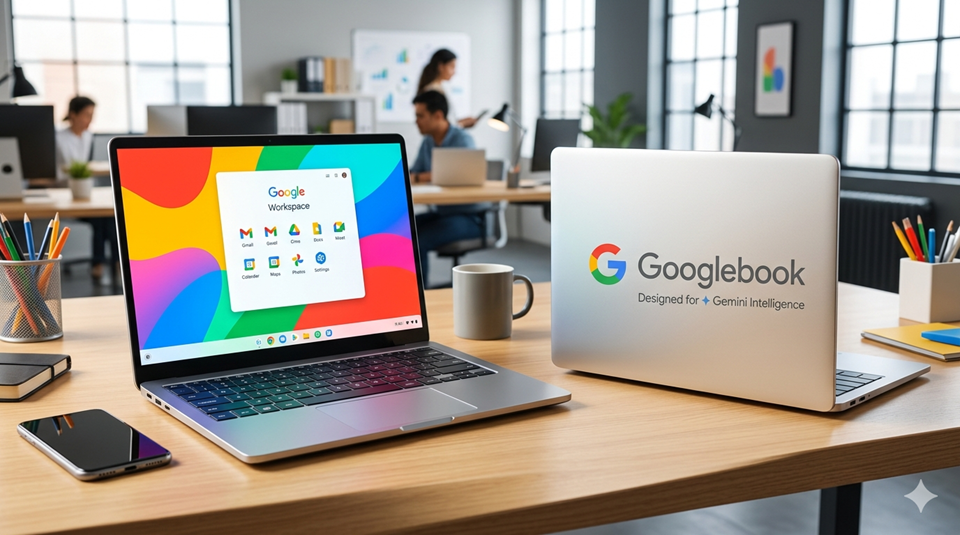
While many expected the spotlight to remain fully on Gemini and Android 17, the company has surprised the tech space with the announcement of the “Googlebook”.
Fifteen years back, Google partnered with laptop manufacturers like Acer, HP, Asus and Lenovo to launch Chromebooks into schools, offices and the general budget market. The idea was to create a simple and lightweight laptop that is built around the Web, instead of heavy desktop software.
Now in 2026, they are revisiting this same strategy, but this time, AI sits at the centre of the experience instead of just the browser.
The Googlebook is not just another Chromebook but with Gemini integrated. According to Google, they are positioning this as an AI-native device, that combines the strengths of Android and ChromeOS.
Intentions Behind the Googlebook
What makes it more interesting is the Chromebook direction Google seems to be taking. Chromebooks were designed to be fast affordable and minimalistic. From information around the Googlebook, it also appears to continue that simplicity, but with “extra wings”.
Features like the new Magic Pointer, a feature built by the DeepMind Team, allow the cursor itself to understand context on the screen and even make meaningful suggestions.
According to the press release from Google, the Googlebook is going to be heavily optimised for the Android ecosystem, because of the massive userbase and adoption on the laptop form. However, it might not be exactly an Android OS. According to Alex Kuscher, the Senior Director for Laptops and Tablets:
“We’re bringing together the best of Android, which comes with powerful apps on Google Play and a modern OS that’s designed for Intelligence, and ChromeOS, which comes with the world’s most popular browser. The result is Googlebook: a new category of laptops built with Gemini’s helpfulness at its core…”
This suggests that Googlebooks might just be an AI “bridge” between the Android ecosystem and ChromeOS.
What Problems Will Googlebooks Likely or Not Likely Solve?
Chromebooks were cloud-first laptops. Googlebooks appear to be AI-first laptops. This difference matters. But main question now is what problems this device category will solve.
For students or casual users, Googlebooks could be one of the smartest productivity laptops they can easily get. Fast booting, light software, Android app compatibility and Gemini assistance could easily make tasks like writing, research, multitasking and media consumption better than before.
For professionals, Googlebooks may also try to be an alternative to Microsoft’s Copilot or Apples AI-focused Macbook models. Especially now that Gemini is becoming a core function of Android, Chrome and Google Workspace, but there are still areas where it will struggle to perform well.
Heavy creative tasks like video editing, 3D rendering and professional software development will still most likely favour Windows laptops and MacBooks unless Google seriously upgrades performance and app optimisation. Some early reactions online are also sceptical about whether users really want AI integrated into every part of their laptop experience.
Google has not officially confirmed hardware specifications like the chipset yet, but might utilise the Google-designed Tensor chips. For other hardware components, Google mentioned that they are currently collaborating with big laptop brands like HP, Lenovo and Asus to make sure Googlebooks are built with premium craftsmanship and materials, coming in different designs.
Pricing might end up deciding the failure or success of this new idea. Chromebooks were popular because they were affordable, simple and practical, but if Googlebooks are expensive premium AI devices, they might risk losing the very market that made Chromebooks popular.
Microsoft is already pushing AI deeply into the Windows ecosystem with Copilot PCs.
Apple is also evolving to serve more users with budget-focused MacBooks like the “MacBook Neo” while quietly expanding Apple Intelligence.
Now Google is responding with something that sits between lightweight like a Chromebook, but intelligent like an AI workstation.