


For years, the Nigerian smartphone market has been controlled by the affordability factor first, and others second.
This is exactly why brands like TECNO, Infinix, itel and now, Samsung understand, and have become household names across Africa.
Now another company wants a piece of this fast-rising market.
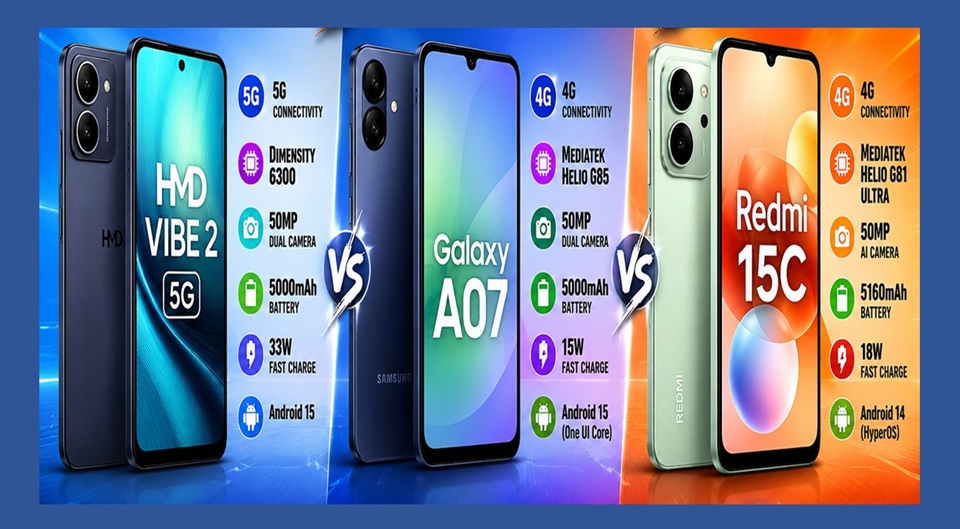
In an attempt to attract more users from emerging economies, Finnish smartphone brand HMD has begun the official rollout of the new HMD Vibe 2 5G, a budget-class device designed for affordability and efficiency.
HMD sounds new but it’s very relatable. After the collapse of the Nokia-Microsoft partnership, Nokia decided to save its brand by partnering with HMD to make Nokia phones while also expanding the HMD name too.
Since then, HMD has become the biggest smartphone manufacturer in Europe, and now the company wants a piece of the African and Indian smartphone market. But it won’t be easy.
Already established brands are already catering for the market, and penetrating might need a big push. Meanwhile, Samsung’s Galaxy A07 has become one of 2026’s bestsellers and Xiaomi’s Redmi 15C is very popular among Nigerian youths, especially in universities.
So the big question is, can the new HMD actually compete with these budget-friendly alternatives, or will it just be another commercial failure?
Display and Size Comparison
- Redmi 15C:8-inch display, HD+ resolution, 120Hz refresh rate, Punch-hole design.
- Galaxy A07:7-inch display, HD+ resolution, 90Hz refresh rate, Waterdrop notch.
- HMD vibe 2 5G:7-inch display, HD+ resolution, 120Hz refresh rate, Slim bezel design, Side fingerprint scanner
The first thing a Nigerian buyer observes in a phone is the design and display. It’s large enough for multimedia and social media consumption or good enough for games and online classes.
The HMD actually competes well with good size, and refresh rate, while looking slim and aesthetic. Samsung, though with the lesser refresh rate among the three, still continues Samsung’s tradition of durability and display balance. While the Redmi 15C offers the best display specs here, with a bigger screen, 120Hz refresh rate and higher screen resolution.
Battery and Charging Comparison
- Redmi 15C: 6,000mAh battery supporting 33W fast charging
- Samsung Galaxy A07: 5,000mAh battery with 25W charging
- HMD vibe 2 5G: 6000mAh with 18W charging
In Nigeria, it’s no news that battery performance is optimal, especially when choosing a phone. A phone that cannot survive a full day or even more without being affected by power outages is difficult to recommend in this part of the world.
Apparently, HMD seems to understand this reality beforehand. With a bigger battery than the Galaxy A07, the HMD vibe 2 5G focuses on power efficiency, along with battery optimisation with low power consumption software running in the background.
However, the Redmi 15C may attract more attention because Xiaomi is known for combining massive batteries with fast charging speeds unlike other budget brands. Still charging speed alone does not determine a better experience.
Thermal management, battery lifespan and software optimisation matter too. This is where Samsung leads.
Chipset and Connectivity Comparison
- Redmi 15C: MediaTek Helio G81 chipset, 4G connectivity, HyperOS software
- Galaxy A07: MediaTek Helio G99 chipset, 4G connectivity, OneUI software
- HMD vibe 2 5G: Snapdragon 4 Gen chipset, 5G connectivity, Stock Android experience
The HMD vibe 2 5G is entering the market at a period where 5G connectivity is becoming mainstream globally, even though the infrastructure is still developing slowly in Nigeria. So, by adding 5G to its branding, it gives it a future-proof appeal.
For processing speed, the HMD’s 5G Unisoc T8200 is decent for everyday performance, ranging from social media to limited multitasking, but heavy functions like gaming might demand more. Meanwhile, the Galaxy A07 is the best here for a balanced performance.
Although not a 5G chip, the Helio G99 is focused mostly on stability and is optimised for consistency and longer software support, unlike the rebranded Unisoc T765 chip on the HMD.
The Redmi also offers a great performance for everyday use. Xiaomi is known for this. The processor, the Redmi 15C works with other specs on the device to deliver fair enough gaming performance and some multitasking.
Camera Comparison
- Redmi 15C: 50MP dual AI main camera, 8MP front camera. Sharper contrast-heavy photos, AI enhancement modes
- HMD vibe 2 5G: 50MP main camera, AI photography features, Clean image processing
- Galaxy A07: 50MP main camera, Samsung image optimisation, Balanced colour processing
All three phones come with similar camera hardware. But the software approach is different.
Samsung focuses on natural balance on the A07, Redmi 15C comes with more vibrant and aggressive image processing, while HMD aims for cleaner and more natural photography output.
Price Comparison
At less than N200,000 naira (sub $150), these phones are ideal for users with a limited budget but who want satisfactory performance. You can get any of them for between N150K – N200K depending on the configuration (4GB/6GB RAM, 64GB/128GB ROM).
- Galaxy A07: N143K – N189K
- Redmi 15C: N150K – 190K
- HMD vibe 2 5G: N150K – N200K
Samsung continues benefiting from higher brand trust and resale value. Redmi remains one of the most aggressive brands for budget pricing, especially among younger Nigerian buyers.
For HMD, their success will depend mainly on whether the company prices the Vibe 2 5G aggressively enough to compete with Xiaomi, TECNO and Samsung.
The new HMD Vibe 2 5G is launching globally at a very difficult time. The Samsung Galaxy A07 still offers stronger mainstream trust and software stability and is one of the best-selling phones this year. The Redmi 15C remains one of the best value-for-money phones for younger buyers and gamers for now.
But the HMD Vibe 2 5G introduces something different. Cleaner Android software, modern design and affordable 5G connectivity.



