


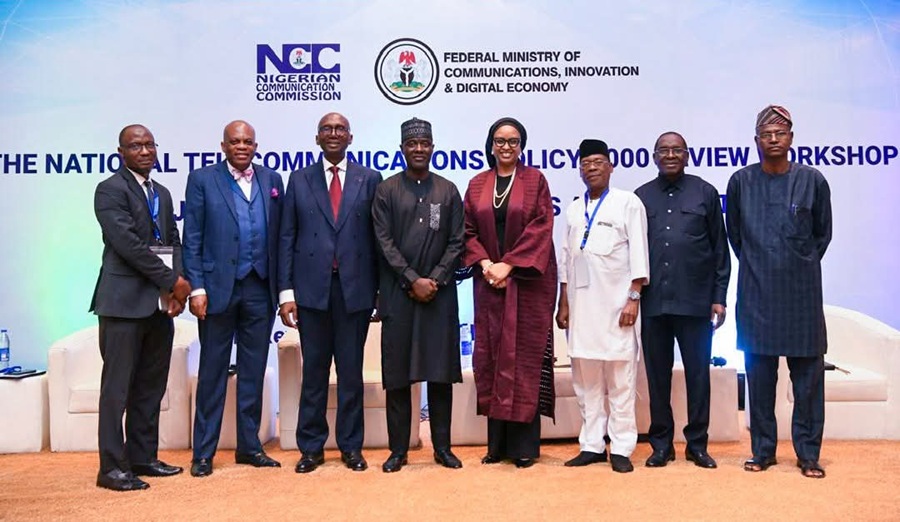
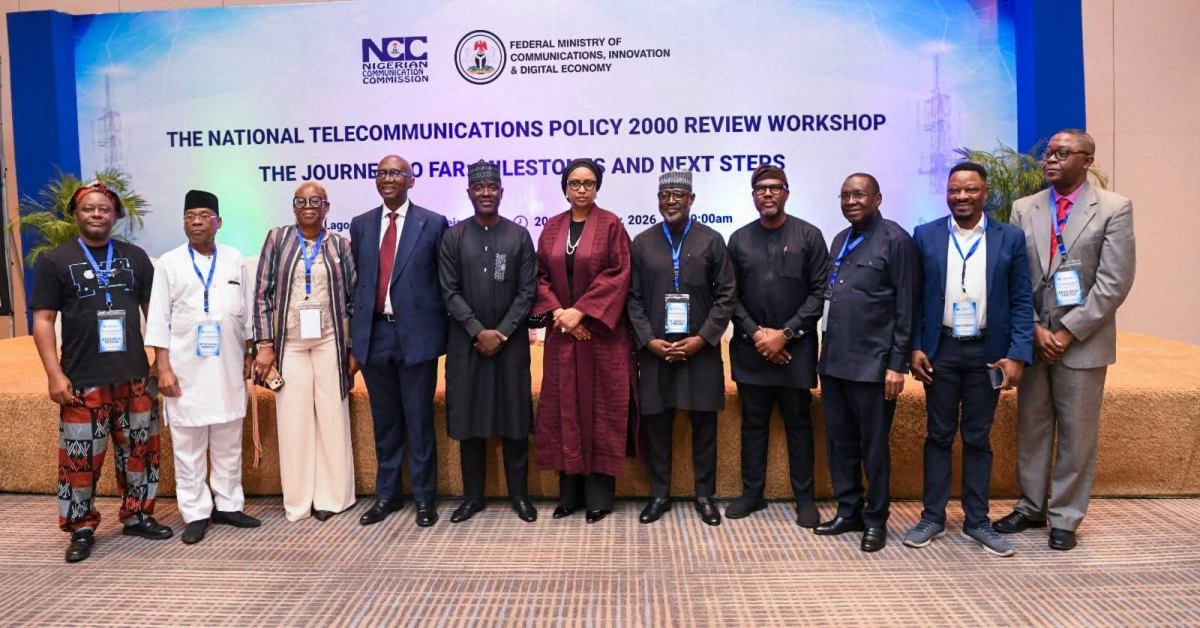
The Nigerian Communications Commission has wrapped up its two-day Stakeholders’ Policy Review Workshop, convening regulators, operators, civil society, and industry players to do what should have happened years ago: formally retire the National Telecommunications Policy of 2000 and begin constructing the architecture that will govern Africa’s largest digital economy for the next generation.
Dr. Aminu Maida, NCC’s executive vice chairman/CEO, framed the challenge with unusual candor.
The communications sector, he argued, has fundamentally transformed from a standalone industry vertical into the connective tissue of the entire economy, and Nigeria’s regulatory architecture has yet to fully reflect that shift.
“The sector has evolved from an isolated vertical into a foundational ecosystem,” Dr. Maida said, a framing that carries significant policy implications. When telecoms infrastructure becomes as critical as roads or power grids, the regulatory philosophy governing it must evolve accordingly.
His agenda for the new framework was ambitious and notably forward-leaning: Artificial Intelligence governance, Satellite Broadband regulation, Internet of Things standards, Digital Sovereignty protections, Critical National Information Infrastructure safeguards, Network Resilience requirements, and a renewed emphasis on Quality of Experience, moving the needle from mere connectivity metrics toward meaningful, usable access.
The workshop’s conclusion is the easy part. What follows, translating ten thematic working group outputs into a coherent, enforceable, and investment-grade policy framework, is where Nigeria’s telecom story will either accelerate or stall.
Twenty-five years is an eternity in technology. When the NTP 2000 was drafted, Nigeria had fewer than 400,000 fixed-line subscribers, mobile internet was a fantasy, and the concept of a digital economy was largely theoretical.
Today, the country hosts over 185.72 million active SIM connections (by March 2026) and ranks among Africa’s most consequential tech markets.
The policy governing all of it has not kept pace.
Here is what each of the ten thematic pillars actually means, and why each one carries consequences far beyond the workshop room.
1. Licensing and Market Access
This is foundational. The licensing regime born out of NTP 2000 midwifed Nigeria’s telecoms revolution, the arrival of MTN, Airtel, Glo, and the liberalisation that followed. But that same framework was designed for a world of discrete service categories: voice here, data there, internet service providers in a separate lane.
That world no longer exists. Operators today are simultaneously connectivity providers, content platforms, fintech rails, and cloud infrastructure hosts. The revised policy must grapple with convergence licensing, a model that reflects what companies actually do, not what they were originally permitted to do.
The risk of getting this wrong is regulatory arbitrage: innovative services operating in grey zones, investment delayed by licence uncertainty, and a market where incumbents use licensing complexity as a moat against new entrants.
2. Technical Regulation and Spectrum Management
Spectrum is sovereign territory. It is finite, rivalrous, and the single most consequential input in wireless communications. Nigeria’s spectrum management history has been marked by underutilisation, delayed assignments, and pricing models that have periodically deterred infrastructure investment.
The NTP revision must confront the 5G rollout reality directly. Nigeria’s 5G deployment has been slower and more geographically concentrated than its regional ambitions suggest.
Dynamic spectrum sharing, secondary market mechanisms, and a clear roadmap for releasing additional mid-band spectrum are not optional reforms; they are prerequisites for the kind of infrastructure density that supports smart cities, industrial IoT, and competitive mobile broadband pricing.
This working group’s output will be watched closely by every tower company, neutral host operator, and equipment vendor active in the market.

3. Consumer Affairs and Online Safety
This pillar is arguably the one most visible to ordinary Nigerians, and the most politically charged. Quality of Service complaints remain endemic.
Tariff transparency is inconsistent. Data throttling practices are poorly disclosed. The recently approved tariff adjustments by operators, the first in over a decade, have sharpened public scrutiny of what consumers actually receive in exchange for what they pay.
Online safety adds an entirely different dimension. Regulatory frameworks for harmful content, platform accountability, digital identity verification, and the intersection of telecoms and social media are live policy debates globally.
Nigeria must decide how much of its online safety architecture sits with the NCC, how much with the National Information Technology Development Agency, and how much with the emerging framework around the Nigeria Data Protection Commission. Fragmentation between agencies has historically been where good policy goes to die.
4. National and International Collaboration
Nigeria does not regulate in isolation. Its policy choices reverberate across West Africa, where it functions as a de facto anchor for regional connectivity, and globally, where its treatment of foreign operators and infrastructure investors sends signals to capital allocators.
The revised NTP must define Nigeria’s posture on submarine cable landing rights, international interconnection, roaming agreements, and its relationship with bodies like the International Telecommunication Union and the African Union’s Digital Transformation Strategy.
There is also the question of reciprocity, whether Nigerian operators receive equivalent treatment in markets where their counterparts operate. This is not merely diplomatic courtesy; it is a competitive economics question.
5. Emerging Technologies
Dr. Aminu Maida’s agenda for the new framework was notably forward-leaning: Artificial Intelligence governance, Satellite Broadband regulation, Internet of Things standards, Digital Sovereignty protections, Critical National Information Infrastructure safeguards, and Network Resilience requirements.
Each of these deserves its own policy instrument, and the NTP can only provide the overarching principles.
The more consequential question is institutional: which body governs AI in telecoms networks? How are Low Earth Orbit satellite operators like Starlink licensed, taxed, and subjected to local content and lawful intercept requirements? What technical standards govern IoT device connectivity at scale?
Nigeria has repeatedly articulated ambitions in emerging technology governance without building the regulatory capacity to match. This working group’s recommendations will reveal whether that gap is being addressed structurally.
6. Economic Regulations
Interconnection rates. Wholesale access pricing. Dominance determinations. Infrastructure sharing mandates. These are the instruments through which the NCC shapes market structure, and market structure shapes investment.
GSMA intelligence projections put hard numbers on the stakes: strategic digitisation could add 2% to Nigeria’s GDP, create two million jobs, and generate ₦1.6 trillion in additional tax revenue. Those gains are entirely contingent on an economic regulatory environment that attracts capital rather than repels it.
The revised policy must strike a delicate balance: ensuring that dominant operators do not leverage infrastructure control to stifle competition, while simultaneously ensuring that the returns on infrastructure investment are sufficient to justify its expansion. Nigeria cannot regulate its way into rural broadband, it must price and incentivise its way there.
7. Universal Access and Service
The digital divide is Nigeria’s most persistent telecoms failure. Broadband penetration in rural and underserved areas remains dramatically below urban concentrations.
The Nigerian Universal Service Provision Fund has existed for years, yet connectivity gaps that should have narrowed have instead deepened relative to the growth of urban digital economies.
The revised NTP must move beyond aspirational targets and define accountability mechanisms: who is responsible for unserved communities, under what timeline, with what penalty for non-delivery, and funded through what sustainable mechanism. The shift from Universal Access (physical infrastructure presence) to Universal Service (meaningful, affordable, usable connectivity) is a necessary conceptual evolution. Whether it translates into enforceable obligations is the real test.
8. Internet and Satellite Communications
This pillar sits at the intersection of several live tensions. The arrival of LEO satellite broadband has disrupted the assumptions underlying terrestrial broadband planning.
Starlink’s penetration in areas where fibre and fixed wireless have failed to reach is a market verdict on the gaps in Nigeria’s connectivity map, and a policy challenge for a framework built around licensed terrestrial operators.
The revised NTP must clarify the regulatory treatment of satellite internet: licensing obligations, spectrum coordination with terrestrial networks, local entity requirements, data localisation obligations, and the tax treatment of satellite-delivered services. Getting this wrong risks either over-regulating a technology that is serving Nigerians the incumbent operators have not reached, or creating an unlevel playing field that disadvantages terrestrially licensed operators who carry far heavier regulatory burdens.
9. Cybersecurity and Trust
The NCC’s framing of the sector as “the connective tissue of the entire economy” carries a direct corollary: an attack on telecommunications infrastructure is an attack on the economy itself. Cybersecurity is no longer a technical annex to telecoms regulation, it is a core policy pillar.
Critical questions include: What minimum security standards must operators meet? How are security incidents reported, and to whom?
What is the NCC’s role versus the Office of the National Security Adviser, the Central Bank of Nigeria (for fintech-adjacent infrastructure), and the Nigeria Data Protection Commission?
How does Nigeria’s approach to network security intersect with the geopolitically sensitive question of which vendors supply its core network equipment? These are not questions with easy answers, but they are questions that cannot be deferred any longer.
10. Capacity Development and Research
Nigeria produces significant technology talent, and exports most of it. The revised NTP must address the policy environment for building and retaining the human capital that a digital economy requires. This means engineering education pipelines, R&D incentives for local innovation, spectrum research facilities, and structured pathways between academia, the NCC, and industry.
It also means building regulatory capacity inside the NCC itself. Effective enforcement of a sophisticated policy framework requires a commission staffed with professionals who understand AI governance, satellite orbital mechanics, cybersecurity threat landscapes, and economic modelling. The gap between the sophistication of modern telecoms challenges and the institutional capacity to address them is real, and the NTP should mandate a strategy to close it.
The Verdict on the Process
The NCC deserves credit for the structure of this review. Organising stakeholders into ten thematic working groups, committing to a participatory process, and inviting public submissions via stakeholders@ncc.gov.ng signals a departure from top-down regulatory drafting.
The invitation for policy proposals and memoranda from the public is not cosmetic, the submissions will be observable and the degree to which they are reflected in the draft will be a measure of the process’s integrity.
The true measure of this review won’t be the policy document that emerges from the workshop. It will be whether the regulatory environment it creates actually accelerates infrastructure investment, enables credible AI and data governance, and translates connectivity into economic participation for Nigerians who remain on the wrong side of the digital divide.

Nigeria has produced visionary policy documents before. Implementation is where ambition meets institutional reality.
The ten working groups have identified the battlegrounds. The draft NTP will reveal which fights the commission is prepared to win.



