


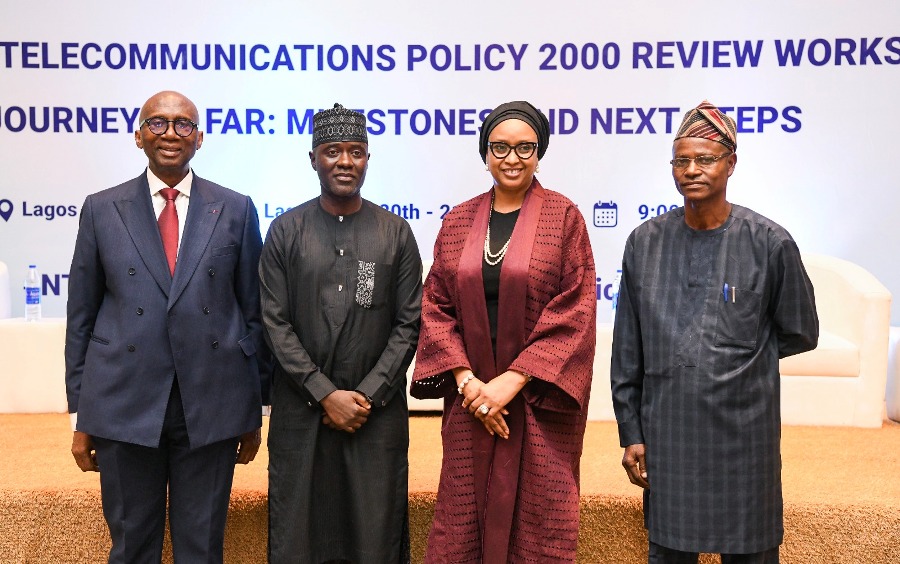
The Nigerian Communications Commission officially opened a two-day Stakeholders’ Policy Review Workshop at the Marriott Hotel, Ikeja, on Wednesday, convening regulators, industry players, and civil society to do something long past due: retire the National Telecommunications Policy of 2000 and architect a framework fit for 2025 and beyond.
Twenty-five years is an eternity in technology. When the NTP 2000 was drafted, Nigeria had fewer than 500,000 fixed-line subscribers, mobile internet was a fantasy, and the concept of a digital economy was largely theoretical.
Today, the country hosts over 220 million active SIM connections and ranks among Africa’s most consequential tech markets. The policy governing all of it has not kept pace, and everyone in the room knows it.
Opening the workshop, Dr. Aminu Maida, NCC’s Executive Vice Chairman and CEO, framed the challenge with unusual candor.
The communications sector, he argued, has fundamentally transformed from a standalone industry vertical into the connective tissue of the entire economy, and Nigeria’s regulatory architecture has yet to fully reflect that shift.
“The sector has evolved from an isolated vertical into a foundational ecosystem,” Dr. Maida said, a framing that carries significant policy implications. When telecoms infrastructure becomes as critical as roads or power grids, the regulatory philosophy governing it must evolve accordingly.
His agenda for the new framework was ambitious and notably forward-leaning: Artificial Intelligence governance, Satellite Broadband regulation, Internet of Things standards, Digital Sovereignty protections, Critical National Information Infrastructure safeguards, Network Resilience requirements, and a renewed emphasis on Quality of Experience, moving the needle from mere connectivity metrics toward meaningful, usable access.
The Economic Argument is Compelling
Dr. Maida didn’t rely on abstract vision alone. Citing GSMA intelligence, he put hard numbers on the table: strategic digitization across agriculture, manufacturing, transport, and trade could add 2% to Nigeria’s GDP, create two million jobs, and generate ₦1.6 trillion in additional tax revenue.
Those are not incremental gains. For an economy navigating significant fiscal pressures and youth unemployment, they represent a genuine structural opportunity, one that is, however, entirely contingent on getting the policy environment right.
Outdated regulation doesn’t just slow growth; it actively redirects investment to more predictable markets.
The inclusion of Cybersecurity, Data Governance, Digital Financing, and Online Safety as urgent regulatory priorities is equally telling.
It signals that the NCC understands this is no longer purely a telecoms conversation; it is a technology governance conversation with economy-wide consequences.
What the Technical Sessions Reveal
The workshop’s panel agenda is itself instructive. Beyond celebrating the milestones of the NTP 2000 era, sessions are actively wrestling with harder questions: how to bridge a digital divide that remains stubbornly geographic and socioeconomic; how to balance innovation velocity against security imperatives; and how Nigeria’s approach aligns, or diverges, from global regulatory best practices.
That last point deserves attention. As the EU implements the AI Act, the US navigates fragmented state-level data privacy laws, and emerging markets increasingly assert digital sovereignty, Nigeria has a genuine opportunity to chart a third path, one that is neither a wholesale import of Western frameworks nor a reactive patchwork of rules.
The stakeholder feedback sessions on the Commission’s published Policy Proposals suggest the NCC is, at minimum, seeking to build that framework with broader buy-in than has historically characterized Nigerian regulatory processes.
The Unfinished Business
The workshop’s ambitions are real, but so are the execution risks. Nigeria has produced forward-looking policy documents before that struggled in implementation.
Broadband penetration targets have historically underperformed. Rural connectivity gaps persist despite multiple intervention programs.
The true measure of this review won’t be the policy document that emerges from the Marriott this week. It will be whether the regulatory environment it creates actually accelerates infrastructure investment, enables credible AI and data governance, and, crucially, translates connectivity into economic participation for Nigerians who remain on the wrong side of the digital divide.
That work begins after the workshop ends.
The two-day workshop concludes Thursday, with stakeholder recommendations expected to inform a revised National Telecommunications Policy slated for public consultation.



