


Every major technology platform reaches a turning point: when “What can this do?” gives way to “How do we control it?”
For African enterprises, that inflection has arrived. Beta Glass Plc, West and Central Africa’s largest glass container manufacturer, just proved it.

The Executive Challenge: From Theory to Enterprise Control
For executives, AI adoption is not about IT delegation; it’s about disciplined execution. The C-suite is asking: How do we ensure data safety? How do we embed AI into audited workflows?
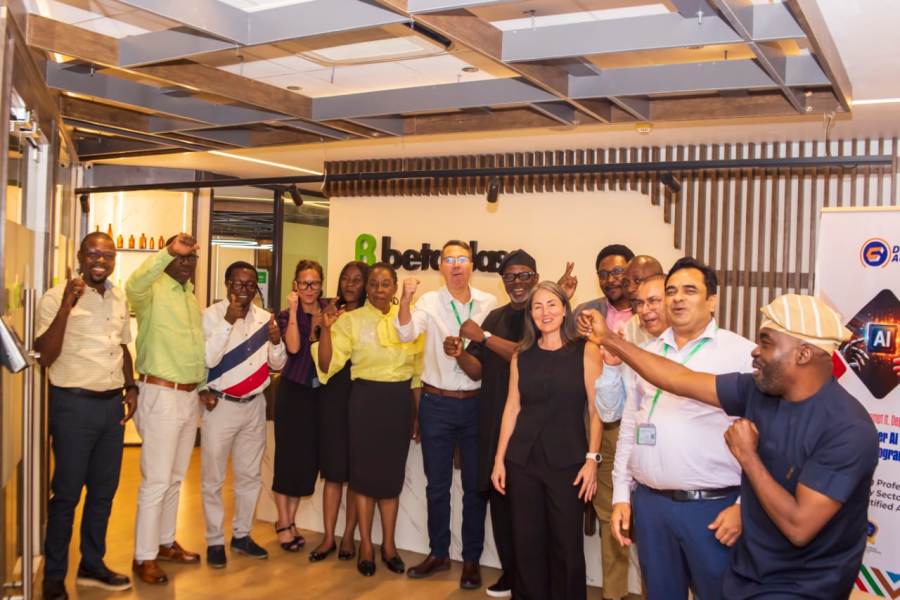
The 13 senior leaders at Beta Glass, spanning Finance, Legal, Commercial, and Manufacturing, entered a two-day immersion focused entirely on these leadership questions. Their top concern was not the technology itself, but Data Confidentiality.
The 48-Hour Outcome: Value and Velocity
In May 2026, those executives completed the intensive AI Capacity Building program. The result: eight enterprise-grade AI systems, live-deployed on real functional workflows, built by the executives legally accountable for governing them.
This rapid build, moving the organization past the ‘Experimenting’ phase toward ‘Integrating’ AI into core operations, delivered staggering value.
Equivalent internal tools, procured traditionally, would cost ₦241–446 million and require 6–12 months. Beta Glass executives designed and shipped functional, production-ready intelligence platforms in two days.
Three Eras of Enterprise AI
The shift from asking the right question to building a permanent system is key to this velocity.
Era 1: Prompt Engineering. Clever questions yielded clever answers once. But every new task required manual re-briefing.
Era 2: Context Engineering. Organizations learned that output quality depends on rich, localized data boundaries, not linguistic ingenuity. This is formalized by the TABS-D Framework (Task, Audience, Background, Style, Detail).
Era 3: The Skills Era. An AI “Skill” is a permanent system prompt embedded with corporate knowledge, operational constraints, and compliance logic. Deploy once. Every subsequent interaction inherits the exact same configuration without manual re-input.
A CEO who builds an “Executive Intelligence Assistant” Skill, using tools like Claude or Lovable, has effectively deployed a persistent digital staff member.
It understands organizational constraints, strategic language, and compliance standards. It can draft board briefs at 7 AM on a Monday without external web searches.
This is not incremental efficiency. It is an architectural transformation.
The Tools They Built: Executive Intelligence in Action
The systems built focused on transforming decision-making, not automating simple tasks. These are “stop-and-read” systems for any executive:
- IFRS-Compliant Financial Intelligence: Ingests raw trial balances, maps to statutory structures, flags compliance anomalies, and generates board commentary. A core objective was converting performance data into management commentary, showing drivers and risks.
- Executive Media & Market Intelligence: The program began with a live intelligence demonstration, showing Beta Glass’s 38% Share of Voice and 78/100 Visibility Score compared to competitors. Executives then built their own Capstone Dashboard to continuously track brand perception, sentiment, and reputation risks.
- Legal & Governance Assistant: Beyond tracking legislation, the system was configured to review contract extracts, flag risk clauses, apply legal privilege caution, and establish clear escalation protocols.
- AI Logistics Control Tower: A 5-layer architecture connecting real-time data ingestion, specialized intelligence, a custom Claude Skill brain, and an interactive dashboard for managing vendor risks and OTIF analysis.
All classified as MVPs functional systems that passed live CEO review, now in structured beta testing, not architectural redesign.
The Governance Layer: From Blackbox to Glassbox
The true innovation is in the control architecture, moving from Blackbox AI (opaque, no audit trail, high risk) to Glassbox AI (visible logic, human review, documented decision trail).
Beta Glass leaders institutionalized this discipline through four non-negotiable pillars:
- Absolute Ownership: One designated executive, directly accountable for all outputs.
- Human-in-the-Loop Review: Mandatory verification before any AI narrative reaches board packs or regulatory filings.
- Data Classification: Strict boundaries defining Public Safe, Internal Only, and Never-in-AI-Environment data.
- Escalation & Fallback: Clear procedural pathways for exceptions and boundary violations.
These pillars are formalized in the BOUNDARIES Governance Framework (Brand-Safe, Operationally Governed, Uncompromising on Data, No Blind Trust, Documented Audit Trail, Scaled Responsibly).
This approach ensures that AI reduces drudgery, strengthens human judgement, and increases accountability.
One moment crystallized why this matters: Sharin, Head of Commercial, unprompted, authored the organization’s first departmental AI Usage Policy.
Her instinct recognized that deploying AI in client-facing operations without data parameters and review boundaries creates unquantified legal and reputational risk.
That governance instinct sparked through hands-on architectural creation, not consultant presentations is precisely what mature AI leadership looks like.
The Lesson for Global Enterprise
The organizations that scale AI sustainably won’t be those buying the flashiest external software. They’ll be those whose C-suite executives, the workflow owners, the risk approvers, understand the architecture deeply enough to own, govern, and evolve it themselves.
Beta Glass proved this level of sovereign corporate capability is achievable in 48 hours.
The question is no longer: “What can AI do?”
The question is: “Who governs it?”



