Let’s be honest. For most Nigerians, home broadband has meant one of two things: a mobile hotspot that runs out at the worst possible moment, or a Starlink dish that works brilliantly but costs an arm and a leg to set up.
The idea of fast, unlimited, wired broadband arriving at the door, like it does in London or Seoul, has felt like a distant dream.
MTN FibreX is trying to change that story. Rebranded and relaunched in April 2025, it has grown from a quiet niche product into Nigeria’s dominant fixed broadband service in less than twelve months. As of February 2026, FibreX holds approximately 88.7% of Nigeria’s entire fixed broadband market.
The Numbers So far:

“Our goal is clear, between 2026 and 2028, we want FibreX to reach over 8 million homes across Nigeria. This is about empowering people to connect and thrive in the digital economy.” — Egerton Idehen, Chief Broadband Officer, MTN Nigeria.
What Exactly is MTN FibreX?
FibreX is MTN Nigeria’s fibre-to-the-home (FTTH) broadband service. Physical fibre-optic cables are run directly into your home or business, delivering internet speeds that a mobile SIM card simply cannot match, with no data cap, no throttling, and no Fair Usage Policy (FUP) hidden in the fine print.
The service was formerly known as MTN Fibre Broadband and existed quietly for nearly a decade with very modest adoption, ranging between 2,000 and 9,000 users at any given time.
The April 2025 rebrand to FibreX coincided with aggressive expansion, a more competitive pricing structure, and a clear strategic mandate: become Nigeria’s largest FTTH operator, by a wide margin.
It’s working. By January 2026, FibreX had 89,441 subscribers, a 658% jump from 11,794 in January 2025. The biggest single-month surge came in September 2025, when the service added 16,640 new users (a 56.8% month-on-month jump). The highest recorded monthly increase since MTN started the service nearly 10 years ago.
The Plans: What You Pay, What You Get
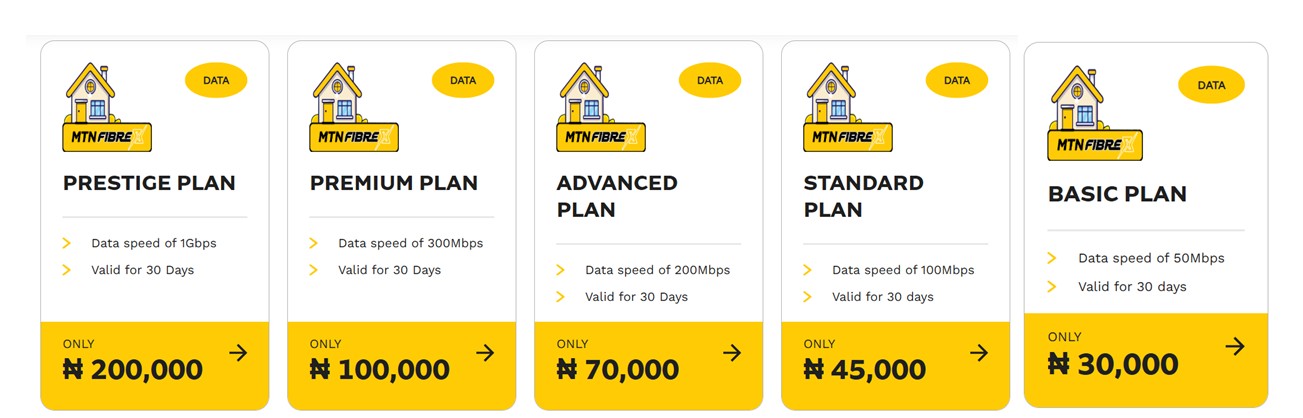
Plans in 2026 range from ₦30,000/month to ₦200,000/month, covering speeds of 50 Mbps to 1GB. All plans are fully unlimited with no speed throttling. The router is provided free-to-use, and installation is free in covered areas. All plans also offer symmetrical upload and download speeds.
The Honest Verdict: Pros & Cons
The Upsides
| Truly Unlimited Data | No data caps, no Fair Usage Policy throttling. Your 50 Mbps stays 50 Mbps on day 1 and day 30 of your billing cycle. |
| Symmetrical Speeds | Upload speeds match download speeds, a game-changer for content creators, Zoom calls, and cloud backups. |
| Free Router & Installation | MTN provides the router on a free-to-use basis and handles all cabling and setup. Zero upfront hardware cost. |
| Cheaper Than Starlink | At ₦30,000/month for 50 Mbps unlimited, FibreX undercuts Starlink’s ₦57,000/month standard plan significantly. |
| Bundled Call Minutes | Select plans bundle MTN-to-any-network call minutes, adding extra value beyond pure connectivity. |
| 24/7 Dedicated Support | A dedicated fibre support line (217) and email channel separate from general MTN customer service. |
Areas of concern:
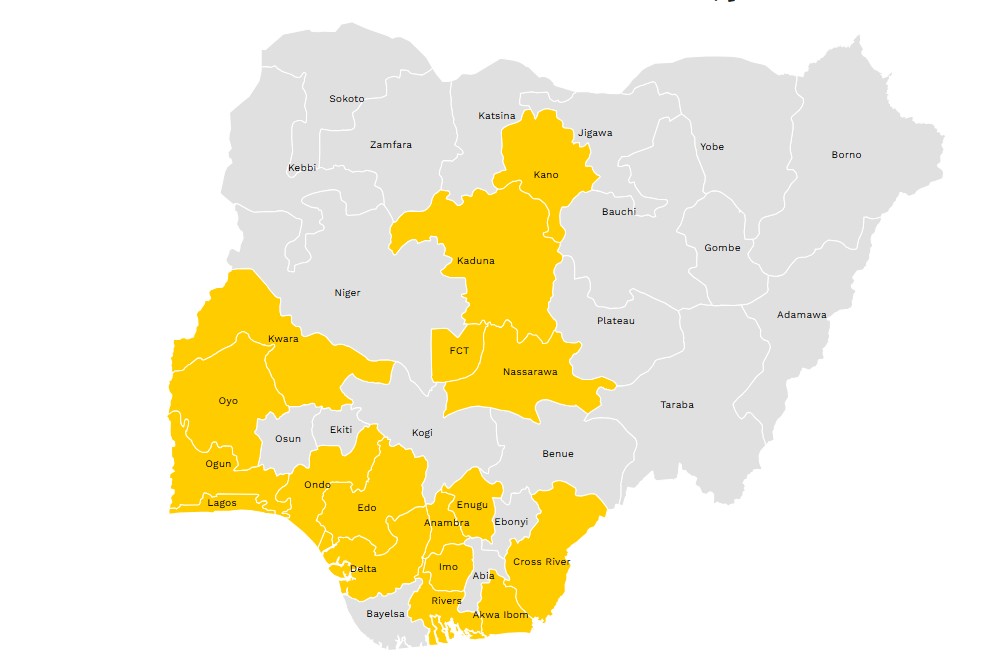
| Coverage Is Still Patchy | FibreX is not yet nationwide. Outside major urban estates in Lagos, Abuja, PH, and select cities, coverage is sparse. |
| 9,218 Fibre Cuts in 2025 | Vandalism, road construction, and theft cut MTN’s fibre cables an average of 25 times per day in 2025, causing real outages. |
| Router Dies When Power Goes | Unlike some 4G routers with battery backup, fibre routers go dark during power cuts. A UPS is strongly recommended. |
| No Mobility | You are connected only at your home address. Mobile workers and frequent travellers still need a separate mobile data solution. |
FibreX vs Starlink vs Spectranet
The honest take from multiple reviewers in early 2026 is consistent: if FibreX cable (over-the-air) has been laid on your street, it is the most cost-effective unlimited home internet option available in Nigeria today.
The challenge remains coverage, Starlink still wins where fibre hasn’t reached, but it costs more than four times as much in the first year when you factor in the hardware kit.
Metric |
MTN FibreX |
Starlink |
Spectranet |
| Monthly Cost (mid-tier) | ₦30,000 / 50 Mbps | ₦57,000 (standard) | ~₦20,000 (FUP applies) |
| Data Cap | None – truly unlimited | None | FUP throttling after limit |
| Speeds | 20–300 Mbps symmetric | 50–200 Mbps (varies) | 10–100 Mbps |
| Latency | Low (<15ms typical) | 20–60ms | Moderate |
| Installation | Free | ~₦590,000 hardware kit | Equipment fee applies |
| Power dependency | Router needs power (no battery) | Needs power (no battery) | Some routers have battery |
| Coverage | Urban estates, expanding | Nationwide (satellite) | Lagos, Abuja, PH, Ibadan |
| Mobility | Fixed address only | Portable (Roam plan) | Fixed address only |
The Elephant In the Room: 9,218 Fibre Cuts
Here is where we have to be straight with you. MTN FibreX has a reliability problem, and it’s not entirely MTN’s fault, but it is MTN’s problem to solve.
In 2025, MTN recorded 9,218 fibre cable cuts across Nigeria, averaging more than 25 per day. Road construction crews sliced through buried cables. Vandals targeted infrastructure.
Cable thieves did what cable thieves do. The result: customers experienced outages that lasted hours, sometimes days, with sparse communication from the company during the downtime.
“For the past three days, the MTN FibreX network has been absolutely terrible, unstable connection, frequent downtimes, and speeds nowhere near what was promised. It’s been oversold.” – Nnamdi Nwabuisi, MD, Nikenga.com (via LinkedIn)
Dr. Karl Toriola, MTN’s CEO publicly acknowledged the issue and pledged accountability. But acknowledgement alone doesn’t restore the connection of a remote worker on a deadline.
The company logged over 1.6 million customer complaints through its service channels in 2025, a figure that should sit uncomfortably in every board review.
This is arguably the biggest risk to FibreX’s growth trajectory. Nigeria needs better legislation to protect buried or ‘over-the-air’ infrastructure, stronger penalties for vandalism, and better coordination between telecoms operators and road construction authorities. Until that systemic fix arrives, no amount of cable-laying will fully solve the outage problem.
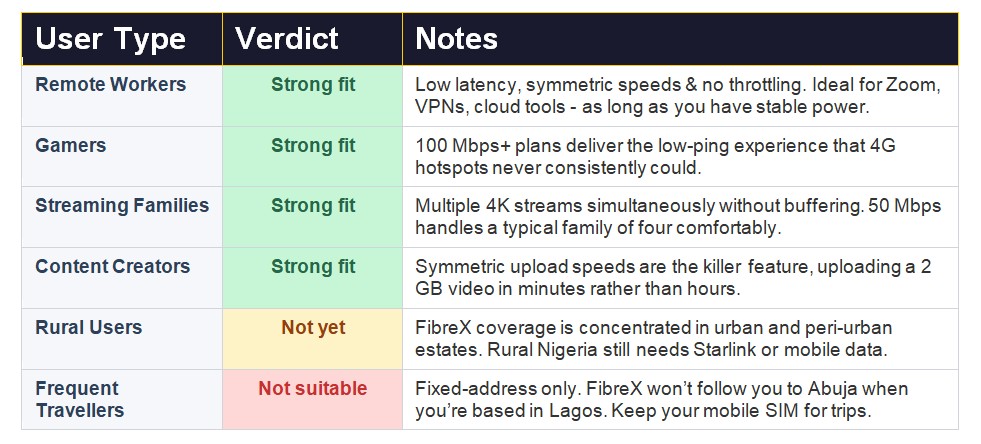
Who is FibreX Actually for?
The Big Picture: What this Means for Nigeria
FibreX is not just a product launch. It’s a bet on a different version of Nigeria’s digital future, one where home broadband is as normal as owning a TV.
Nigeria’s broadband penetration reached 53.07% by January 2026, up from 45.61% a year earlier. But the vast majority of that is mobile broadband.
Fixed wired connections remain a rounding error compared to 104 million mobile broadband subscriptions.
MTN’s ambition to connect 8 million homes by 2028, a 160-fold increase from current levels, is the kind of infrastructure push that, if achieved, would fundamentally reshape how Nigerian families work, learn, and create.
It aligns directly with the National Broadband Plan’s target of 70% broadband penetration and the expansion of Nigeria’s fibre backbone from 35,000 km to 125,000 km.
But a 160-fold increase is a massive ask. Today’s 110,564 FibreX subscribers are impressive as a growth story. As a fraction of 8 million homes, it is 1.4%.
The distance between here and there requires capital (MTN spent ₦1 trillion in capex in 2025, much of it on fibre), policy support, and, critically, a resolution to the vandalism and fibre-cut crisis that is simultaneously the biggest operational headache and the most persistent threat to consumer trust.
“We are going to be, by a country mile, the largest fibre-to-the-home operator, and we’ll also eventually provide redundancy solutions where you have a combination of fibre and fixed wireless access so that at no point in time do you ever experience any outage.” — Dr. Karl Toriola, CEO, MTN Nigeria
The Bottom Line
MTN FibreX is the most compelling home broadband option in Nigeria if it has reached your street. The pricing is genuinely competitive, ₦30,000 a month for unlimited 50 Mbps, with free installation and a free router, is hard to argue with.
The speed tiers cover every use case from a student’s bedroom to a small business office. And the absence of data caps or throttling removes the daily anxiety that defines Nigeria’s mobile data experience.
The caveats are real, though. The fibre-cut problem is not cosmetic, it is a structural weakness in Nigeria’s physical infrastructure that no single company can fix alone.
The coverage map still leaves most of the country unserved. And new subscribers need to budget at least ₦30,000/month from day one.
But the direction of travel is unmistakably right. The 658% subscriber growth in a single year reflects genuine product-market fit. The 8-million-home ambition, if even 30% is achieved by 2028, would represent a qualitative shift in how millions of Nigerians experience the internet.
For too long, home internet or braodband in Nigeria has meant rationed megabytes and a hotspot shared across six devices. FibreX isn’t the finished article. But it might just be the first believable step toward something better.
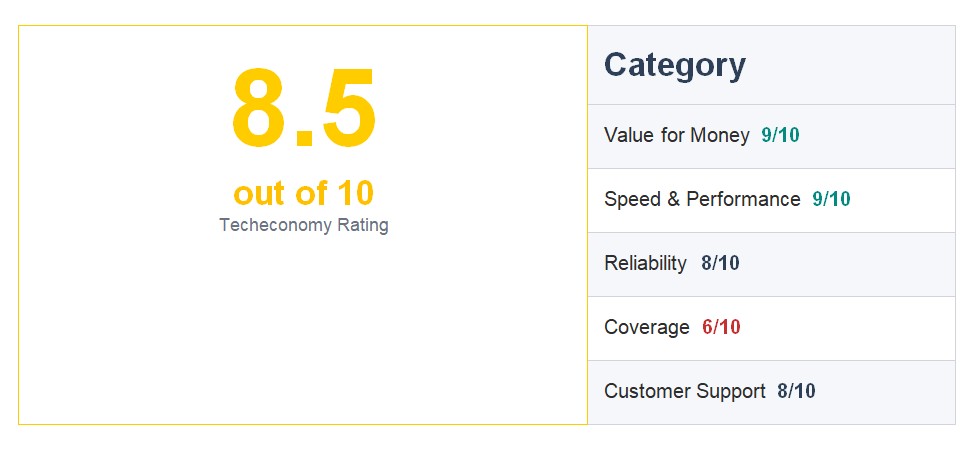
Overall Rating