ADVERTISEMENT
Wednesday, June 10, 2026
Tech | Business | Economy
No Result
View All Result
  • Technology
    • Trends
    • Telecoms
      • Broadband
    • ConsumerTech
      • Gadgets and Appliances
      • Apps
      • Accessories
      • Reviews
      • Unboxing
    • EnterpriseTECH
    • Security & Data Protection
    • How To
  • Business
    • Company News
    • StartUPs
      • Founder’s Story
      • Funding
    • Deals
    • People & Moves
    • SME & Entrepreneur Focus
    • BUSINESS SENSE FOR SMEs
    • Competition & Market Positioning
    • Commerce & Mobility
    • Travel
    • WomenPreneurs
  • Economy
    • Macroeconomic Trends
      • Macro Monday
      • TE Insights
    • Finance
      • Banks
      • Fintech
      • Insurance
      • Digital Assets
      • Personal Finance
    • Policies
      • Tech & Society
    • Market Analysis
    • Jobs & Workforce Economy
  • Features
    • Guest Writer
      • Chidiverse
      • Digital Assets
      • GameTech
    • EventDIARY
    • IndustryINFLUENCERS
    • MarkTECH
    • TBS
    • NewsEXTRA
  • Editorial
  • Brand Content
  • TECHECONOMY TV
Wednesday, June 10, 2026
Tech | Business | Economy
No Result
View All Result
Tech | Business | Economy
No Result
View All Result

Home » 8 Signs To Know Your Startup is Falling Apart

8 Signs To Know Your Startup is Falling Apart

Joan Aimuengheuwa by Joan Aimuengheuwa
September 12, 2022
in StartUPs
Reading Time: 4 mins read
0

Losing employees more frequently than you hire, making stagnant profit and having increased expenses than income, are not the only red flags showing that your startup is about falling off a cliff.

Carefully put together, these eight signs are clear warnings of a startup’s fall. Before we delve into this, you should have it at the back of your mind, that whether your company is at this point or not, you should look through carefully, think of sustainable ways for growth and get your startup on a solid footing.

  1. Negative cash flow

This is a situation where a company spends more money than it is making. Not to be confused with profit, a company can be making profit but have a negative cash flow and vice versa. Negative cash flow prevents a company from expanding and meeting up with short- and long-term liabilities.

  1. Inadequate accounting record

When a business does not have a grip on its financials, incorrect financial statements, lack of proper expense records and no authorisation for most of its activities, these are red flags against a company’s growth.

  1. High Management Drawings

This is when the owner of the business starts to withdraw money from the business account for his personal expenses. When this becomes too high, the business suffers.

Subscribe to our Telegram channel for the latest updates.

Follow the latest developments with instant alerts on breaking news, top stories, and trending headlines.

Join Channel
  1. Very low return on assets

How much of your assets are you using to make your sales? Is your business having a low return on assets? 

If the amount you’re making from sales is more than the worth of your assets, then that’s good. In cases where sales are below assets’ worth, that’s not good. 

When your assets are more, it could mean you have more assets than you need and expenses are incurred on them while they bring no positive sales, or you’re not utilising those assets as well as you should to make sales

What you should do is sell or lease the assets you’re not using, ultimately preventing wastage.

  1. Negative growth rates in key indices

Key indices are sales, gross profit, net profit and the like. A negative growth rate on these is a warning sign that your startup’s sustainability is at risk.

  1. Increasing receivable paying period

Receivable paying period is the time it takes for you to recover your receivables. For instance, when a customer buys on credit, you recognise it as your sales though you haven’t received the cash; this is your receivable. 

If it takes a very long period for the customer to pay, that means your receivable paying period is increasing and this will affect your cash flow as you would have incurred the money used to purchase the good, but haven’t received the money for selling it and your cash is tied up somewhere, leaving you without enough cash to run your operations.

  1. Reduction in payable payment periods

Payable is the opposite of receivables. It involves business owners purchasing goods from suppliers on credit and then the supplier asks for payments within a short period than you would have made enough sales.

You’re then forced to release cash although you’re not receiving cash, leading to negative cash flow.

  1. Increasing current liabilities

Here, we have current and non-current liabilities. For non-current, you have over 12 months to make payments, while current liabilities involve making payments within 12 months.

Once the current liabilities are increasing and more pressing, that means you need to stand firm to hold your startup well.

There you have it. You didn’t start up to fall back, so, understand where you’ve been getting it wrong and focus on a resilient win.


0Shares
Previous Post

Remote Workplace Services Market worth $58.5 billion by 2027

Next Post

NEAR Anchors New $100m VC Fund

Joan Aimuengheuwa

Joan Aimuengheuwa

Joan thrives at helping individuals and businesses scale via storytelling...

Related Posts

OneDosh pre-seed funding

OneDosh Secures Additional $1 million Pre-seed Investment, Bringing Total Funding to $4 Million

June 9, 2026
NITDA Innovation Hub OAU AI Robotics

FG Launches NITDA Innovation Hub at OAU to Boost AI, Robotics Skills in Nigeria

June 9, 2026

From Community Insight to Digital Innovation | How Edidiong Ishola is Building New Infrastructure for Maternal Mental Health

June 8, 2026
Load More
Next Post

NEAR Anchors New $100m VC Fund

Leave a Reply Cancel reply

Your email address will not be published. Required fields are marked *

I agree to the Terms & Conditions and Privacy Policy.

This site uses Akismet to reduce spam. Learn how your comment data is processed.

Techeconomy Podcast
Techeconomy Podcast

The Techeconomy Podcast is a thought-leadership show exploring the powerful intersection of technology, business, and the economy, with a strong focus on Africa’s fast-evolving digital landscape.

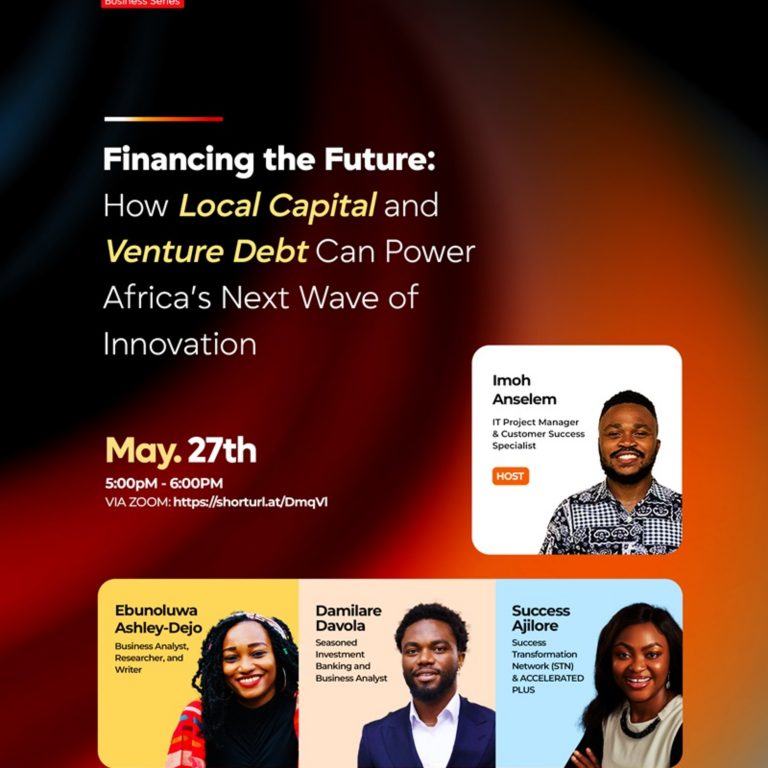
Financing the Future: Venture Debt, Local Capital & African Innovation | TBS May 2026 Webinar
byTecheconomy

Africa’s innovation ecosystem is evolving, but where will the funding for the next generation of startups come from?

In this edition of the Techeconomy Business Series (TBS) May 2026, industry experts explore how local capital, venture debt, and smarter investment structures are redefining startup growth and innovation across Africa.

🎙️ Featured Speakers:

* Ebunoluwa Ashley-Dejo

* Damilare Davola

* Success Ajilore (STN & Accelerated Plus)

Key conversations in this webinar include:

✔️ The future of startup financing in Africa

✔️ Venture debt and alternative funding models

✔️ The role of local investors in scaling innovation

✔️ Sustainable investment strategies for African startups

✔️ Opportunities and challenges in the African tech ecosystem

Subscribe for more conversations shaping Africa’s digital economy and innovation landscape.

#TBS2026 #AfricanInnovation #VentureDebt #StartupFinance #TechInAfrica #Techeconomy #AfricanStartups #InnovationEconomy

Financing the Future: Venture Debt, Local Capital & African Innovation | TBS May 2026 Webinar
May 27, 2026
Techeconomy
PROTECTING INNOVATION IN AFRICA’S STARTUP ECOSYSTEM
April 29, 2026
Techeconomy
BUILDING TRUST IN AFRICA ECOSYSTEM
February 27, 2026
Techeconomy
Navigating a Career in Tech Sales
January 29, 2026
Techeconomy
How Technology is Transforming Education, Health, and Business
November 27, 2025
Techeconomy
Search Results placeholder
MTN Live It 100 Thematic Campaign
ADVERTISEMENT
  • About Us
  • Careers
  • Contact Us
  • Privacy Policy

© 2026 TECHECONOMY.

No Result
View All Result
  • Technology
  • Business
  • Economy
  • Features
  • Editorial
  • Brand Content
  • TECHECONOMY TV

© 2026 TECHECONOMY.

This website uses cookies. By continuing to use this website you are giving consent to cookies being used. Visit our Privacy and Cookie Policy.