

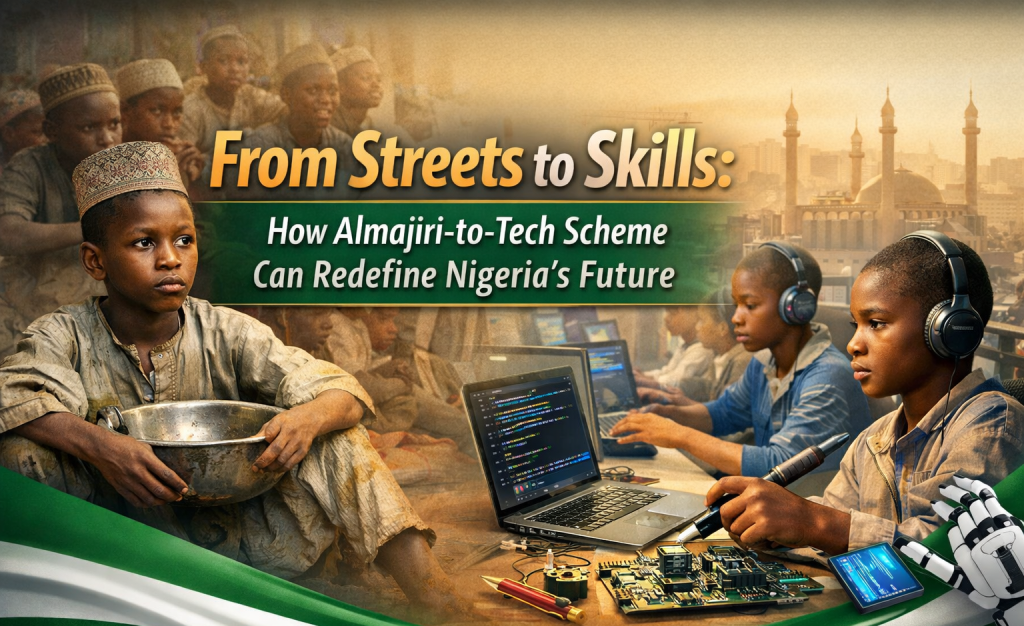
In the bustling streets of Nigeria’s cities, particularly in the North, beneath the constant hum of traffic and the pulsating rhythm of everyday life, there exists a population of children whose potential has long been neglected, the Almajiris.
Traditionally sent out to seek religious knowledge, millions now scramble for daily survival on the streets, invisible to most yet painfully present to themselves and their families.
This entrenched social dilemma reflects not personal failure, but a persistent failure of opportunity. New Horizons Nigeria’s Almajiri-to-Tech initiative (estimated to cost over ₦50 million) is changing that story.

At its core, the Almajiri-to-Tech scheme is simple yet profound: a 90-day, fully-funded, hands-on technical skills training designed to take children off the street and into the skilled workforce.
Participants are immersed in practical learning, from computer and mobile repairs to sustainable electronic practices, alongside mindset reorientation that teaches discipline, citizenship, patriotism, and the dignity of work. All essentials for responsible adulthood.
This initiative is not a quick fix. It is a reclaiming of human dignity, reframing abandonment into opportunity, neglect into investment, and hopelessness into hope.
It recognizes that no child is born worthless, only underserved by a system that too often equates survival with street begging instead of structured opportunity.
Learning from the World: Human Capital as the Engine of Transformation
Nation-building is not a serendipitous event. Throughout history, countries that have risen from poverty and underdevelopment did so by intentionally investing in their people.
In East Asia, China’s focus on vocational and technical education has been a pillar of its economic rise. Strategic investment in skill training, closely linked to industry needs, has helped deliver millions of competent workers whose talents support innovation and productivity, expanding incomes and sustaining rapid growth.
Similarly, Japan and Germany have long placed technical education at the heart of workforce excellence, integrating vocational pathways with industrial excellence so that young people find dignity and opportunity in skills that drive economic competitiveness.
These systems don’t just educate, they empower.
In the United States, too, apprenticeship programs and workplace training historically helped millions transition into meaningful careers, bridging education and employment with real economic impact. Skills, not just degrees, became pathways to prosperity and security.
These global templates share a common lesson: nations that develop robust human capital unleash unparalleled creative and economic energy. The strategy is not merely technical, it is profoundly human.
Why Almajiri-for-Tech Matters for Nigeria
Nigeria stands at a pivotal point. With an estimated 15 million Almajiris, and growing, the choices we make today will define our tomorrow.
For too long, reactive security measures have dominated public discourse, deploying force to manage symptoms rather than resolve underlying causes of unrest, poverty and crime.
New Horizons Nigeria’ programme shifts the paradigm: it recognizes that idle and disenfranchised youth are far more fragile and vulnerable than inherently dangerous. What they need is access; access to skills, purpose, economic inclusion, and dignity.

Here’s how this initiative delivers transformation:
1. Tackling insecurity at its root:
When young people lack opportunity, the void left behind is fertile ground for criminality, banditry, and recruitment into violent networks. Training them into skilled workers changes that narrative, reducing vulnerability and promoting peaceful livelihoods.
2. Building a tech-ready workforce:
With digital and technical skills now central to the global economy, preparing youth for the future is not a luxury, it’s a necessity.
Through practical training, these young Nigerians are not just employable, they become part of the country’s competitive creative economy.
3. Human dignity over survival:
By equipping individuals with skills that earn income and respect, the initiative speaks to the human heart.
It transforms self-perception from mere survivor to contributor, nurturing confidence, agency, and aspiration.
4. Economic growth and productivity:
Experts suggest that empowering Almajiris could potentially add billions to Nigeria’s GDP, a reminder that when people are productive, the entire nation gains.
A Call to Action: Scaling What Works
We at Techeconomy vote yes to the Almajiri-to-Tech initiative by New Horizons Nigeria. In fact, it should not be a lonely effort, rather adopted as a national movement, a convergence of government, private sector, civil society, faith organisations, and citizens, aimed at scaling human potential across every community.
Mr. Tim Akano, the initiator and chief implementor of this initiative deserves national commendation and all the support he needs to ensure this is achieved.

Investing in young Nigerians is not charity, it is strategic national security and economic policy. It is a testimony to what Nigeria can become when skills replace streets, dignity replaces despair, and possibility replaces neglect.
If human capital is the currency of progress, then, we recommend Nigeria must mint it with intention, courage, and compassion.
The Almajiri-for-Tech initiative isn’t just a programme, it’s a promise of what’s possible: a generation of empowered, skilled, hopeful young Nigerians ready to shape the future.
This is not merely transformation, it is reclamation of our collective destiny.