
In a banquet hall in Awka on Monday, Anambra State made its most concentrated statement yet about the kind of economy it intends to build, and who it intends to build it with.
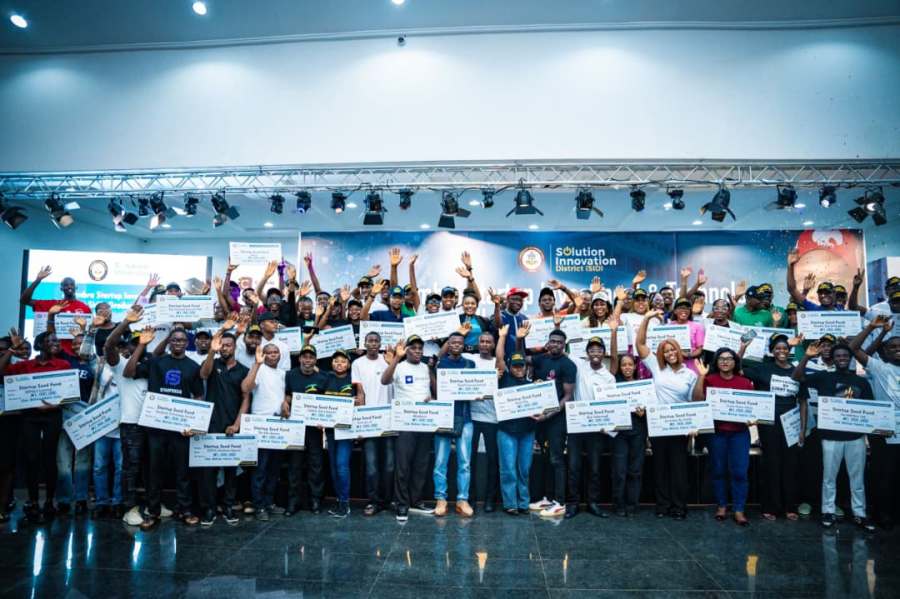
The Anambra Startup Investment and Technology Skills Graduation Ceremony, convened on June 16, 2026 by the Solution Innovation District (SID) at The Light House in Awka, brought together 400 newly certified technology professionals, 80 funded startup founders, state officials, university representatives, and private sector partners for an event that was equal parts milestone and manifesto.
Governor Prof. Chukwuma Charles Soludo, who addressed the gathering, described the occasion not as a government programme completion but as evidence of a system working, one built on the premise that Anambra’s path to economic transformation runs through digital talent and homegrown enterprise.
Three programmes. One afternoon. A coherent strategy
The ceremony marked the graduation of three distinct but strategically connected programmes, each delivered under SID’s coordination and each representing a different layer of the state’s digital economy architecture.
The first was the Robotics Training Programme, delivered across eight cohorts in partnership with Circum Technologies under CEO Mr. Sylvester Uzoma.
Three hundred participants completed training in embedded systems, sensor programming, and industrial automation, a curriculum designed, in the words of SID CEO Chinwe Okoli, to ensure that the Fourth Industrial Revolution arrives in Anambra “not as a disruption but with our people among its creators.“
A deliberate subset of graduates was additionally trained as instructors, creating a train-the-trainer pipeline that extends the programme’s reach beyond its current cohort.
The second was the ISP Network Engineering Programme, a three-month technical curriculum developed with Connekt Broadband under CEO Mr. Ifeanyi Adirika.

One hundred participants completed a structured progression from virtual theory in Month One through laboratory practicals in Month Two to live field deployments in Month Three, covering MikroTik, Ubiquiti, and Cambium configuration, fibre splicing, OTDR testing, and real-world hybrid network design.
The third was the Anambra Startup Incubation Programme, through which 80 startups across three cohorts completed a 12-week process covering business model validation, customer discovery, financial planning, market testing, and investor readiness, each exiting with a Minimum Viable Product and, in several cases, early revenue or angel investment already secured.
‘Silicon Anambra’ – Prof. Soludo’s Vision
Speaking at the ceremony, the Governor reiterated his administration’s commitment to transforming Anambra into Africa’s Silicon Valley.
This vision, he said, is driven not by politics, but by a clear and strategic imperative to secure the future of our state and its people.
In his words:
“As the world evolves at an unprecedented pace, we must ensure that our young people are equipped with the skills and opportunities needed to thrive in the digital age.
“Through transformative initiatives such as the Solution Innovation District (SID) and the 1 Million Anambra Digital Tribe, we are building a strong foundation for a technology-driven and globally competitive economy.
“I congratulate all the graduates, including those trained in robotics and ISP network engineering, for their dedication and achievement. I also commend our partners and sponsors for their invaluable contributions to strengthening Anambra’s innovation ecosystem.
“Anambra is steadily emerging as a leading destination for technology, innovation, and digital enterprise. We remain committed to sustaining this momentum and creating opportunities for future generations. May Anambra continue to win.”
What made it structurally unusual
The event’s significance is not simply in the numbers of graduates but in the design philosophy running through all three programmes: the deliberate avoidance of training for its own sake.
ISP graduates are not entering a skills directory awaiting placement. They are being positioned as the last-mile deployment workforce for Anambra’s ongoing 2,000-kilometre statewide fibre rollout, the engineers who will take connectivity from backbone infrastructure into homes, schools, and communities that have never had reliable internet access.
“The engineers who will complete that last-mile connection are no longer being imported from other states,” Okoli said. “They are members of the Anambra Digital-Tribe, trained here at SID.”
Robotics graduates leave with practical assembly and programming experience applicable to agriculture, manufacturing, and local industry, not certificates for disciplines that have no immediate deployment context in Anambra’s current economy.
Startup founders exited incubation with validated business models and, for 80 of them, government-backed seed capital in hand.
The private sector co-investment
One of the ceremony’s most significant subplots was the degree to which private sector partners absorbed programme costs.
Circum Technologies provided all robotics training kits, covered full implementation costs, and supplied laptops to top-performing participants, at zero cost to the state or to participants.
Connekt Broadband covered every training fee and all equipment deployed across the ISP programme’s three months of instruction.
The partnership model, where government provides mandate, environment, and equity investment while private partners contribute expertise, equipment, and employment pathways, is what SID’s CEO Chinwe Okoli described as the Triple Helix: the deliberate alignment of government, private sector, and academia as one integrated ecosystem.
Connekt Broadband’s Adirika went further at the ceremony, announcing plans to establish a BPO facility at SID’s forthcoming permanent campus, creating additional employment opportunities specifically for SID graduates, a commitment that transforms the private sector’s role from training partner to downstream employer within the same ecosystem.
The moment in context
Anambra’s innovation agenda has accumulated external validation alongside its internal milestones.
The state received the Inspiring Solutions Award at the 2025 IASP World Conference in Beijing, a global acknowledgement of its innovation ecosystem development that the SID team described not as a trophy but as a mandate.
The former Government House premises, now housing SID’s operations, is being developed into a permanent innovation campus, with a new building expected to be commissioned in the near term.
For Okoli, whose office coordinated all three programmes, the ceremony was neither a conclusion nor a celebration in the conventional sense.
“Anambra is not waiting to be discovered,” she said in her address. “We are building the future ourselves.”