


| By: Francis Onyemachi
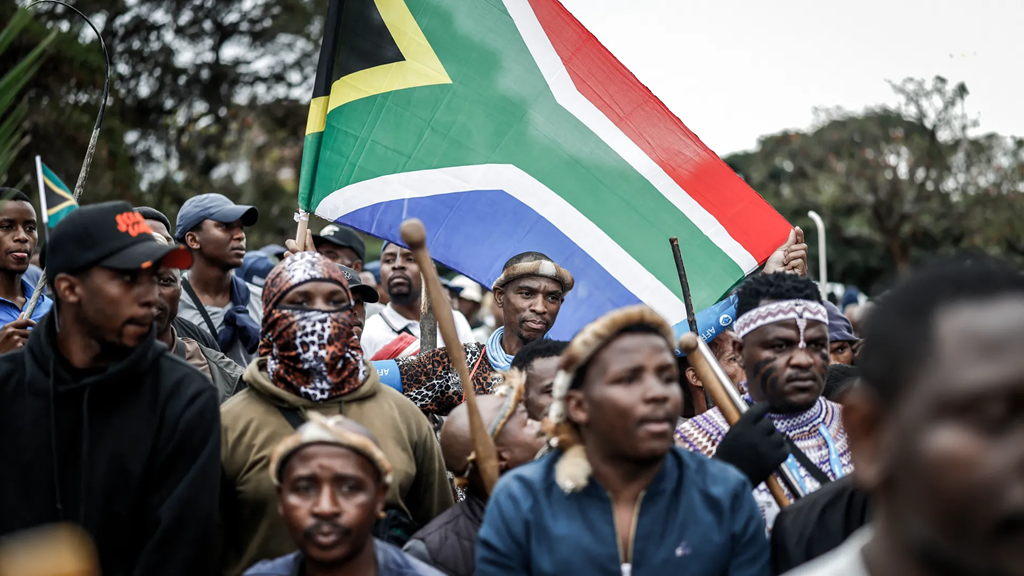
Anti-immigration protesters occupied the streets of South Africa, today Tuesday, June 30, 2026, demanding the evacuation of undocumented foreigners from the country.
The protest followed an earlier notice issued by anti-migration campaigners asking undocumented immigrants to leave the country.
Footage shared across social media showed thousands of protesters marching through Johannesburg, demanding that undocumented immigrants leave South Africa with immediate effect.
The videos also showed heavily armed police officers deployed across the country to ensure the demonstrations remained peaceful.
What is South Africa’s President Saying?
South African President Cyril Ramaphosa earlier appealed to protesters to demonstrate peacefully, urging them to refrain from intimidation, threats or ultimatums.

According to the president, the protest should remain peaceful despite his administration’s commitment to immigration reform.
“South Africans have raised deep concerns about illegal immigration, border management, pressure on public services, criminal syndicates that exploit our immigration system and the impact these challenges have on communities. These concerns are real and they deserve to be heard.
“The right to protest is enshrined in our Constitution. It is a credit to our robust democratic order that people are able to express their grievances openly. But the right to protest and freedom of expression does not allow people to threaten or intimidate others, or to engage in acts of vandalism or violence,” the president said.
Streets were unusually quiet in the coastal city of Durban, where several thousand protesters in Zulu attire marched through the city centre chanting “Abahambe!”, meaning “They must go!” in isiZulu, one of the country’s most widely spoken languages.
Despite the president’s earlier warning, reports said some protesters threw bricks, smashing the windows of flats in Yeoville, a suburb with a large African migrant population.
Meanwhile, dozens of Nigerians gathered at the Nigerian High Commission in Pretoria on Monday, June 29, 2026, seeking refuge over fears of possible xenophobic attacks ahead of the June 30 protests.
The June 30 deadline for undocumented immigrants to leave South Africa, promoted by anti-migrant groups, follows weeks of protests, intimidation and violence targeting foreign nationals.
According to reports, two Mozambicans and one Malawian have been killed, leaving many migrants living in fear.
The growing security concerns have prompted several African countries, including Malawi, Zimbabwe, Mozambique, Ghana, Nigeria, Kenya and the Democratic Republic of Congo, to organise voluntary repatriation efforts, with thousands already returning home.
The Federal Government of Nigeria has continued its voluntary evacuation programme. Another batch of 271 Nigerians arrived at the Murtala Muhammed International Airport, Lagos, on Tuesday aboard an Air Peace flight from Johannesburg and were received by officials of the National Emergency Management Agency, the Nigeria Immigration Service and the Nigerians in Diaspora Commission.
South African police confirmed that 25,000 people have been repatriated so far, most of them from other African countries.
The Ministry of Police also said the protests had largely remained peaceful across the country, despite isolated incidents of looting.
However, Police Minister Firoz Cachalia confirmed that the army had been deployed on a contingency basis in parts of Johannesburg as well as Durban.
Police also confirmed the arrest of three more people in Hillbrow, a Johannesburg suburb with a large migrant population, after two people were injured during the protests.
Meanwhile, the BBC reported that some protesters handed a memorandum containing their demands to government officials in Durban and Johannesburg.
The leader of the anti-migrant group March, Jacinta Ngobese-Zuma, said they would protest every Thursday for the next six months to pressure the government to remove undocumented migrants who remain in South Africa.



