

Tubosun Alake, the Lagos State commissioner for Innovation, Science and Technology, has revealed that the government intends to double the contribution of technology and innovation to Lagos’ economy by 2030.
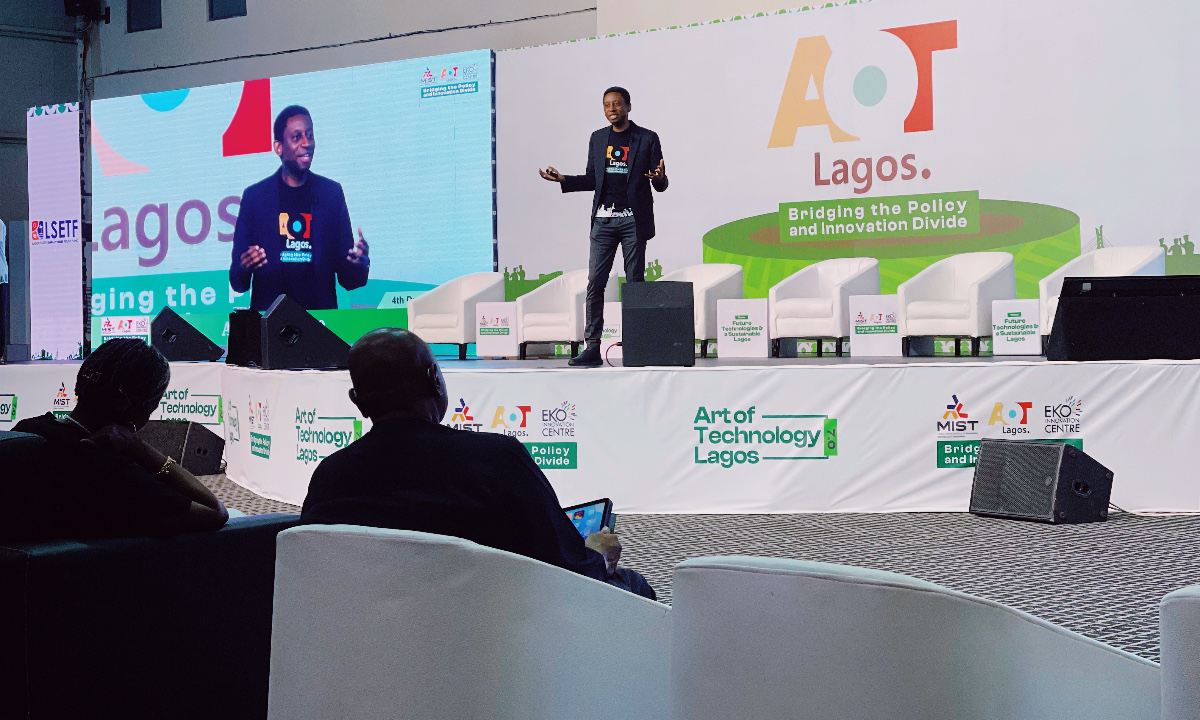
He made this known today, Thursday, December 4, at the ongoing Art of Technology Lagos 7.0, holding at the Landmark Event Centre.
Themed “Future Technologies & a Sustainable Lagos”, AOT Lagos 7.0 marks seven years of bringing together the city’s full innovation ecosystem, including founders, developers, entrepreneurs, financiers, academia, and policy-makers.
Over those years the state has built a solid and broad infrastructure. “We are the de facto IT department for Lagos State,” Alake said, “managing connectivity, data centres, ERP systems, smart-city implementation, and driving public-service digitisation through government.”
Among the State’s achievements he disclosed that between 2019 and 2024, Lagos-based tech startups attracted over $6 billion in funding, representing more than 70% of Nigeria’s total tech investment inflows.
Alake said that today the ecosystem is roughly valued at $15.3 billion, with Lagos accounting for 80–90% of the country’s startups, making it “the largest startup concentration on the continent.”
He explained how the state government is supporting this boom. Through Lagos State Science Research and Innovation Council (LASRIC), more than 75 startups have been funded, and over 85 research and development initiatives across four to five major universities are currently supported.
Some of these initiatives have already produced commendable results, including research patents and spin-off companies in areas like climate resilience, green energy, agritech and construction tech.
In addressing infrastructure, Alake disclosed that Lagos now has about 15,000 kilometres of fibre-optic cables, having expanded connectivity by roughly 500 km per year on average.

This fibre backbone supports public schools, hospitals, government buildings and businesses, a foundation for a truly digital Lagos.
On the public-service side, Alake pointed to the success of the Lagos State Digital Service Portal, launched at last year’s AOT. The portal has recorded over 50,000 unique visitors in the past 60 days alone, enabling citizens to file taxes, apply for planning permits or digital identity, and access other government services online.
He said work is underway to enhance the portal into a unified gateway for all citizen and business services.
At AOT 7.0, Alake also announced the forthcoming Lagos Innovation Bill, a legal and regulatory framework designed to embed innovation in the state’s economic DNA.
Once passed, the Bill will, among other things, require large companies in sectors such as telecoms, energy and infrastructure to collaborate with universities and research institutions when seeking solutions.
For example, building local capacity to design base stations rather than importing equipment.
By 2030, Lagos plans to increase the contribution of IT and innovation to the state economy by 100%, and stimulate a 50% rise in scientific research and invention directed at solving Lagos-specific challenges.
Alake said, “If you have a technical problem, Lagos is the place to solve it,” stressing that this vision requires “coordination, collaboration, and all of us, working hard, putting aside differences, and moving on shared vision.”
He called on everyone in the ecosystem, including the government, private sector, academia, investors, and citizens, to contribute.
The ultimate goal is to make innovation a permanent feature of Lagos’ economic and social life.