


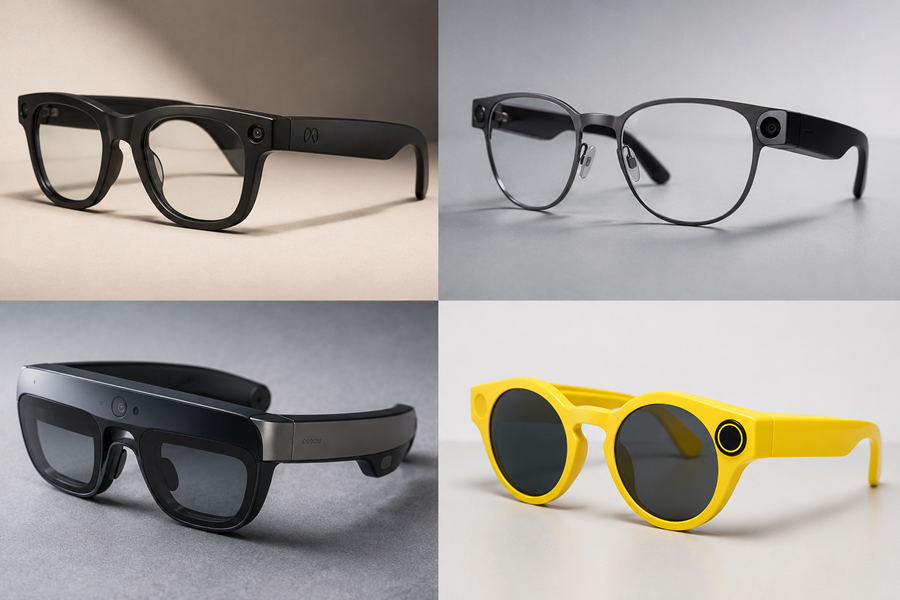
The scale at which gadget manufacturers are pushing upgrades and entirely new form factors beyond the regular smartphone slab and laptop clamshell designs has not been seen in decades.
In fact, the last time we saw this level of experimentation was in the late 1990s and early 2000s, when manufacturers were still trying to figure out what portable personal devices should look like.
And there is one major factor driving this new wave of innovation: artificial intelligence.
Unlike last year, when AI mostly existed as software features built into apps and devices, 2026 has seen AI spread much deeper into processor chips (NPUs) and operating systems. This has made it possible to create entirely new categories of devices.
The clearest example is smart eyewear. Google introduced a new line of AI-powered glasses, Snap unveiled its new SPECS, and Meta just announced the Meta Glasses. Starting at $299, Meta’s latest offering is around $90 cheaper than the entry-level Ray-Ban Meta glasses.
This new wave of AI wearables is worth paying attention to because manufacturers have traditionally paid less attention to the eyewear form factor. But things are changing quickly. Here are the most interesting AI-powered eyewear products announced so far in 2026.
1. Meta Glasses
It is fitting to start with the most recent announcement.
Meta is clearly trying to expand its smart glasses lineup with the new Meta Glasses. They are expected to start at $299, making them considerably cheaper than the Ray-Ban Meta glasses. Although they are still built in collaboration with Ray-Ban’s manufacturer (EssilorLuxottica), they do not carry the Ray-Ban branding.
Meta has emerged as one of the biggest players in the AI race, and these glasses are another sign that the company wants AI to become part of everyday life.
Integrated with Meta AI, the glasses are designed to handle tasks naturally without requiring users to constantly reach for their phones.
The biggest attraction is the price. By reducing the cost, Meta hopes to bring smart glasses to more people and attract buyers who may have considered the category too expensive in the past. If the company gets the balance right between features and affordability, these glasses could become one of the most widely used AI wearables yet.
2. Google’s Intelligent Eyewear
Unlike the original Google Glass, which was developed entirely by Google and eventually failed to gain mainstream acceptance, Google is taking a different approach this time.
Instead of building everything under its own branding, the company is working closely with hardware partners like Samsung and Qualcomm.
As a result, there will not be a single product carrying Google’s branding. Rather, Google is creating a new category it calls “Intelligent Eyewear”.
The common thread across these products is Google’s Android XR software and Gemini AI optimisation. The goal is to reduce how often people need to touch or even look at their phones. Tasks like translation, navigation, notifications and contextual assistance can all be handled through voice interactions.
More importantly, because it is not tied to a single hardware product, the platform allows manufacturers to release devices across different price ranges, from premium models to more affordable options. This is a contrast to Google Glass, which launched with a $1,500 price tag.
The first wave of Intelligent Eyewear, expected around September, will focus mainly on audio experiences rather than visual interfaces. More advanced versions with visual capabilities are expected later.
3. XGIMI Memo-Mind One
Announced earlier this year at CES 2026 and already available for preorder, the XGIMI Memo-Mind One is another interesting attempt at AI-powered eyewear.
Created by projector specialist XGIMI, the glasses are camera-free and designed with privacy in mind. Instead of recording video, they project useful information such as notifications, translations and navigation directly into the wearer’s field of view.
The company places heavy emphasis on comfort, battery life and customisation, making the glasses suitable for all-day use.
However, the relatively high price could make them less attractive compared with offerings from Meta and Google. Still, for users looking to try something different from the major brands, the Memo-Mind One is an interesting alternative.
4. Snap SPECS
Snap, the company behind Snapchat, has been experimenting with smart eyewear for years, and its latest effort is called SPECS.
These ultra-lightweight AR glasses run on Snapdragon chips and SnapOS 2. They are packed with advanced augmented reality features, but they also come with a premium price tag of more than $2,000.
Snap says the glasses deliver around four hours of battery life, which is respectable considering the technology involved. But with cheaper options coming from Meta and Google’s ecosystem, it is difficult to argue that SPECS offers the best value for money.
For now, they appear to be aimed more at developers and enthusiasts rather than everyday consumers..
After years of cautious experimentation, smart eyewear is finally moving closer to the mainstream, driven largely by AI.
Among all the products announced so far, the most anticipated are those coming from Meta and Google. On one side is Meta, which is betting on affordable hardware and its rapidly growing AI ecosystem.
On the other is Google, which is building an entire platform with partners like Samsung and Qualcomm.
It is shaping up to be a competitive race between two AI pioneers, and the outcome could determine how millions of people interact with technology in the years ahead.
The certain thing is that smart glasses are no longer a futuristic concept. They are becoming the next major form factor in consumer technology.



