

Nigeria spends billions treating illnesses caused by smoke in kitchens, but then, a single clean stove can return $1,000 to society in just three years.
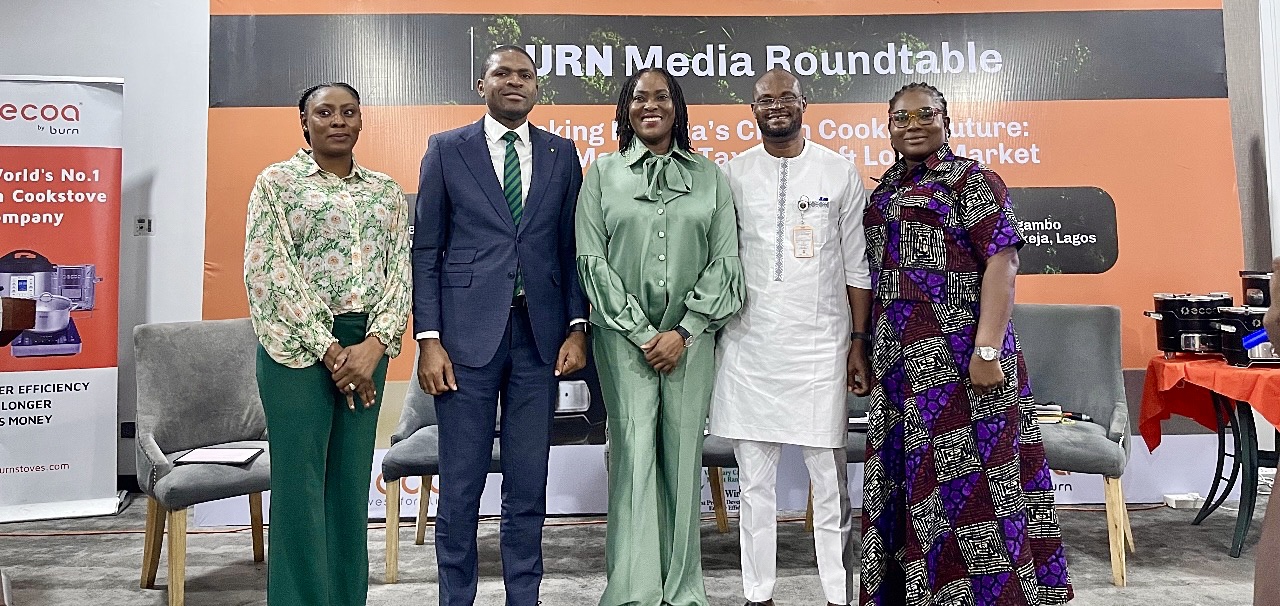
This was revealed at the BURN Clean Cooking Media Roundtable in Lagos on Wednesday, where policymakers, tax experts, manufacturers and climate advisers met to confront the challenge of how 90 million households still cook.
Held on January 28 at L’Eola Hotel, Maryland, stakeholders across carbon finance, tax policy, standards regulation and manufacturing aligned with Nigeria’s 2030 universal clean cooking access goal, and defined what must happen after COP30 for that goal to remain credible.
Etulan Ikpoki, country manager at BURN Manufacturing Nigeria, anchored climate policy in everyday life. She noted that clean cooking is usually discussed in abstract terms, but is lived daily by families who cook with charcoal, firewood, and unsafe fuels.
“Clean cooking, carbon markets, industrial policy, these are often seen as technical issues, but at the core, they are human stories. They are about how families cook, how women and children breathe, how jobs are created, and how Nigeria delivers on its climate ambition in practical ways.”
Ikpoki pointed to Nigeria’s recent policy changes, including the Nigeria Carbon Market Activation Policy launched in October 2025 and ongoing tax and industrial reforms, as commendable, but warned that policy alone does not provide outcomes.
“What we are now seeing is a shift from ambition on paper to delivery on the ground. That transition depends not only on policy and investment, but on informed, accurate and responsible reporting.”
She described the roundtable as a means to demystify how clean cooking works end-to-end, from factory floor to household kitchen, from emissions measurement to carbon revenue, and from subsidy models to affordability.
During the session, BURN showcased its locally manufactured ECOA clean cookstove, designed for charcoal users transitioning away from inefficient cooking methods. The company said the stove retails below N100,000, with carbon finance used to reduce the upfront cost for low-income households.
BURN explained that the ECOA clean cookstove sits at the centre of its clean cooking strategy in Nigeria, combining fuel efficiency, reduced household smoke, and carbon-financed affordability.
“Clean cooking is one of the few climate solutions Nigeria can scale quickly, credibly, and at household level. When local manufacturing, strong standards, and carbon finance work together, the results are immediate—lower emissions, healthier families, and real economic value.
“We welcome the government’s leadership in putting policy frameworks in place that support credible carbon markets and clean energy investment,” Ikpoki said.
Carbon markets and the value of certainty
That link between credibility and capital was taken further during the technical session, which walked journalists through the journey of a BURN stove, from manufacturing to first carbon credit.
Using the ECOA cookstove as a case study, the company showed how emissions reductions are measured, verified and issued as carbon credits, and how those revenues are used to lower the cost of clean cooking for households.
The presentation explained how clean cooking projects currently operate in voluntary carbon markets, where credits trade at lower values, and how Nigeria’s emerging compliance frameworks could significantly change investor trust.
The discussion clarified that once government authorisation frameworks are fully operational, clean cooking projects become eligible for higher-value international mechanisms, including bilateral transactions and aviation offsets.
That transition, speakers stressed, is what turns climate finance into a durable revenue stream rather than short-term subsidy.
Carbon finance rewards integrity, measurement, and regulatory alignment. Without those, scale stalls.

Tax policy as an industrial tool
The panel session, moderated by Irene Obinikpo, Call Centre Manager at BURN Manufacturing Nigeria, shifted the conversation from carbon to fiscal structure.
Chijoke Odo, Indirect Tax Partner and West Africa Trade Advisory Leader at Deloitte, explained that tax policy is usually treated narrowly as a revenue tool, when it should be used intentionally to shape industrial outcomes.
He argued that Nigeria already has incentive frameworks capable of reducing production costs for manufacturers like BURN, but that many businesses fail to fully align with them.
More importantly, he stressed that fiscal incentives only work when government agencies act in coordination. Incentives provided by one arm of government can be cancelled out by misaligned standards enforcement or customs practices elsewhere.
Standards, safety and enforcement
That point flowed naturally into contributions from Engr. Benedict Souarede Preake, Chief Technical Officer at the Standards Organisation of Nigeria (SON).
Preake emphasised that clean cooking scale cannot come at the expense of safety or quality. Weak enforcement, he noted, allows sub-standard and counterfeit stoves into the market, undercutting compliant manufacturers and putting households at risk.
For clean cooking to earn public trust, he said, standards must be enforced consistently, not selectively. Quality assurance, certification, and testing are not optional add-ons; they are the backbone of market assurance.
Manufacturing, jobs and the Nigeria-First argument
From an industry perspective, Mrs Victoria Onuoha, who oversees the Manufacturers Association of Nigeria’s environment and green manufacturing agenda, described clean cooking as an industrial opportunity Nigeria cannot afford to ignore.
She argued that locally manufactured clean stoves sit at the meeting point of climate action and job creation, offering a good course to green industrialisation if supported by coherent policy.
Her position aligned with Olamide Fagbuji, Senior Special Assistant to the President on Climate Technology and Operations, who spoke on the need for policy coordination across ministries to ensure climate commitments translate into operational outcomes.
Both speakers reinforced the idea that Nigeria-First policies must move beyond slogans, embedding climate manufacturing into tax, customs, and industrial planning.
Governance, accountability and global standards
Adding a governance lens, Naomi Nwokolo, Executive Director of the UN Global Compact Network Nigeria, situated clean cooking within Nigeria’s ESG and sustainable development commitments.
She stressed that credible climate solutions require transparency, accountability, and alignment with global best practice, especially as Nigeria seeks to attract long-term investment into its carbon market.
Clean cooking, she noted, is one of the few climate interventions that delivers measurable benefits across health, gender equity, emissions reduction, and economic resilience, but only if integrity is maintained.
Evidence from the field
The data presented throughout the session grounded the policy debate in measurable results.
Independent research noted during the roundtable showed that one BURN ECOA clean cookstove delivers average household savings of $119 per year, achieves 98% customer satisfaction, and generates a 295% internal rate of return.
Over three years, the total social return reaches $1,000 per stove, through fuel savings, health improvements, and emissions reductions.
As of 2026, BURN has distributed over 500,000 clean cookstoves in Nigeria, positively impacting 2.2 million lives, saving 7.8 million tonnes of wood, and avoiding 11.9 million tonnes of CO₂ emissions nationwide.