


TelCables Nigeria, a subsidiary of Angola Cables, is scaling up Clouds2Africa, a naira-denominated cloud and artificial intelligence infrastructure offering aimed at helping Nigerian banks, fintechs and startups meet Central Bank of Nigeria (CBN).
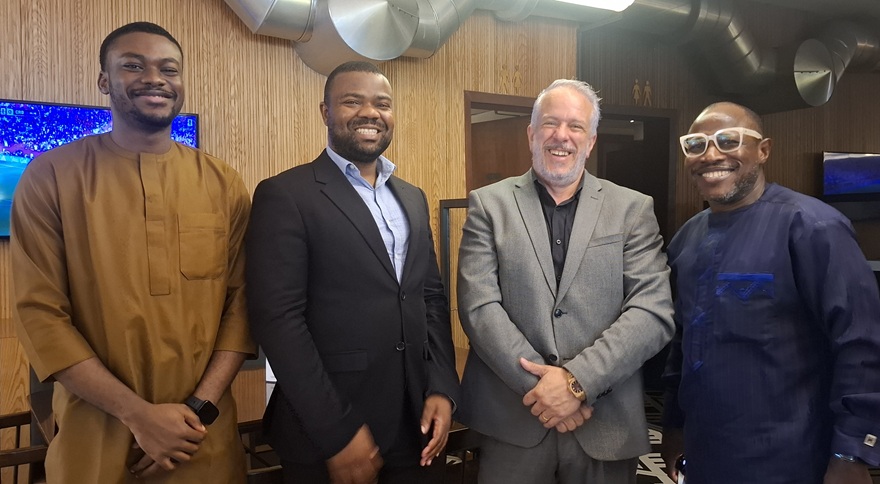
Clouds2Africa has unveiled to the media on over the weekend by TelCables Nigeria executives in Lagos as as CBN data localisation requirements option with business-friendly pricing model for accessing advanced AI models.
In an interview with Techeconomy, Fernando Fernandes, chief executive officer of TelCables Nigeria detailed a two-pronged strategy built around a multi-model AI API platform and a local cloud hosting service, both priced in Naira and hosted from data centres inside Nigeria.
Multi-model API Gives Startups Access to Claude, LLaMA, DeepSeek
At the centre of the offering is Token Factory, accessed through the GoForAI suite, which gives developers a single API through which to reach multiple large language models, including Claude, Meta’s LLaMA, DeepSeek and Kimi AI.
Users register on the portal and can integrate the API into an existing product, a banking application, for instance, with minimal code changes, according to the executives.
Switching between models requires only changing the model name in the API request, he affirmed, allowing developers to compare performance or cost across providers without rebuilding their integration.
The platform also allows users to spin up virtual machines pre-configured with GPU access, which the company said lets startups install, fine-tune or train AI models locally and privately rather than relying solely on third-party model providers.
Payment is handled through an integration with Paystack, letting Nigerian users fund their usage wallets directly in Naira rather than through foreign-currency billing.
Clouds2Africa Targets CBN Data Localization Compliance
Fernando told Techeconomy that the company’s cloud hosting product, Clouds2Africa, is aimed at developers seeking to host platforms locally rather than on international hyperscalers.
“It is publicly accessible via the company’s website, accepts payment through standard Nigerian Naira ATM cards, and includes a pricing calculator that lets prospective customers estimate consumption costs before committing”, he said.
Fernandes linked the product directly to CBN regulatory requirements on data localisation, saying the company operates two local cloud nodes housed in two Tier 3 data centres within Nigeria.
“Running two in-country nodes,” he said, “allows TelCables Nigeria to offer local data backup and disaster recovery,” a requirement he described as critical for financial-sector clients bound by CBN rules on keeping sensitive data within Nigerian borders.
No Migration or Traffic Fees
TelCables Nigeria is positioning cost and support as differentiators against international cloud providers.
Fernando said the company does not charge customers to migrate existing data onto its platform, and does not levy the traffic charges that international providers typically apply to data moving between a customer and the local node.
“The infrastructure includes embedded DDoS protection built to withstand the volume of attacks typically directed at telecom networks,” the TelCables Nigeria CEO told Techeconomy.
Despite its local focus, the platform is connected to more than 500 cloud nodes globally through Angola Cables’ network, which the executive said allows Nigerian clients to scale internationally without changing providers.
For companies without in-house technical capacity, TelCables Nigeria said it deploys a team of more than 30 engineers to support workload migration.
99.99% Uptime Pledge, Tiered Support
On service reliability, Julio Chilela, the chief digital officer of Angola Cables said that TelCables Nigeria is committed to a 99.99% (“four nines”) availability service-level agreement, backed by a tiered support structure:
“Level 1 engineer(s) handles (handle) direct customer contact and initial troubleshooting, while Level 2 engineers are dedicated to resolving deeper technical issues.
“A separate infrastructure and observability team monitors the company’s running services on an ongoing basis,” Julio explained.
Clouds2Africa push comes as Nigerian regulators, including the CBN, tighten data localisation and sovereignty requirements for financial and payment-sector operators, pressuring firms to weigh compliance costs against the reach and pricing of established global cloud providers.



