…with Nigeria Positioned to Gain
Global credit insurer Coface has downgraded risk assessments for eight countries and 45 economic sectors following more than fifteen weeks of Middle East conflict, warning that the inflationary and supply-chain disruptions triggered by the crisis will weigh on African economies through 2027, even as commodity exporters such as Nigeria stand to benefit from higher oil prices.
The assessment, published in Coface’s June 2026 Risk Review, comes as a memorandum of understanding between the United States and Iran signals a fragile de-escalation in the region.
But according to Coface, the pause in hostilities does not equate to a return to normal conditions. The duration and intensity of the conflict far exceeded initial expectations and has disrupted a region central to global energy supply chains, the report said.
A widening gap between importers and exporters
Coface’s analysis draws a sharp distinction between Africa’s oil-importing and oil-exporting economies.
South Africa, Egypt and Morocco, all net oil importers, face intensifying inflationary pressure, particularly on food and transport costs, as energy prices rise.
Nigeria, by contrast, is positioned among the continent’s commodity exporters that could see a net benefit from higher global oil prices, even as it also ranks among Africa’s most industrialised, and therefore most oil-dependent, consuming economies.
That dual exposure, as both a major oil producer and a significant fuel-importing economy given Nigeria’s historical reliance on imported refined petroleum products, means the net effect of the shock on Nigeria’s economy is unlikely to be straightforwardly positive, though the report does not model Nigeria’s net position in isolation.
Coface said the inflationary spillover will not be confined to oil-consuming industrialised economies.
Even less oil-dependent African economies will face pressure through rising food prices, driven by higher input costs, fertiliser shortages and adverse weather conditions, a combination the report says will weigh on continental GDP growth in 2026 and 2027.
Countries “with deteriorated public finances or external accounts face heightened risks in a context of tighter financing conditions,” the report noted, while commodity exporters benefiting from higher prices will reinforce a growing divergence in economic performance across the continent.
Global growth downgraded, insolvencies rising
Coface revised its global GDP growth forecast down to 2.3% for 2026 and 2.5% for 2027, a cumulative reduction of 0.6 percentage points across both years, citing production stoppages, the return of inflationary pressure, and tightening financial conditions.
The firm said governments globally have very little room for manoeuvre to support economic activity and incomes in response.
Brent crude is now expected to average $85 per barrel in 2026, according to Coface’s revised forecast.
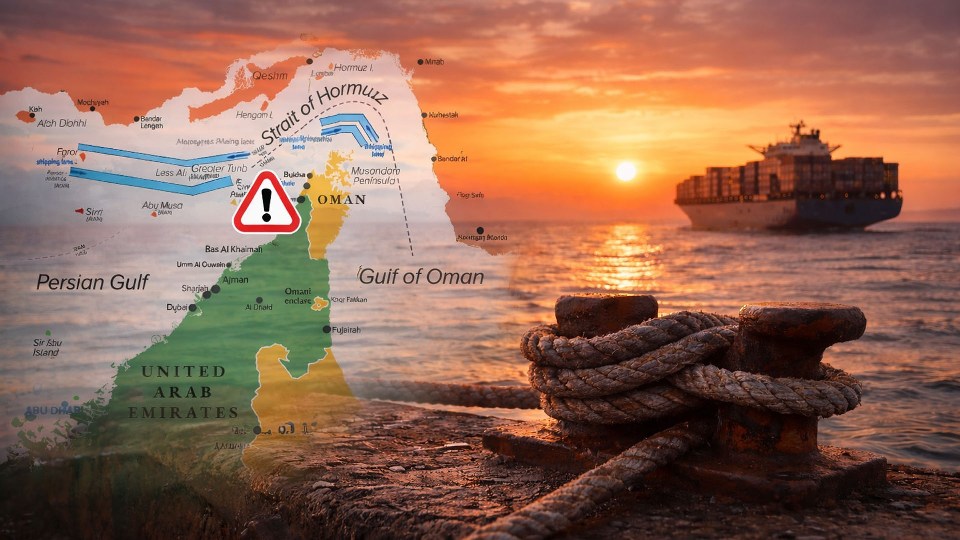
The disruption has been most visible in maritime transport through the Strait of Hormuz, a critical chokepoint for global hydrocarbon supply.
Coface data shows only 145 vessels transited the strait in May 2026, compared with more than 3,300 during the same month a year earlier, a contraction the firm says has already produced longer delivery times, rising costs, and early signs of shortages as companies build precautionary stockpiles at the expense of cash flow and margins.
Against that backdrop, Coface expects global corporate insolvencies to rise 6% this year, with particularly sharp increases forecast in the United States, France and Japan.
Regional divergence
Coface’s report details significant variation in how the shock is being felt across regions:
- Middle East: Gulf states directly exposed to the Strait of Hormuz have seen the sharpest contractions, given their dependence on the passageway for exports.
- Europe: Rising energy prices and prolonged uncertainty are weighing on domestic demand, with eurozone growth now forecast at just 0.7%.
- United States: Inflation has risen sharply, from 2.4% in February to 4.2% in May, squeezing purchasing power and consumption among low-income households.
- Asia: The picture is mixed, South Korean semiconductor exports are up 153% since the start of the year, while other sectors face squeezed margins.
- Latin America: The shock has driven a resurgence in inflation and more restrictive monetary policy, with Brazil’s key interest rate now at 14.5%.
41 sector downgrades across 19 countries
Jean-Christophe Caffet, Coface’s chief economist, said the de-escalation in the Middle East should not obscure the scale of economic damage already set in motion.
“The lull in hostilities in the Middle East is good news, but it cannot conceal the key issue: the disruptions that are already under way will drag on business activity, income and employment,” Caffet said. “An unprecedented total of 41 sector downgrades across 19 countries underscores the global impact of a conflict whose consequences for trade flows and corporate profitability will continue to weigh heavily in the coming months.”
Of Coface’s 45 total sector risk reassessments, 41 were downgrades and just four were upgrades, a ratio the firm frames as evidence of how broadly the conflict’s economic effects have spread beyond the Middle East itself.
What this means for Nigeria
For Nigeria, the report’s findings point to a familiar but sharpened tension. As one of Africa’s largest crude oil producers, higher Brent prices, now expected to average $85 per barrel in 2026, could improve government revenue and foreign exchange inflows if sustained.
But Nigeria’s continued exposure to imported refined fuel, alongside broader continental pressure on food prices from fertiliser shortages and rising input costs, complicates any straightforward reading of the country as a clear winner from the shock.
Coface’s report does not provide Nigeria-specific growth or sector-downgrade figures, leaving the precise domestic impact, including whether Nigeria features among the eight downgraded countries or 45 reassessed sectors, unspecified in the material reviewed.