

In 1947, Edward Bernays, the man history calls the father of public relations, published an essay titled ‘The Engineering of Consent.’
His thesis was revolutionary: public opinion is not a natural phenomenon. It is an environment that skilled communicators can systematically shape.
Nearly eight decades later, as artificial intelligence transforms every aspect of how organisations communicate, I believe Bernays’ insight demands a critical update.
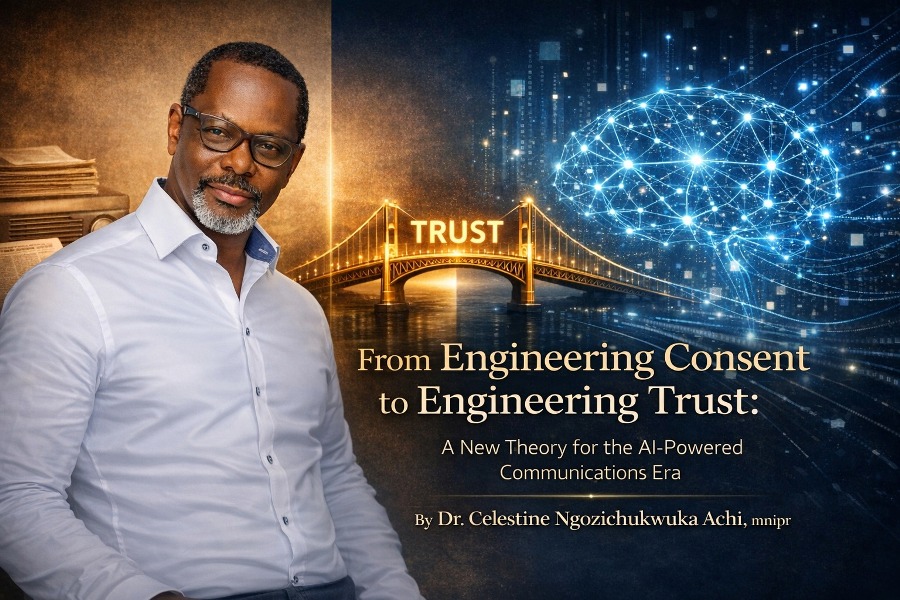
We have moved beyond the engineering of consent. We have passed through the engineering of attention that defined the social media era. We have now entered what I call the Engineering of Trust, and Nigeria’s communications professionals are at the centre of this transformation.
The logic is straightforward. When a communications professional deploys AI to draft a press release, analyse media sentiment, or generate stakeholder reports, they are engineering the informational context that the AI uses to reason and produce output.
This is what the technology industry calls ‘context engineering’, a discipline Gartner has predicted will define enterprise AI adoption globally by 2026.
But the communicator’s responsibility does not end there. The output that the AI produces must then be trusted by its human audience: the journalist, the regulator, the board member, the citizen. If either level fails, if the AI receives poor context, or if the human audience receives untrustworthy output, the entire system collapses.
This is why trust is now both the method and the measure of AI-powered communications. It is the input to the system and the output expected by stakeholders. It is the operating system.
I have seen this play out directly. Over the past two years, through Cihan Digital Academy, I have trained more than 5,600 communications professionals across Nigerian institutions including the National Pension Commission, the National Orientation Agency, the Federal Radio Corporation of Nigeria, FCMB, the Asset Management Corporation of Nigeria, and the Nigeria Customs Service.
The pattern is consistent. The professionals who succeed with AI are those who treat implementation as an exercise in trust engineering, building literacy, identifying gaps, creating practical solutions, testing rigorously before deployment, and then scaling with continuous oversight.
This is the methodology we formalised as the TABS-D Framework: Train, Adapt, Build, Ship, Deploy.
The professionals who struggle are those who treat AI as a magic box. They input a question, receive an answer, and publish it without verification. They are one fabricated statistic away from a credibility crisis.

The National Orientation Agency provides a compelling example of what trust engineering looks like in practice.
Using our TABS-D-inspired process, the agency deployed an AI-driven citizen-engagement system, an agency-to-agency AI collaborator, and a visualiser dashboard that identifies emerging scenarios for proactive policy response. Every phase was an exercise in building trustworthy systems, not just functional ones.
Through this work, I have identified six principles that define the Engineering of Trust:
Context determines trust – the quality of the AI’s informational context determines the quality of its output.
Trust is architectura; it is built through system design, not individual outputs. The communicator now engineers for two audiences, both the AI and the human stakeholder.
Verification is not optional; human oversight is a structural requirement, not a safety net. Trust scales only through governance, organisational trust requires formal frameworks. And trust lost to AI is harder to rebuild, because stakeholders attribute AI errors to systemic failure, not human fallibility.
Nigeria stands at a consequential juncture. Our institutions are adopting AI at pace. The National Information Technology Development Agency has established a policy framework. Federal agencies are integrating AI into their communications operations. The private sector is moving even faster.
But adoption without trust engineering is a liability masquerading as progress. Every AI-generated press release that contains an unchecked fabrication, every sentiment report built on poorly structured data, every governance document that misses a regulatory requirement, these are not technology failures.
They are trust engineering failures. And in a society where institutional trust is already fragile, the cost of such failures is compounded.
Bernays understood that the environment matters more than the message. In Nigeria’s AI era, this insight carries life-or-death weight for institutional credibility. We must engineer trust into every AI system we deploy, not as an afterthought, but as the foundation.
The era of the Engineering of Trust has begun. Nigerian communicators must lead it.
Dr. Celestine Ngozichukwuka Achi is the CEO of Cihan Media Communications, Founder of Cihan Digital Academy, and author of ‘AI-Powered PR: The Essential Guide for Communications Leaders to Master Artificial Intelligence.’ He has trained over 5,600 professionals in AI-powered communications across Nigeria and Africa.