



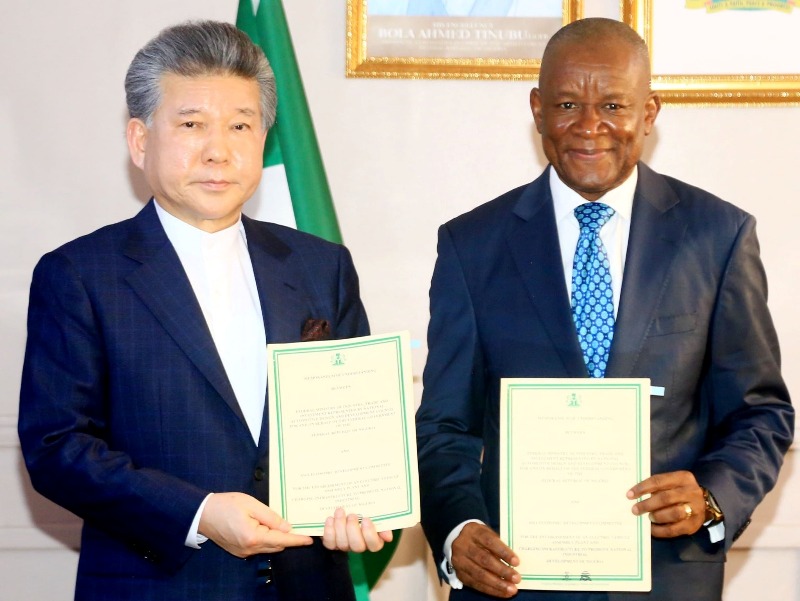
Nigeria and South Korea have agreed to establish an electric vehicle (EV) manufacturing plant and charging infrastructure, aimed at boosting local production and EV adoption.
The Memorandum of Understanding (MoU) was signed by John Enoh, minister of State for Industry, and representatives of South Korea’s Asia Economic Development Committee (AEDC).
The National Automotive Design and Development Council (NADDC), in announcing the bilateral agreement, said the pact aligns with Nigeria’s National Energy Transition Plan (ETP) and the National Automotive Industry Development Plan (NAIDP).
The zero-emission vehicle initiative will be implemented in phases, with each batch increasing production toward an optimal capacity of 300,000 vehicles. The objectives include creating 10,000 direct and indirect jobs.
“The project will be implemented in phases, beginning with EV assembly and expanding into full in-house production, with an estimated capacity of 300,000 vehicles and the creation of approximately 10,000 jobs,” the NADDC stated.
According to Oluwemimo Osanipin, director-general (DG) of the NADDC, the Electric Vehicle initiative will boost research, design, human capital development, and technological advancement.

Osanipin was represented by Nura Sidi, the head of policy, planning, and statistics.
The NADDC added that Nigeria is building “a sustainable automotive ecosystem that supports local manufacturing, green energy adoption, and global competitiveness”.
The bill seeking to establish legal, legislative, and policy frameworks for Nigeria’s shift from petrol vehicles to electric vehicles scaled second reading at the Senate on November 5, 2025.
The sponsor of the bill, Orji Uzor Kalu, senator representing Abia North senatorial district, noted that the proposal will help to reduce carbon emissions, boost local manufacturing, and enhance clean mobility.