



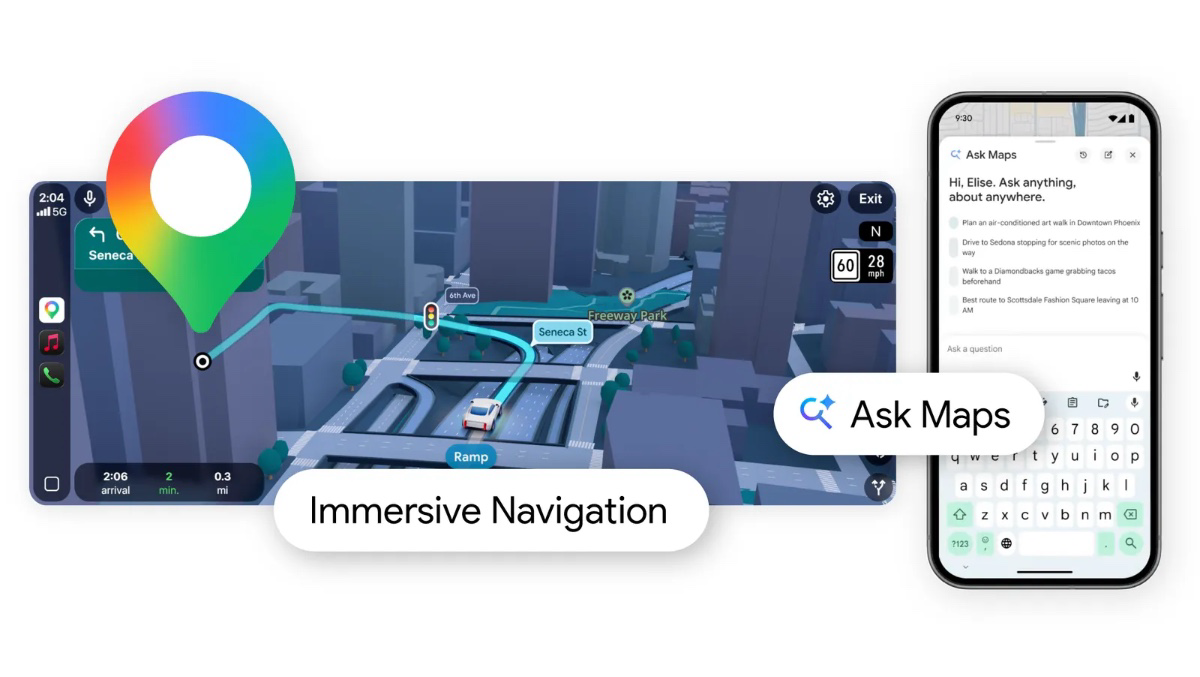
Google Maps is introducing a new conversational feature powered by Gemini, allowing users to ask detailed questions directly inside the app.
At the same time, the company is rolling out a redesigned navigation system that shows routes in a more detailed 3D view and offers clearer driving guidance.
The update was announced on Thursday and affects both exploration and driving features in the mapping service.
Google says the new tool, called Ask Maps, allows people to search for places using natural language. Instead of typing short queries, users can ask full questions about real-world situations.
For example, someone could ask where to charge a dying phone without waiting in a coffee shop queue. Another query might be about public tennis courts with lights available at night.
The feature can also help with trip planning. A user heading to locations such as the Grand Canyon, Horseshoe Bend and Coral Dunes could ask for recommended stops along the route. Maps then provides directions, estimated travel times and suggestions drawn from reviews and tips shared by other users.
Google says the answers are personalised as the system uses signals from a person’s past searches and saved locations in their account. If someone often searches for vegan restaurants, the service may prioritise restaurants with vegan options when suggesting places to meet friends.
The company says the feature draws on information from more than 300 million places listed in Maps and reviews contributed by over 500 million community members.
Ask Maps is now rolling out in the United States and India on Android and iOS devices. Google says desktop access will follow later.
Alongside the conversational tool, Google is also updating the app’s navigation system with a new experience called Immersive Navigation.

The update brings a 3D view that reflects nearby buildings, overpasses and terrain. It also highlights important road details, including lanes, traffic lights, crosswalks and stop signs, giving drivers a clearer sense of their surroundings.
Maps will also provide a wider preview of the route ahead. Smart zoom features and transparent buildings help drivers prepare for lane changes or difficult turns earlier.
Voice instructions are also changing. Instead of standard directions, the app now provides more natural guidance. For example, drivers approaching a highway exit may hear instructions such as, “Go past this exit and take the next one for Illinois 43 South.”
In addition, the system explains alternative routes and the trade-offs involved. A longer route with lighter traffic or a faster route that includes toll roads may both appear, allowing drivers to choose.
The app will also alert drivers to disruptions along their route, including crashes or road construction. Google says these updates rely on information shared by users across both Maps and Waze communities.
Before starting a trip, users can preview their destination using Street View imagery. Maps can suggest parking areas and, as drivers get closer, highlight the correct entrance to a building and the side of the street where it is located.
“Our team set out to redesign the driving experience with the objective of taking the guesswork out of trips,” said Miriam Daniel during a briefing with reporters.
“Immersive navigation is a complete transformation of the navigation experience. It’s got redesigned visuals, fresh real-world information that’s brought to you just in time, and more intuitive guidance.”
Immersive Navigation begins rolling out in the United States from Thursday. Google says the feature will gradually reach supported Android and iOS devices, as well as Apple CarPlay, Android Auto and vehicles with Google built-in systems.
Google had already begun integrating Gemini into Maps last year. That earlier update allowed the assistant to answer questions about locations along a route and use landmarks identified through Street View imagery to improve navigation directions.