

The scale is no longer something to doubt because the world’s largest technology companies are fully ready to spend between $650 billion and $690 billion on AI infrastructure this year 2026, nearly double what they committed just a year earlier.
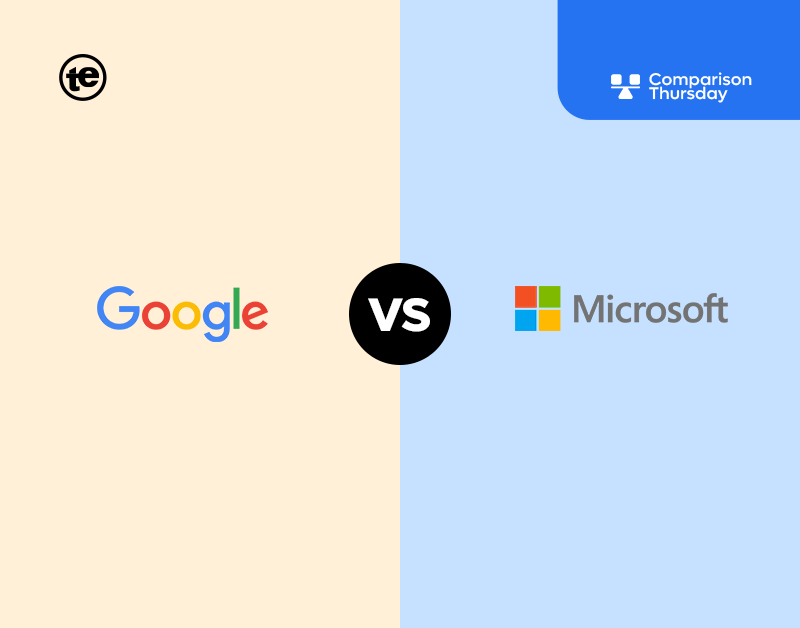
Within that surge, the drive between Google and Microsoft has become one to pull focus on, not just for technology leadership, but for how artificial intelligence (AI) turns into profitable business, especially with committed spending.
Two Companies, Two Directions
Even before you look deeper, you’d notice both companies are building similar systems, but you’d see the difference in how those systems are used.
Google is pushing its models into products people already use every day, including Search, Android, and YouTube. Its Gemini platform has crossed 750 million monthly users, giving it reach that few competitors can match.
Microsoft is taking a different route which is more structured. Its Copilot tools are built into Word, Excel, Teams and other workplace software. The idea is to make businesses pay for productivity.
That difference is where we place our attention. Google has scale, while Microsoft has pricing.
The Competition is Infrastructure
It is easy to focus on apps and chat interfaces, but that is not where the case is being decided.
It is in infrastructure you’d find the competition; data centres, chips, and computing power.
Alphabet, Google’s parent company, plans to spend $175 billion to $185 billion in 2026 alone, largely on servers, networking and AI capacity.
Microsoft is also increasing spending, with its capital expenditure expected to move towards $100 billion or more, driven by demand for cloud and AI services.
This level of investment changes the nature of the industry. AI is not just software, it is capital-intensive, closer to energy or telecoms than traditional tech.
I would put it this way, whoever controls compute, controls the market.
Products: Gemini vs Copilot
The difference in strategy becomes better to grasp at the product level.
Google’s Gemini is built for wide use, sitting inside search results, mobile devices and developer tools. Updates have been frequent, with new versions released through 2025 and early 2026 to improve reasoning and performance.
Microsoft’s Copilot is more targeted, focusing on workplace tasks, writing documents, analysing spreadsheets, and summarising meetings.
But adoption?
Microsoft has around 15 million paid Copilot users, a small share of its Microsoft 365 base of hundreds of millions.
That gap stresses the fact that interest in AI tools is high. Paying for them is still limited.
Cloud: Where the Money Actually Comes From
The revenue engine is behind the scenes. Google Cloud has been expanding, with revenue growth close to 48% year-on-year, driven largely by demand for AI workloads.
Microsoft Azure is however a larger business, with strong growth tied directly to AI usage and enterprise demand.
This is where the competition becomes tougher because companies are not just using AI tools, they are renting computing power to run them.

Cloud turns AI into something billable.
Spending is Increasing Faster Than Returns
There is, nonetheless, an imbalance.
Microsoft is targeting $25 billion in AI-related revenue by 2026, supported by Copilot and Azure services.
Google is already seeing profits in advertising and cloud from its AI rollout.
But both are spending far ahead of what they are earning.
Even within Microsoft’s ecosystem, only a small percentage of users are paying for AI features, despite heavy investment and promotion.
So when does this start paying off?
It is Important to note that Investors are not ignoring the risk.
Google’s decision to increase spending has already triggered mixed reactions in the market, even as its core business stands strong.
Microsoft is facing a different issue, which is adoption. Copilot is growing, but not at a pace that fully justifies the scale of investment yet.
So the market is in a strange position, believing in the long-term potential, but watching the short-term numbers carefully.
Here the Bigger Question Comes
This has gone beyond a competition between two companies. Will the current level of investment produce the kind of productivity being promised?
The comparison with past technology cycles is unavoidable. Large amounts of capital are being deployed ahead of proven returns. That does not automatically mean a bubble, but it does introduce risk.
Right now, demand for computing power is strong, but what we don’t know is whether that demand will remain strong enough to justify the infrastructure being built.
Who is Ahead?
The answer depends on how you measure it.
Google is ahead when it comes to reach. Its products touch billions of users, and its AI systems are already embedded into everyday digital activity.
Microsoft comes top in structure. It has a clearer path to monetisation through enterprise software and cloud services.
Google and Microsoft are strong when it comes to AI, both are spending heavily, but neither has fully solved the same problem, which is turning scale into sustained profit.
So, let’s not look at who builds the better model between Google and Microsoft or who comes top in AI spending, but who can turn artificial intelligence into a reliable business before the cost of building it becomes harder to justify.
That is where this growth will be decided.