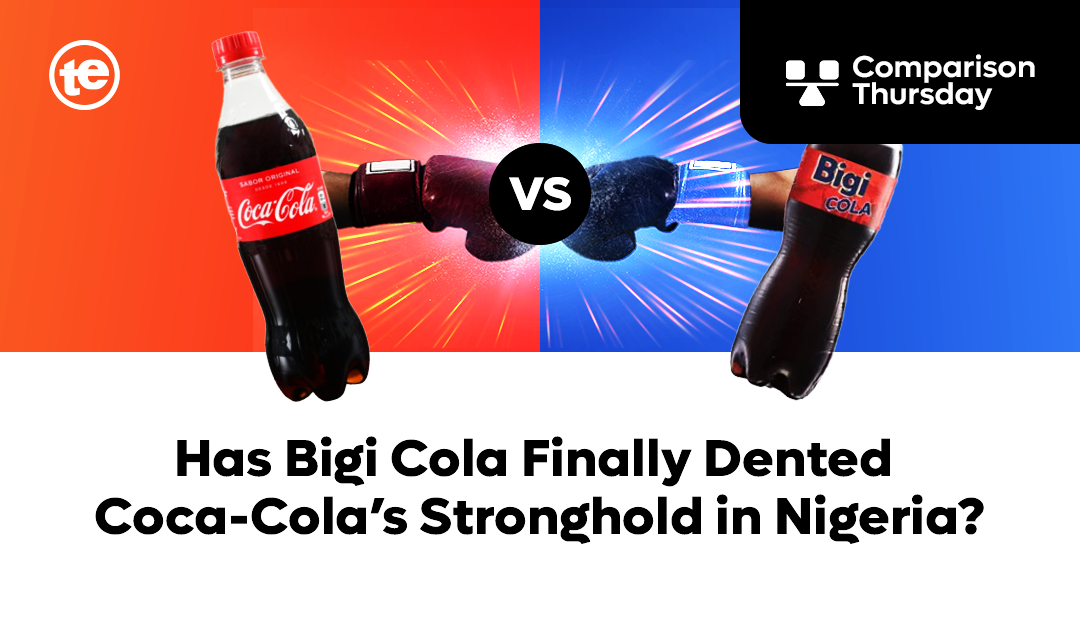
There’s a kind of irony that only Nigerians can appreciate. In our country, survival shapes spending habits, and a N500 Coca-Cola bottle sells like a status symbol.
Meanwhile, the Bigi Cola bottle, standing tall at 60cl and priced at N300, sits right next to it on the shelf, not projecting sophistication or class, but screaming survival.
We are not just looking at soda here. It’s about economics, branding, loyalty, and the unspoken tension between global legacy and local strategy.
This is the cola competition. And it’s happening right now in kiosks, supermarkets, roadside stalls, and food trays across Nigeria.
A Tale of Two Brands
Coca-Cola is, without argument, a global giant. With a brand value of $106.45 billion as of 2024 and a U.S. market share of 44.9%, it has stayed for years. It spent over $5 billion on advertising in 2023 alone, strengthening its image in every corner of the world, from Super Bowl stadiums to rural villages in Kano.
But Bigi Cola is not here to compete on ad spend or international presence. It’s competing where it matters most in today’s Nigeria; price, volume, and relevance.
Produced by Rite Foods, a proudly Nigerian company based in Ogun State, Bigi Cola is built for this market. Its pricing is tactical. Its 60cl bottle is larger than Coca-Cola’s 50cl offering, though we’ve recently seen coke’s 60cl, but we are not sure how long it will stay.
And in a society where perception and quantity usually compete, Bigi is playing a game it understands well.
Pricing and the Power of the Pocket
Truthfully, our economy is biting. Inflation has turned soft drinks into luxury items. Households are being forced to prioritise. The average consumer today is less concerned about whether a drink is “classic” or “premium,” and more interested in what gives them more sip per naira.
Bigi Cola taps into this logic perfectly. For N300, you get more volume, though individuals have varying taste preferences, when stressed and tasty, some forget about taste and go for ‘affordable chill’. Coca-Cola, with brand nostalgia and global polish, can’t argue with affordability, at least not convincingly.
Taste and the Nigerian Palate
There are talks in streets and online forums, which one tastes better?
Coca-Cola has its signature blend, the same formula across 200+ countries. It’s familiar, comforting, and, to some, irreplaceable.
But Bigi isn’t trying to be familiar. It’s going for intensity. Its cola has a slightly sharper bite. Some call it “harsh,” others say it’s “richer.” But what’s obvious is that Bigi isn’t aiming to replicate Coke. It’s offering a different flavour for a different kind of loyalty, one built not on nostalgia, but on current realities.
And those realities are changing direction. Coca-Cola Zero Sugar saw an 11% rise in Q3 2024 globally, showing that concerns about health are growing. But in Nigeria, sugar-free isn’t the trend, affordability is.
Marketing: Emotion vs Tactics
Coca-Cola is a master of emotional storytelling. “Share a Coke.” “Open Happiness.” It doesn’t just sell as soda, but as moments, identity, memories.
Bigi doesn’t do memories. Its branding is loud, punchy, and product-focused. It sponsors Nigerian Idol and other local events, speaks the street language, and sells itself as the drink for now, not yesterday.
While Coca-Cola’s ads are usually lustrous and global, Bigi focuses on more drink, less money. That’s a message Nigerians understand without subtitles.
Distribution and Availability
Both brands are visible, but Bigi’s penetration has been strategic. It’s flooded secondary markets, filling gaps Coca-Cola didn’t even know existed, from small towns to remote communities. With agile distribution and local pricing control, Bigi’s approach mirrors Nigeria’s informal economy; fast, adaptive, and rooted way deep.
Coca-Cola’s network is expansive, but its pricing feels detached from the Nigerian economic pulse. While it dominates urban areas and fast food chains, it’s losing ground in corner shops and roadside bukas, the real battleground.
We are not all about business stories, but a cultural one. Coca-Cola symbolises aspiration. To many, drinking it still feels like stepping into a global lifestyle. But Bigi represents something else, resilience, relevance, and survival. It’s not trying to be elite. It’s trying to be enough.
And sometimes, enough is exactly what people need. In that sense, Bigi Cola is beyond a cheaper option. It’s a reflection of how Nigerians are adjusting their expectations, priorities, and tastes in response to economic hardship. It’s not always about loyalty, sometimes, it’s about logic.
Finally?
Bigi Cola will not take Coca-Cola’s crown, but that’s not the point. It doesn’t need to dethrone the king. It just needs to keep growing in a market that’s tired of paying premium for prestige.
Coca-Cola’s strength lies in its brand power and emotional connection. Bigi’s strength is in its adaptability and alignment with the present situation of Nigeria. There’s space for both, but the gap is closing.
So, what’s in your fridge right now? A N500 bottle of global heritage or a N300 gulp of local fortitude? Your next drink might just be casting a vote.