


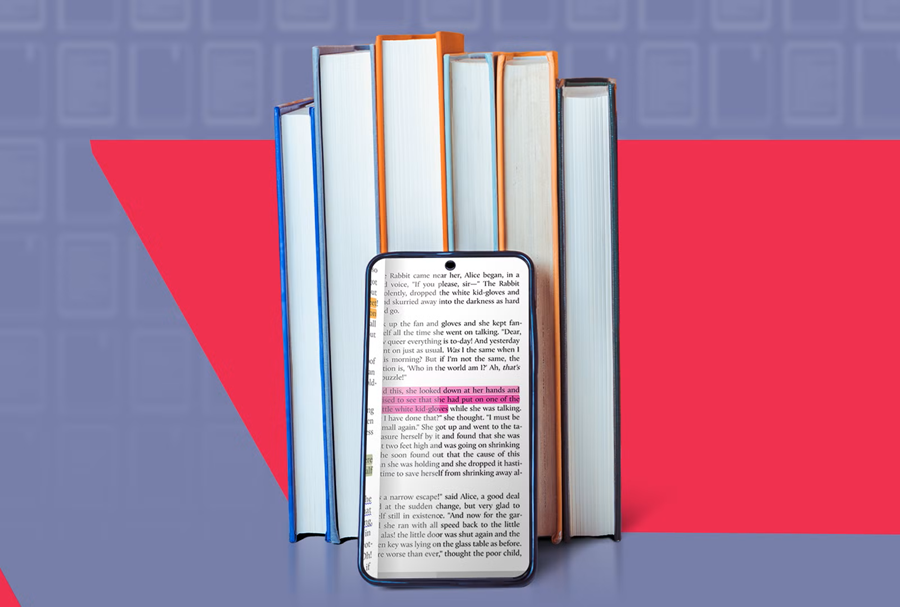
World Book Day was marked last week, but if you survey students across many Nigerian higher institutions, you will notice something different.
The heavy books of the past are disappearing and, in their place, is the smartphone.
This change is not something new. Digital learning has been growing for quite some time now. However, in 2026, smartphone trends point to a stronger transition from distraction device to digital workstation, or more accurately, a portable classroom.
Driven by advances in hardware and artificial intelligence, the marketing of 2026 smartphones now focuses more on processing power and productivity, rather than only entertainment and communication.
However, as we examine this shift, we must also consider the current market reality, where budget smartphones now sell for as much as what a flagship would cost three years ago.
This review explores how the smartphone trends this year positively influence the study life of Nigerian students.
Display Ergonomics: The Industry Shift to Flat Screens
For years, smartphone manufacturers chased after curved displays for the premium “wow” factor. But for a student trying to read an ebook on Classical Mechanics, curved displays created challenges like text distortions and annoying glare.
From the phones released so far in 2026, the industry has returned to flat displays. From Samsung’s A series or flagship S series, which is known for curved screen models, to the new Infinix Note 50, flat panels are back in both the midrange and premium segments.
For students and e-readers generally, flat panels eliminate the edge distortions and light refraction that come with curved displays. This shift improves text legibility and the precision of stylus pens, making smartphones and tablets more like physical notebooks.
On-Device AI: Integrating Intelligent Research Tools
In 2026, the biggest trend in tech is on-device AI, and for Nigerian students, this is more than a lifesaver. The new AI features now clearly supersede the voice command era of Siri, and this is due to the new advanced processors with NPUs from Mediatek and Qualcomm.
With a 2026 smartphone, you can upload a 100-page academic e-book and the AI will summarise, give context or key takeaways in seconds. You can also carry out extensive voice-to-text lectures or study a book written in a foreign language with the help of the new AI-powered phones of 2026.
This does not mean phones from previous years are not good for AI processing, it only implies that 2026 chips are more AI-specific and local AI processing is more prevalent than ever.
High-Capacity Batteries With up to 100W Fast Charging
To be realistic, a “digital classroom” is useless if there is no power supply and your battery is below 10 percent.
The 2026 smartphones have fully addressed this challenge with batteries the size of power banks combined with reverse wired charging. We are seeing more phones with over 6000mAh batteries combined with up to 100W fast charging in even the entry-level segment.
This battery trend guarantees more hours of reading for entertainment and studying, and also AI processing for more intensive tasks.
The Reality Check
We cannot talk about 2026 smartphone trends without mentioning how price hikes have made them more inaccessible, especially in Nigeria.
Countries like Nigeria are more affected because aside from the global chip shortage, factors like local inflation, and foreign exchange also influence smartphone prices, as Nigeria is a net importer of technology.
Many people now turn to refurbished flagships just to get the screen quality and AI capabilities they need for study.
Altogether, as we celebrate World Book Day this week, it is good to know that books are more accessible digitally, but the hardware is becoming harder to afford.
Despite the price increase, 2026 phones are still great devices for study and research.



