


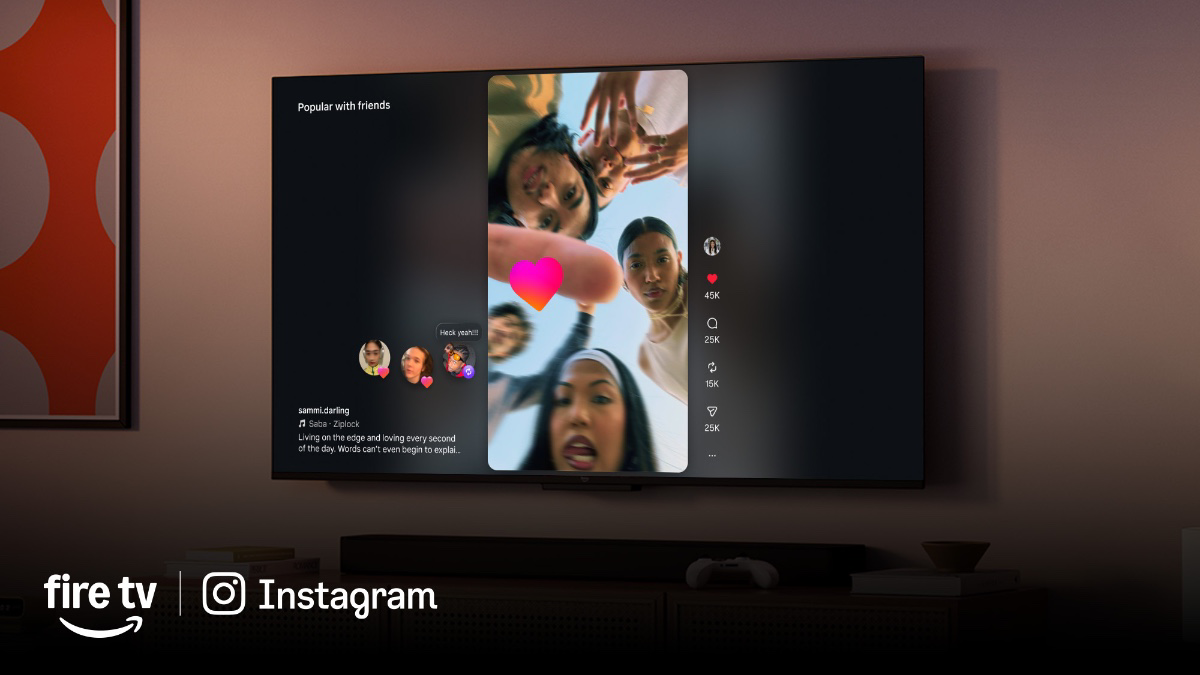
Instagram has begun testing a television version of its app, taking its short-form Reels videos onto the living-room screen for the first time.
The pilot, called Instagram for TV, is launching on Amazon Fire TV devices in the United States, going beyond phones and tablets.
The new app is built almost entirely around Reels. Once signed in, viewers are met with personalised streams of videos arranged into channels such as music, comedy, sports, travel and trending moments.
Clips play automatically, one after the other, removing the need to scroll endlessly. You can still skip, like a Reel, check comments or re-share content, all from the TV interface.
This is necessary because television is no longer limited to long shows and films. We are seeing a fight for attention on the biggest screen in the house, and Instagram wants a seat at that table.
YouTube already dominates TV viewing, while TikTok is widely reported to be working on a similar product. Instagram’s answer is to make couch-watching feel closer to flicking through channels than swiping a phone.
Personalisation sits at the centre of the experience. The TV app pulls from the same signals as the mobile version, showing creators and topics you already follow or engage with.
Reels are grouped into themed collections, making it easier to explore interests without searching for individual accounts. A search tool is also built in, allowing users to find creators, browse profiles and dive into specific topics.

Households are not locked into a single profile. Instagram for TV supports up to five accounts on one device, so different viewers can switch between their own recommendations. There is also the option to create a separate account purely for TV viewing, keeping it distinct from a personal mobile feed.
Meta has been careful to draw a line between this launch and its earlier, abandoned experiment. Instagram for TV is not a return of IGTV, the long-form video app that was shut down in 2022. This is a focused bet on short videos, designed specifically for television habits rather than stretched from mobile.
The idea itself has been brewing for months. Speaking in October, Instagram boss Adam Mosseri openly acknowledged that the company was late to the space. “We’re exploring TV,” Mosseri said at Bloomberg’s Screentime event.
“TV is an increasingly important surface, it’s been very important for YouTube […] it’s been very important for TikTok. So we’d like to figure out how to make sure that we show up in a compelling way on all the relevant devices.”
Amazon, which is hosting the first release on Fire TV, sees the partnership as part of a drive to turn televisions into all-purpose content hubs. “Our mission is to get you to the world’s best content fast, and we’re thrilled to welcome Instagram to Fire TV,” said Aidan Marcuss, vice president of Fire TV.
“We’re committed to keep pushing the boundaries of entertainment on customers’ biggest screens—the Instagram team has built an awesome experience, and we’re excited to be the first place to offer it. We can’t wait to see what customers think.”
For now, availability is limited to select Fire TV sticks and Fire TV televisions in the US. Meta says the rollout will expand to more devices and countries as it learns from the test. Features such as using a phone as a remote and smoother ways to jump between channels are also being considered.
Short videos will no longer be confined to small screens, and Instagram is repositioning itself for a social media that competes directly with traditional TV viewing.