



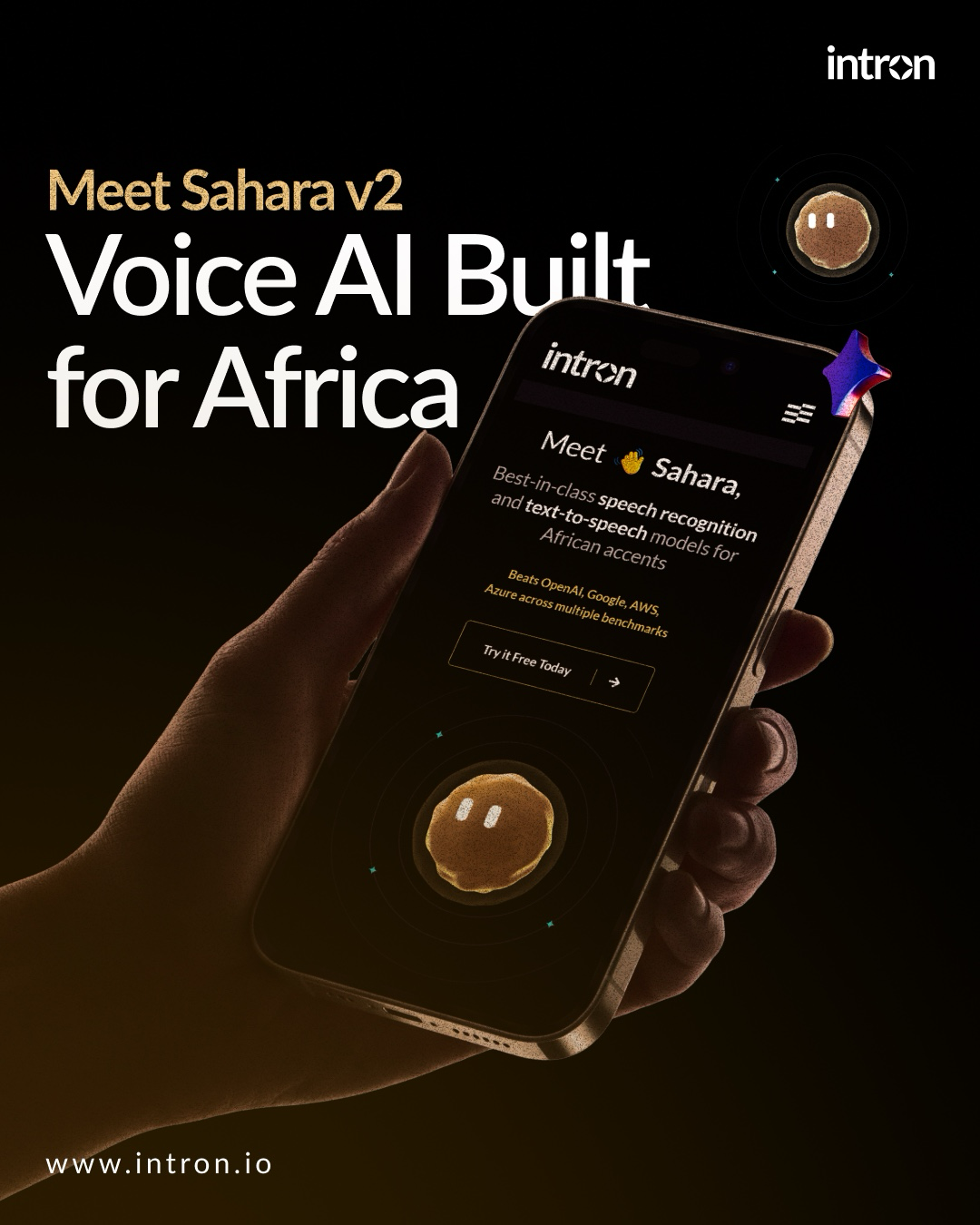
Nigerian technology company, Intron, has launched a new voice recognition model designed to better understand African languages and accents, after years of complaints that global voice AI assistants usually misinterpret local speech.
The model, called Sahara v2, supports 24 African languages and recognises more than 500 African English accents. The company said the system was trained using more than 14 million audio clips collected from over 40,000 speakers across Africa and the diaspora.
For many users on the continent, voice technology usually has challenges with everyday phrases and names. Common expressions can be misheard or completely distorted, making digital assistants unreliable for basic tasks.
Developers say the problem lies in how most global systems were built. Many were trained mainly on Western speech patterns and do not align with the tonal nature, accent variety and frequent language mixing common across African countries.
With Sahara v2, Intron says it wants to close that gap by building technology that listens to how people actually speak. The recordings used to train the system were gathered across environments, including clinics, courtrooms, call centres, streets and offices.
The new model covers languages such as Hausa, Swahili, Yoruba, Igbo, Zulu, Twi, Kinyarwanda and Xhosa. In total, Intron says its systems now support 57 languages.
One of the additions is a bilingual speech recognition system that switches between English and Swahili. Intron developed the model with Kenya-based health provider Penda Health to better match how people naturally move between both languages in conversation.
The company also released a Hausa text-to-speech system designed to power local language voice assistants that can run continuously for services such as customer support.
Intron said the new system can also operate offline, allowing organisations to run voice tools locally where privacy or data security is a concern.

According to the company, Sahara v2 performs better on African speech compared with several widely used global models. These include systems developed by Google, OpenAI, Amazon Web Services and Microsoft.
Testing carried out by the company showed stronger accuracy when recognising African names, locations, numbers and sector-specific terms used in areas such as finance, healthcare and telecommunications.
Several organisations have already begun using the system in their services. These include voice banking platforms, medical documentation tools, courtroom transcription systems and automated call centre software.
Ayo Oluleye, head of Data and Insights at ARM Investments, said the model improved the accuracy of automated transcription.
“Using Intron AI models, we’ve seen significant improvement in transcription and summaries compared to models we previously explored. Their systems capture context and nuance better, leading to more accurate results.”
Sarah Morris, chief product officer at Audere, said the system also performed well during testing. “In our testing, accuracy was excellent on several Southern African accents and APIs were robust with 99%+ success rates.”
Alongside the launch, Intron also released its first Africa Voice AI report for 2026, examining how voice technology is being developed and used across the continent.
The report aims to guide governments, businesses, investors and researchers working to expand digital services that rely on speech technology.
Tobi Olatunji, chief executive of Intron, noted that the project shows what happens when technology is designed with local languages in mind.
“Sahara v2 proves that when technology is built with deep cultural and linguistic understanding, amazing things can happen, and we’re just getting started.”