
The recent circular issued on the 25th May, 2026 by the Head of the Civil Service of the Federation, Mrs Didi Esther Walson-Jack, following the approval of the harmonisation of the schemes of service for Information Communication Technology (IT) roles in the civil service by the National Council on Establishment at its 47th meeting in Kano last year, marks a watershed moment in Nigeria’s digital transformation journey.
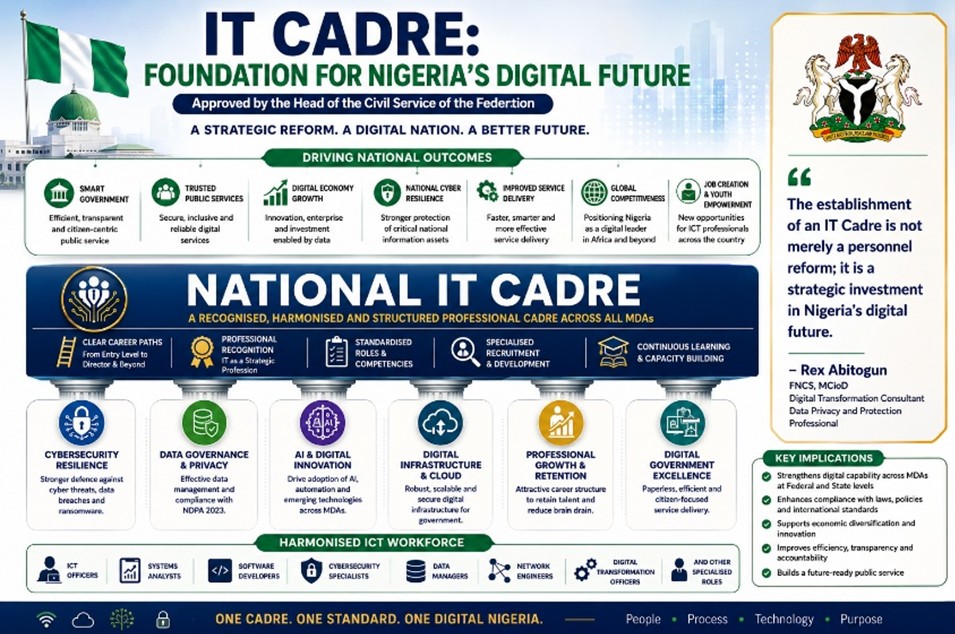
While the announcement may appear administrative on the surface, its implications extend far beyond the civil service. It represents a strategic recognition that technology is no longer a support function but a critical enabler of governance, economic growth, national security, and public service delivery.
For decades, information technology professionals within government institutions have operated under fragmented structures. Many were employed under different job titles, career frameworks, and promotion pathways despite performing similar functions.
In some cases, highly skilled technology professionals found themselves trapped in administrative structures that neither recognized nor rewarded their specialized competencies. The approval of a harmonised IT cadre changes this narrative.
At its core, harmonisation seeks to establish a unified framework for technology professionals across government.
It provides a clear scheme of service, standardises qualifications and competencies, defines career progression paths, and creates a structured professional ecosystem for ICT practitioners within the public sector.
This means that an IT professional can now envision a clear career trajectory from entry-level positions to senior management and directorate levels without abandoning the profession for administrative roles.
It also signals a long-overdue institutional recognition of technology as a profession deserving of the same status accorded to fields such as law, engineering, accounting, and medicine.
Beyond professional recognition, the implications for Nigeria’s digital economy are profound. First, the establishment of an IT cadre will strengthen the government’s capacity to drive digital transformation initiatives.
Across the country, public institutions are increasingly adopting digital platforms, electronic workflow systems, cloud technologies, digital identity systems, artificial intelligence tools, and data-driven decision-making frameworks.
However, technology investments can only deliver value when supported by competent professionals responsible for their design, implementation, governance, and maintenance.
Second, the initiative is expected to create significant employment opportunities for technology professionals.
Government institutions will increasingly require specialists in cybersecurity, software development, data governance, artificial intelligence, cloud computing, enterprise architecture, digital transformation, and IT service management. This demand will stimulate talent development and encourage more young Nigerians to pursue careers in technology.
Third, the reform has important implications for national cybersecurity. As government services become more digitised, the risks associated with cyberattacks, data breaches, ransomware incidents, and insider threats continue to grow. A dedicated IT cadre will enable public institutions to recruit and retain cybersecurity professionals capable of safeguarding critical national information infrastructure.
Another important benefit is the strengthening of data governance and privacy compliance. The enactment of the Nigeria Data Protection Act has increased expectations around the responsible management of personal data. A professional IT cadre creates opportunities for specialised roles in data governance, information security, privacy engineering, and digital risk management, thereby supporting regulatory compliance and public trust.
The approval also presents an opportunity to address one of the most persistent challenges facing government technology initiatives, the retention of skilled professionals. For years, the public sector has struggled to compete with private organisations that offer more attractive career opportunities and compensation packages.
While remuneration remains an important factor, a structured career framework can significantly improve job satisfaction, professional identity, and long-term commitment among government technology personnel.
At the state level, adoption of the harmonised framework could accelerate digital government initiatives, improve service delivery, strengthen internally generated revenue systems, and enhance the security and resilience of digital infrastructure.
However, the success of this reform will depend on effective implementation. Establishing a cadre is only the first step. Government must also invest in continuous capacity development, professional certification, talent retention strategies, and modern workplace environments that enable technology professionals to thrive.
Furthermore, collaboration among stakeholders, including government institutions, professional bodies, academia, industry associations, and regulators, will be essential to ensure that the cadre evolves in line with global technology trends and emerging digital competencies.
The world is entering an era where economic competitiveness, national security, and public sector efficiency are increasingly determined by digital capabilities.
Nations that recognise and institutionalise technology leadership will be better positioned to compete in the global digital economy.
The approval of an IT cadre within Nigeria’s public service is therefore more than a personnel reform. It is a strategic investment in the country’s digital future.
If properly implemented, this initiative could become the foundation upon which Nigeria builds a digitally enabled public service, strengthens cybersecurity resilience, improves data governance, accelerates innovation, and advances its ambition of becoming a leading digital economy in Africa.
For the Nigerian technology profession, this is not merely an administrative milestone; it is a defining moment.